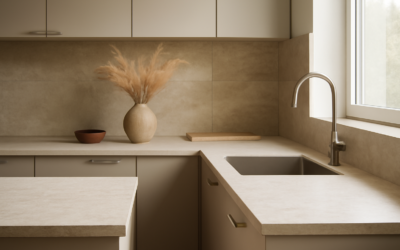
New countertops can transform a dated kitchen faster than almost any other upgrade, but sticker shock stops a lot of homeowners before they start. Replacing kitchen countertops on a budget is entirely realistic once you know which materials deliver the best look per dollar and where you can safely skip the pro. A full slab of quartz might run $4,000 installed, yet the same kitchen can get a fresh, durable surface for $600 to $1,500 with smart choices.
Part of our Countertops guide — explore the full guide →
The trick is matching the material to how you actually use the space. A rental flip, a starter home, and a forever kitchen all call for different tradeoffs between price, longevity, and resale appeal. Below are the cheapest countertop routes, honest numbers, and the shortcuts that separate a budget win from a budget regret.
- Set a Realistic Budget First
- The Cheapest Countertop Materials Ranked by Price
- Laminate: The Best Value Play
- Butcher Block for Warmth and DIY Simplicity
- Tile Countertops: Cheap Materials, Patient Labor
- Hunt for Stone Remnants
- Ways to Cut Costs Without Cutting Corners
- Refinishing: When You Skip Replacement Entirely
- DIY vs. Hiring Out: Where the Savings Really Live
- Which Budget Option Should You Choose?
Set a Realistic Budget First
Before shopping, measure your linear feet of counter. A typical 10-by-10 kitchen has around 30 square feet of surface, or roughly 25 to 30 linear feet. That number drives every quote you get. Knowing it also keeps salespeople from upselling you into square footage you do not have.
Factor in the hidden costs that wreck budgets: tear-out and disposal ($100 to $300), sink and faucet reconnection ($150 to $250 if you hire a plumber), and a new undermount or drop-in sink if yours is tired. Setting aside 15 percent for surprises keeps the project from stalling halfway through.
The Cheapest Countertop Materials Ranked by Price
Not every affordable surface is created equal. Here is how the budget contenders stack up on installed cost per square foot, assuming a mix of DIY and light pro help.
- Laminate: $10 to $40 per sq ft installed. The undisputed budget champ.
- Ceramic or porcelain tile: $15 to $45 per sq ft. Cheap materials, labor-heavy.
- Butcher block: $20 to $60 per sq ft. Warm look, DIY-friendly.
- Cultured or solid-surface remnants: $25 to $55 per sq ft when bought as offcuts.
- Concrete (DIY pour): $8 to $25 per sq ft in materials, high labor if hired.
- Granite remnants or tile: $30 to $60 per sq ft using leftover slab pieces.
For comparison, new quartz and full granite slabs typically land between $50 and $120 per square foot installed, which is exactly why the list above matters when money is tight.
Laminate: The Best Value Play
Modern laminate has shaken off its 1980s reputation. Brands like Wilsonart and Formica now print convincing marble, soapstone, and concrete patterns, and premium lines offer matte finishes with a real stone feel. A pre-formed post-form counter with an integrated backsplash costs $10 to $30 per linear foot at home centers and drops onto base cabinets in an afternoon.
If your layout has standard 25-inch-deep runs and simple corners, a confident DIYer can install laminate with a circular saw, a router for the edge, and contact cement. Custom lengths ordered through a fabricator cost more, around $25 to $40 per square foot installed, but still undercut stone by a wide margin. The main limitation is heat: never set a hot pan directly on laminate, and avoid it if you want undermount sinks, which laminate cannot support.
Butcher Block for Warmth and DIY Simplicity
Wood countertops bring instant warmth and are shockingly beginner-friendly. IKEA sells birch and oak blocks in 8-foot lengths for $150 to $350, and hardwood specialty suppliers carry maple, walnut, and acacia. You cut them with a standard circular saw, sand the edges, and finish with food-safe mineral oil or a hard-wax oil like Rubio Monocoat.
Budget on $20 to $50 per square foot in materials for most species. The catch is maintenance: re-oil every one to three months, wipe up standing water fast, and use a cutting board rather than slicing directly on the surface. Around sinks, seal end grain aggressively to prevent black water stains. Done right, butcher block lasts decades and can be sanded back to new whenever it looks worn.
Tile Countertops: Cheap Materials, Patient Labor
Tile is having a comeback, and it is one of the few surfaces where the material cost is almost trivial. Field tile runs $2 to $10 per square foot, and even upscale porcelain or handmade zellige stays affordable in the small quantities a counter needs. The expense is time and precision, not money.
You will need cement backer board, thinset, spacers, and grout. Large-format 12-by-24-inch porcelain minimizes grout lines and reads as a slab from a few feet away, while classic 4-inch squares lean vintage. Use epoxy grout or a quality sealed cement grout to fight kitchen stains. Budget a full weekend and expect $15 to $30 per square foot all-in for a DIY job. Tile handles hot pots better than almost anything on this list, which is a real perk for serious cooks.
Hunt for Stone Remnants
Every stone fabricator has a back lot full of remnants, the leftover pieces from larger jobs that are too small to sell as full slabs. For islands, bathroom vanities, or short galley runs, these offcuts of granite, quartz, and marble sell for 30 to 50 percent below full-slab pricing. A 4-by-6-foot granite remnant might cost $200 to $600 including fabrication.
Call three or four fabricators, tell them your dimensions, and ask what is sitting in their remnant yard. You lose color selection freedom, but if your kitchen is small you can get genuine stone with an undermount sink for the price of mid-grade laminate. This is the single best trick for landing a premium look on a tight budget.
Ways to Cut Costs Without Cutting Corners
Beyond material choice, several tactics stretch every dollar further:
- Do your own tear-out. Removing old counters is unskilled labor. Unscrew from below, cut caulk lines, and haul it out yourself to save $150 or more.
- Keep your existing sink and faucet if they are in good shape. Reusing fixtures avoids $200 to $500 in new hardware.
- Reface instead of replace when surfaces are structurally sound. Countertop refinishing kits from Rust-Oleum or Giani run $50 to $120 and mimic stone with a paint-and-flake system.
- Shop the “as-is” and clearance sections at home centers for discontinued laminate and remnant tile.
- Buy pre-formed edges to skip fabrication labor on laminate and butcher block.
Refinishing: When You Skip Replacement Entirely
Sometimes the cheapest countertop is the one you already own. If your existing laminate or tile is structurally sound but ugly, a refinishing kit can buy several more years for a fraction of replacement cost. Products from Rust-Oleum, Giani, and Daich apply as a multi-step system: a bonding primer, decorative mineral flakes or a stone-look base coat, and a protective clear topcoat. Kits cover 35 to 50 square feet for $50 to $120.
The results look surprisingly convincing from a few feet away, mimicking speckled granite or solid quartz. The limits are real, though. Refinished surfaces are less heat- and scratch-resistant than the genuine material, and the process takes two to four days of drying between coats. Treat a refinished counter gently, use trivets and cutting boards religiously, and view it as a smart interim fix rather than a forever solution. For a rental you are prepping to lease or a kitchen you plan to fully remodel in a few years, it is an outstanding value.
DIY vs. Hiring Out: Where the Savings Really Live
Labor is where budget countertops win or lose. Fabrication and installation of stone routinely doubles the material cost, so every task you take on yourself compounds your savings. Tear-out, disposal, and prep are almost entirely unskilled and safe for any homeowner with a screwdriver and a truck. Installing pre-formed laminate or oiling butcher block is well within reach for a patient beginner.
Know your limits, too. Cutting a sink opening in stone, plumbing a garbage disposal, or seaming laminate around complex corners can go wrong fast and expensively. A sensible middle path is hybrid: do the demo, prep, and finishing yourself, then pay a pro only for the one or two steps that demand real skill. Many fabricators will template and install a remnant you supply for a flat fee, letting you capture material savings while leaving the precision cuts to someone with the right tools.
Which Budget Option Should You Choose?
Match the surface to your goals. For the lowest possible spend and fastest install, laminate wins every time. If you want character and enjoy hands-on work, butcher block delivers charm for the money and forgives beginner mistakes. Choose tile when you cook constantly and want heat resistance without paying for stone. And if you crave real granite or quartz, chase remnants before you settle for anything else.
Ultimately, replacing kitchen countertops on a budget rewards planning over spending. Measure carefully, do the demo and prep yourself, reuse what still works, and reserve your dollars for the visible surface. With $600 to $1,500 and a free weekend, most kitchens can look completely refreshed, no five-figure remodel required.