Your circuit breaker box is the heart of your home’s electrical system — the gray metal panel, usually in the garage, basement, or utility closet, where power from the utility splits into the circuits that feed every outlet, light, and appliance. Most homeowners only open it to flip a tripped breaker, but understanding what’s inside makes you safer, saves you money on service calls, and helps you know the difference between a nuisance trip and a genuine hazard. Here’s what every homeowner should know, and — just as important — where to stop and call a pro.
- What the Panel Actually Does
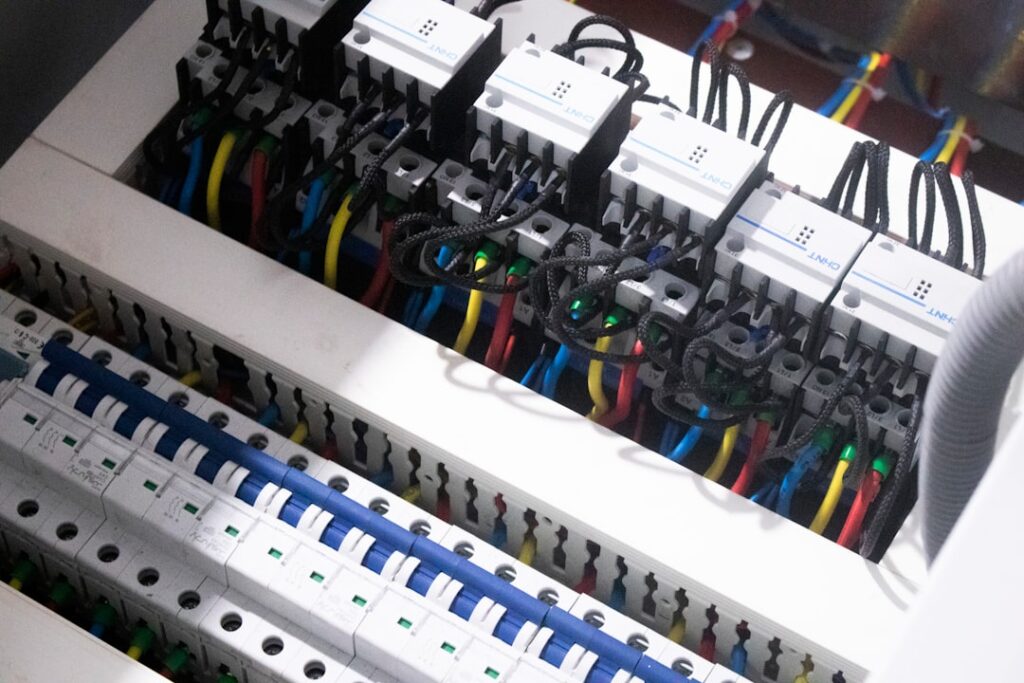
- Inside the Box: The Main Parts
- Types of Breakers
- Reading Amp Ratings and Circuit Loads
- How to Reset a Tripped Breaker
- Labeling Your Panel
- Warning Signs of a Problem
- When to Upgrade the Panel
- Know Where to Stop
- Where Your Panel Should Be Located
- Subpanels: When You Need One
- Frequently Asked Questions
What the Panel Actually Does
The circuit breaker box (also called the load center, breaker panel, or service panel) takes the incoming power from your electric meter and distributes it through individual breakers to separate circuits. Each breaker is a resettable safety switch: it carries normal current, but if a circuit draws too much — from an overload or a short — the breaker trips and cuts power before the wiring can overheat and start a fire. That protective trip is the whole purpose. A breaker isn’t an inconvenience; it’s doing its job.
Inside the Box: The Main Parts
Open the panel door (not the inner cover — leave that to a pro) and you’ll see:
- Main breaker: The big double breaker at the top, rated for your whole home’s amperage (commonly 100, 150, or 200 amps). Flipping it off kills power to the entire house.
- Branch breakers: The rows of smaller breakers, each feeding one circuit — a bedroom’s outlets, the kitchen counter, the dryer.
- Bus bars: The metal strips behind the breakers that carry power to them. Do not touch these.
- Neutral and ground bars: Where the white neutral and bare ground wires terminate.
The amperage rating stamped on the main breaker tells you your service size — a key number when you’re adding big loads like an EV charger or a tankless water heater.
Types of Breakers
Not all breakers are the same, and modern code requires specialized types in certain areas:
- Single-pole (120V): The standard breaker for lights and general outlets, rated 15 or 20 amps.
- Double-pole (240V): Two poles for high-draw appliances — electric ranges, dryers, water heaters, AC — rated 30 to 50-plus amps.
- GFCI: Ground-fault protection that trips on tiny current leaks, required for bathrooms, kitchens, garages, and outdoors to prevent shock.
- AFCI: Arc-fault protection that senses dangerous arcing (a fire cause), required by the NEC for most living-area circuits in newer homes.
- Dual-function (CAFCI/GFCI): Combines both protections in one breaker.
Breakers must match your panel brand and be rated for the wire gauge — never swap a 15-amp breaker for a 20 to stop nuisance trips. That defeats the protection and is a fire risk.
Reading Amp Ratings and Circuit Loads
The number on each breaker’s toggle is its amp rating, and it must match the wire it protects: 15-amp breakers on 14-gauge wire, 20-amp on 12-gauge, 30-amp on 10-gauge, and so on. A circuit shouldn’t be loaded beyond 80% of its rating continuously — that’s 12 amps on a 15-amp circuit, or about 1,440 watts. When you keep tripping a breaker, you’re either drawing more than the circuit can carry (overload) or there’s a fault. Adding up the wattage of what’s plugged in usually reveals an overload.
How to Reset a Tripped Breaker
Resetting is one of the few panel tasks a homeowner should do, and it’s simple:
- Find the tripped breaker — its toggle sits in the middle, not fully “on” or “off.”
- First unplug or turn off whatever caused the trip, so you don’t immediately overload it again.
- Push the breaker firmly all the way to “off,” then back to “on.” That off-first step is required; flipping from the middle position won’t reset it.
If a breaker trips again immediately after resetting, stop. That’s a sign of a short circuit or ground fault, not a simple overload — leave it off and call an electrician.
Labeling Your Panel
A well-labeled circuit breaker box saves you time and stress during an emergency or a project. If your panel’s directory is blank or cryptic (“Bedroom?”), map it properly: with a helper, turn off one breaker at a time and note which outlets, lights, and appliances go dead, then write clear labels on the directory card. Use specific descriptions — “Kitchen counter GFCI, east wall” beats “Kitchen.” A phone photo of the labeled panel stored in your files is handy when you’re not home.
Warning Signs of a Problem
Some panel symptoms are urgent. Call a licensed electrician right away if you notice:
- Burning smell or scorch marks around the panel — a serious fire hazard.
- Warm or hot breakers or panel cover to the touch.
- Buzzing, crackling, or sizzling sounds from the box.
- Frequent tripping with no obvious overload cause.
- Rust or moisture inside the panel.
- A Federal Pacific (Stab-Lok) or Zinsco panel — these obsolete brands have documented failure-to-trip problems and are widely recommended for replacement.
When to Upgrade the Panel
Older homes often have 60- or 100-amp service that can’t keep up with modern demand. Consider upgrading to a 200-amp panel if you’re adding an EV charger, a hot tub, central AC, an electric range, or a home addition, or if you’re constantly out of breaker slots. A service upgrade runs $1,500 to $4,000 depending on scope, requires a permit and inspection, and coordination with your utility.
Know Where to Stop
Here’s the hard line every homeowner needs: resetting breakers and labeling the panel are fine. Removing the inner cover, adding or replacing breakers, touching wiring, or working near the bus bars is not DIY territory unless you’re trained — the main lugs stay live even with the main breaker off, and that power can kill you. A circuit breaker box rewards you for understanding it, but respects only those who know its limits. Learn the layout, watch for warning signs, keep it labeled, and hand the wiring work to a licensed electrician.
Where Your Panel Should Be Located
Code sets rules for panel placement that are worth knowing, especially if you’re finishing a basement or planning a remodel. The NEC requires clear working space in front of the panel — generally 30 inches wide, 36 inches deep, and a full 6.5 feet tall — so you can safely operate it in an emergency. Nothing can be stored in that zone, which is why building a shelf or closet tight against the breaker box is a violation. Panels also can’t be installed in bathrooms or clothes closets, and they need adequate lighting. If your panel is buried behind stored boxes or blocked by shelving, clearing that space isn’t just tidy — it’s a safety requirement that lets you reach the main breaker fast when it counts.
Subpanels: When You Need One
As homes add circuits — a finished garage, a workshop, a backyard studio — a main panel can run out of slots or the wiring distance to a far corner becomes impractical. A subpanel solves both. Fed from the main panel by a single heavy circuit, a subpanel is a smaller breaker box placed closer to a cluster of loads, distributing them locally. It’s common for detached garages, additions, and shops. A subpanel install is licensed-electrician work — it involves sizing the feeder, running conductors, and correctly separating neutrals and grounds — but knowing the option exists helps you plan a project. If you’re constantly out of breaker space or extending power to an outbuilding, ask your electrician whether a subpanel makes more sense than cramming the main.
Frequently Asked Questions
Why does my breaker keep tripping?
Either the circuit is overloaded (too much wattage drawing at once) or there’s a fault. If it trips only under heavy load, reduce what’s plugged in. If it trips immediately every time you reset it, that’s a short or ground fault — stop and call an electrician.
Can I replace a breaker myself?
It’s strongly discouraged. The panel’s main lugs stay energized even with the main breaker off, and a mistake can be fatal. Breaker replacement is a job for a licensed electrician.
How do I know if I need a panel upgrade?
Consider upgrading to 200-amp service if you’re adding an EV charger, hot tub, or central AC, if you’re out of breaker slots, or if you have an obsolete Federal Pacific or Zinsco panel known for failing to trip.