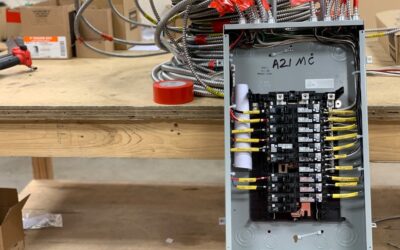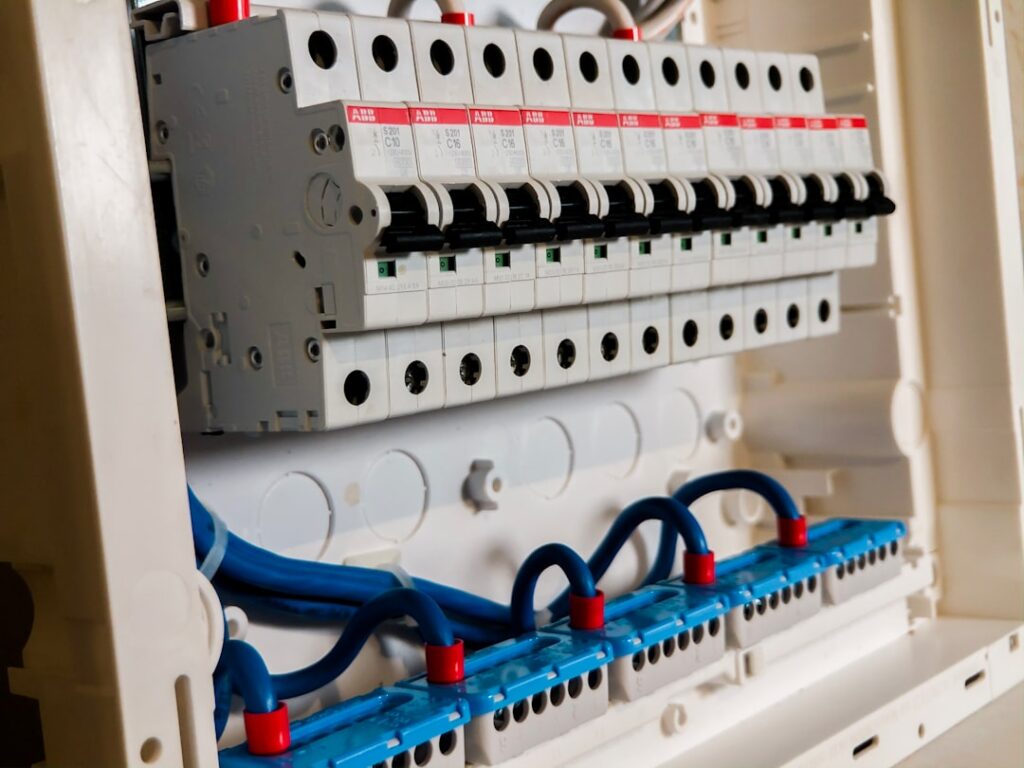
Every wire in your house eventually leads back to one gray metal box, and that box is your circuit breaker panel. It’s the traffic cop for your home’s electricity — splitting the incoming power into individual circuits and shutting each one down the instant something goes wrong. Understanding your panel won’t turn you into an electrician, but it will help you flip the right breaker, spot a hazard early, and know exactly when the work has crossed the line into pro territory.
- What a Circuit Breaker Panel Actually Does
- Main Breaker vs. Subpanel
- The One Thing That Stays Live No Matter What
- Reading Your Panel Directory
- Types of Breakers in Your Panel
- Common Panel Brands and What to Know
- Signs Your Panel Needs Attention
- What a Panel Costs
- How to Reset a Tripped Breaker
- What You Can and Can’t DIY
What a Circuit Breaker Panel Actually Does
Power from the utility enters through the meter, runs to the panel, and lands on two hot bus bars sitting at 120 volts each. Add them together across a double-pole breaker and you get 240 volts for big loads like a dryer or range. Individual breakers clip onto those bus bars and feed the branch circuits running through your walls.
A breaker has one job: interrupt the current before the wire overheats. Draw more than the breaker’s rating — a 20A breaker on a 20A circuit — and it trips. A dead short trips it instantly. That trip is the difference between a nuisance and a house fire, which is why you never upsize a breaker to stop it tripping. The breaker is sized to protect the wire, not the appliance.
Main Breaker vs. Subpanel
Your main panel holds the main breaker — usually a big double-pole breaker rated 100A, 150A, or 200A that controls every circuit downstream. Flipping it off kills power to the whole house in one motion. That rating is your service size; a modern home with central AC, an electric range, and maybe an EV charger generally wants 200A.
A subpanel is a smaller panel fed from the main, used to extend circuits to a garage, addition, or workshop without running a dozen home runs back to the main box. Key difference: in a subpanel the neutral and ground bars are kept separate and the neutral is isolated from the enclosure, while in the main panel they’re bonded together. Get that wrong and you create a shock hazard. This is a common DIY mistake and a big reason subpanel work usually belongs with a licensed electrician.
The One Thing That Stays Live No Matter What
Here’s the safety fact that trips up homeowners: turning off the main breaker does not make the panel safe to open and work on. The lugs above the main breaker — where the utility feeders land — stay energized at full service voltage even with the main off. Only the utility can cut the service drop at the transformer or pull the meter.
So while you can safely flip individual breakers all day, anything that involves touching the incoming feeders, the main lugs, or the bus bars is genuinely dangerous. Replacing or upgrading a panel is pro work, requires a permit and inspection nearly everywhere, and usually needs the utility to disconnect power at the meter first. Treat the interior line side of the panel as always energized.
Reading Your Panel Directory
Open the door and you should find a directory mapping each breaker to a room or appliance. If yours is blank or wrong, mapping it is a worthwhile Saturday project:
- Plug a lamp or radio into an outlet, flip breakers one at a time, and note what dies.
- Label 240V double-pole breakers by appliance — dryer, range, water heater, AC condenser.
- Note any AFCI or GFCI breakers, which have a built-in test button and a white pigtail wire.
- Write in pencil so you can update it after any changes.
A clear directory saves you fumbling in the dark and helps any electrician who works on the house later.
Types of Breakers in Your Panel
Not every breaker in the box is the same, and knowing which is which helps you read your panel. The common types:
- Single-pole — the standard 15A or 20A breaker occupying one slot, feeding 120V circuits like lights and general outlets.
- Double-pole — a breaker spanning two slots that ties into both hot bus bars for 240V loads. Dryers run 30A, electric ranges 40–50A, water heaters 30A, and an AC condenser often 30–60A.
- Tandem — a slim breaker that fits two circuits into one physical slot. Handy when a panel is full, but the panel must be rated to accept them in that position.
- AFCI — arc-fault breakers that detect the dangerous arcing that starts most electrical fires; code now requires them on most living-area circuits.
- GFCI and dual-function (AFCI/GFCI) — protect against ground faults, or both hazards in one device.
Matching amperage to wire gauge is the rule behind all of it: 14 AWG copper for a 15A breaker, 12 AWG for a 20A breaker, 10 AWG for 30A. Oversizing a breaker on undersized wire is the classic recipe for an overheated conductor that never trips.
Common Panel Brands and What to Know
Breakers are not universally interchangeable — each panel accepts specific breaker lines, and mixing brands voids the listing. Common residential panels include:
- Square D — the QO line (premium, higher interrupting rating) and Homeline (builder-grade, budget-friendly).
- Eaton — BR and the older CH series.
- Siemens — QP breakers, widely available at home centers.
- GE — now largely under the ABB/Siemens umbrella but still common in existing homes.
Two brands to flag: Federal Pacific (FPE) Stab-Lok and Zinsco panels have documented histories of breakers that fail to trip. If you have one, have it evaluated — many electricians and inspectors recommend replacement outright.
Signs Your Panel Needs Attention
Call a licensed electrician for evaluation if you notice any of these:
- Breakers that trip repeatedly or won’t reset.
- A burning smell, scorch marks, or discoloration around the panel.
- Warm or buzzing breakers, or a warm panel cover.
- Rust inside the cabinet or water intrusion.
- A fuse box instead of breakers, or a fully-tapped panel with no room to add circuits.
- Reliance on double-tapped breakers or a nest of “tandem” breakers to squeeze in circuits.
A 60A or 100A service in a home that’s added central air, an electric range, and a hot tub is often running near capacity, and that’s when you start seeing chronic tripping.
What a Panel Costs
Prices vary by region and scope, but rough ballparks help you sanity-check a quote:
- Replacing a single standard breaker: $5–$20 for the part, or $100–$250 with an electrician’s labor and trip charge.
- An AFCI or GFCI breaker: $40–$60 each.
- A full 200A panel upgrade (new panel, breakers, permit, inspection): $2,000–$4,500, more if the service entrance, mast, or grounding needs work.
- Adding a subpanel: $1,000–$2,500 depending on distance and circuit count.
Get at least two itemized bids and confirm the price includes the permit and inspection.
How to Reset a Tripped Breaker
A tripped breaker doesn’t snap all the way to “off” — it usually rests in a middle position. Resetting it correctly matters:
- Push the breaker firmly all the way to the OFF position first. You’ll often feel a click.
- Then flip it fully back to ON.
- Simply nudging it toward on from the tripped middle position often won’t re-latch the mechanism.
If it trips again immediately, stop. That’s the breaker doing its job, telling you the circuit has a genuine fault or overload. Unplug what you added, and if it keeps tripping with nothing on the circuit, you likely have a short or a failing breaker that needs an electrician. Repeated resetting of a breaker that won’t hold is not a fix — it’s ignoring a warning.
What You Can and Can’t DIY
Safe homeowner tasks are limited but real: resetting a tripped breaker, testing GFCI/AFCI buttons monthly, mapping and labeling the directory, and keeping the area in front of the panel clear (code wants 36 inches of clearance). Beyond that, the risk climbs fast.
Before any work near the panel, follow the basics: switch the relevant breaker OFF, verify the circuit is de-energized with a non-contact voltage tester or a multimeter, and never assume a breaker labeled “off” is actually dead — test to confirm. For anything involving the main breaker, feeders, bus bars, a panel swap, or a service upgrade, hire a licensed electrician and pull a permit. The circuit breaker panel is the heart of your home’s electrical system; respecting where DIY ends is the whole point of understanding it.