Specifying the wrong floor for a high-traffic building is an expensive mistake that shows up within months as gouges, delamination, and constant maintenance calls. Commercial flooring systems are engineered for a different world than residential floors, one measured in thousands of foot-traffic cycles a day, rolling loads, chemical spills, and code requirements for slip resistance and cleanability.
Choosing well means matching the system to the environment, warehouse, hospital, office, restaurant, or retail floor, and weighing installed cost against lifecycle cost. A cheaper floor that needs replacing in five years often costs more than a durable system that lasts twenty. This guide breaks down the major commercial flooring types, what each does best, and the price ranges to budget.
- What Sets Commercial Flooring Apart
- Epoxy and Resinous Floor Coatings
- Vinyl Composition Tile and Luxury Vinyl
- Polished Concrete
- Carpet Tile and Broadloom
- Rubber and Specialty Athletic Flooring
- Subfloor Prep and Moisture: The Hidden Deciding Factor
- Maintenance and Total Lifecycle Cost
- Choosing the Right System for Your Building
What Sets Commercial Flooring Apart
Commercial floors are built around durability, safety, and total cost of ownership rather than looks alone. Wear layers are thicker, adhesives and coatings are more robust, and many systems carry ratings for slip resistance, static control, and chemical exposure that residential products never address.
The decision hinges on the specific demands of the space. A hospital corridor needs seamless, sanitary, sound-absorbing flooring; a manufacturing floor needs impact and chemical resistance; a retail showroom needs a durable surface that still looks polished. Foot traffic volume, exposure to moisture and chemicals, forklift or cart loads, acoustic needs, and maintenance budget all drive the choice.
Epoxy and Resinous Floor Coatings
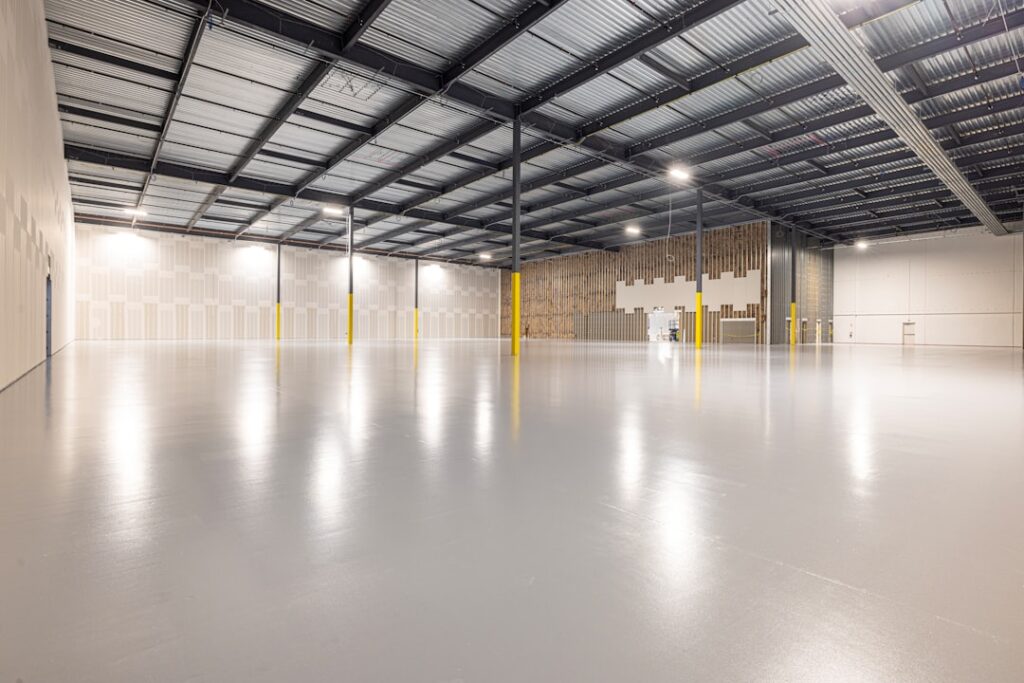
Epoxy and other resinous systems are poured or troweled on to form a seamless, chemical-resistant surface bonded directly to the concrete slab. They dominate warehouses, garages, food-processing plants, and industrial spaces because they shrug off impact, chemicals, and heavy rolling loads while leaving no seams for dirt or bacteria to hide in.
A standard epoxy coating runs about $3 to $12 per square foot installed, with high-build and specialty systems like decorative flake or urethane cement reaching $12 or more. The upside is exceptional durability and easy cleaning; the downsides are a labor-intensive install requiring careful concrete prep and moisture testing, downtime for curing, and the fact that a failed slab prep leads to peeling. Properly installed, these floors last 10 to 20 years.
Vinyl Composition Tile and Luxury Vinyl
Vinyl composition tile, or VCT, has been a commercial standard for decades, especially in schools, hospitals, and retail. It is inexpensive at roughly $2 to $5 per square foot installed and easily replaced tile by tile, but it demands ongoing stripping, waxing, and buffing that adds real labor cost over its life.
Luxury vinyl tile and plank, LVT and LVP, have largely taken over new commercial specs because they deliver realistic wood and stone looks with a tough wear layer and, critically, no waxing. Commercial-grade LVT with a 20-mil or thicker wear layer runs about $4 to $9 per square foot installed and handles heavy traffic in offices, hospitality, and retail. Its water resistance and low maintenance make it the versatile default for many projects.
Polished Concrete
Polished concrete turns the structural slab itself into the finished floor by grinding and densifying it to a hard, glossy surface. Big-box retailers, showrooms, and modern offices favor it for extreme durability, near-zero material waste, and a maintenance routine that amounts to dust mopping and occasional buffing.
Installed cost ranges from about $3 to $8 per square foot for a basic polish, climbing with dyes, decorative aggregates, and higher gloss levels. The floor can last the life of the building and reflects light well enough to cut lighting costs. Limitations are hardness underfoot, which is fatiguing for standing workers, potential slipperiness when wet, and the need for a sound slab, since existing cracks telegraph through.
Carpet Tile and Broadloom
Carpet remains the go-to for offices, conference rooms, and hospitality where acoustics and comfort matter. Modular carpet tile has largely replaced broadloom in commercial work because individual tiles can be swapped when stained or worn, cutting long-term replacement cost and simplifying access to under-floor cabling.
Commercial carpet tile runs roughly $3 to $8 per square foot installed, with solution-dyed nylon offering the best stain and wear resistance for the money. It absorbs sound, softens the space, and installs quickly, but it holds dirt and moisture, is a poor fit for wet or food-service areas, and needs regular extraction cleaning. For quiet, comfortable, and easily maintained office zones, though, it is hard to beat.
Rubber and Specialty Athletic Flooring
Rubber flooring earns its place in gyms, healthcare settings, stairwells, and anywhere ergonomics and slip resistance are priorities. Its natural cushioning reduces fatigue for standing workers and softens impact for fitness facilities, while its high traction improves safety in wet or high-traffic corridors.
Sheet and tile rubber runs about $5 to $12 per square foot installed, and poured athletic surfaces cost more. Rubber resists burns and abrasion, dampens sound, and lasts decades, though it can be marked by certain chemicals and oils and carries a higher upfront price. Related specialty systems include static-dissipative flooring for electronics manufacturing and seamless sheet vinyl for surgical suites where sterility is paramount.
Subfloor Prep and Moisture: The Hidden Deciding Factor
The best flooring system in the world fails over a bad subfloor, and moisture is the number-one culprit behind commercial floor failures. Concrete slabs, especially on grade, release vapor that can debond adhesives and blister coatings, so any resinous, vinyl, or glued-down system requires moisture testing first. A calcium chloride or relative-humidity probe test tells you whether the slab is dry enough to bond to.
Surface prep is equally decisive. Epoxy and polished-concrete systems demand mechanical grinding or shot-blasting to open the concrete’s pores for a real bond, while vinyl and carpet tile need a smooth, level, patched substrate free of ridges that would telegraph through. Budgeting for proper prep, moisture mitigation coatings where needed, and slab flatness correction is not optional; skipping it is the fastest route to premature failure and warranty disputes.
Maintenance and Total Lifecycle Cost
The sticker price of installation tells only part of the story, and smart facility managers weigh the maintenance labor a floor demands over its full service life. VCT looks cheap at $2 to $5 per square foot installed, but stripping and rewaxing several times a year across a large building adds thousands in labor annually. Polished concrete and LVT, by contrast, need only routine cleaning, which can make a pricier install the cheaper choice over 15 years.
Factor in downtime as well, since a floor that takes days to cure or install interrupts operations and costs revenue in retail and hospitality settings. Warranties matter too; commercial products often carry 10-to-20-year wear warranties, but only when installed by certified crews over a properly prepared substrate. Running the numbers on installed cost plus decades of upkeep and downtime usually reveals that durability, not the lowest bid, delivers the best value.
Choosing the Right System for Your Building
Start with the environment and work backward to the product. Map out traffic volume, moisture and chemical exposure, load types, acoustic and safety codes, and how much maintenance labor you can sustain, then shortlist the systems that meet all of those demands before comparing looks and price.
Weigh installed cost against lifecycle cost honestly. A VCT floor is cheap to lay but expensive to maintain over 15 years of waxing; an epoxy or polished concrete floor costs more upfront but can outlast several cycles of cheaper materials. Factor in downtime, since curing and installation schedules affect operations. Get the system matched to the space, and your commercial flooring will protect its subfloor, keep occupants safe, and hold up for decades instead of becoming a recurring line item.
When the specification is complex or the building sees demanding conditions, involve a flooring consultant or the manufacturer’s technical representative early. They can run moisture tests, recommend the right wear-layer thickness, and flag code requirements for slip resistance or static control before a single square foot is ordered. Many facilities also benefit from mixing systems zone by zone: polished concrete in the warehouse, LVT in the offices, rubber in the stairwells, and seamless epoxy in the wet areas. Matching each material to how that specific space is actually used, rather than defaulting to one product throughout, is what delivers the best combination of durability, safety, and value across the whole building.
Prefer to explore on your own?
See how new flooring looks in your actual room in seconds — free, no signup.
Try the free Floor Studio →