
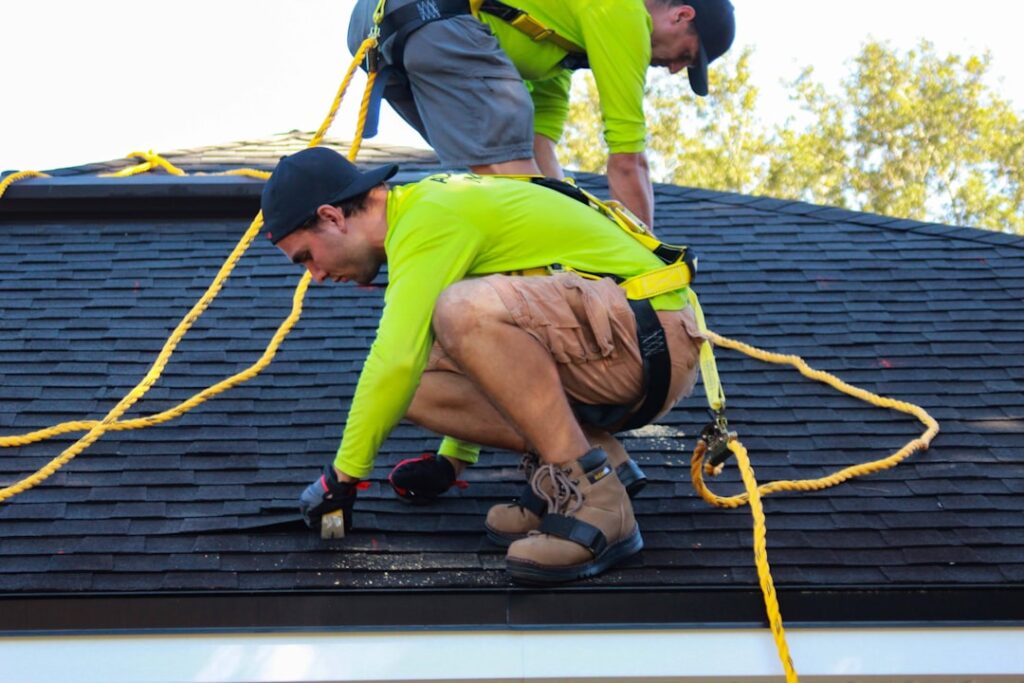
On a flat commercial roof, the drip in the ceiling tile and the hole in the membrane can be 40 feet apart — water enters at a seam, travels along the top of the insulation or inside flute channels of a metal deck, and surfaces wherever it finds a light fixture or a deck joint. That’s why commercial roof leak repair is two distinct skills: leak detection, which is detective work, and leak fixing, which is membrane-specific surgery. Get the first one wrong and you’ll patch the wrong spot three times while the insulation below soaks into a $30,000 tear-off. This guide covers the tracing process the pros use, then the correct patch method for each major roof system.
Part of our Roofing guide — explore the full guide →
Triage First: Stop the Damage Inside
Before anyone climbs a ladder, control the interior. Punch a small relief hole in any bulging, water-filled ceiling tile or drywall belly and drain it into a bucket — a controlled quart now beats a collapsed ceiling at 2 a.m. Move or tarp inventory and electronics, mark every drip location on a floor plan with the date and weather conditions, and photograph everything for the insurance file. That drip map becomes your best detection tool: leaks that appear only during wind-driven rain point to flashings and walls; leaks that lag hours behind a storm suggest long travel paths or saturated insulation slowly releasing.
How Professionals Trace a Commercial Leak
Start where the odds are. Industry failure data consistently puts the large majority of flat-roof leaks at penetrations, seams, and flashings rather than in the open field of the membrane. The systematic hunt:
- Map inside to outside. Transfer drip locations to the roof surface using measurements from walls and columns — then search uphill (upslope) from that point, remembering flat roofs slope toward drains.
- Inspect the usual suspects within a 30-foot radius: pitch pockets around conduit, HVAC curb corners and rusted unit pans (condensate and gasket failures on rooftop units masquerade as roof leaks constantly), drain clamping rings, skylight curbs, and every field seam.
- Read the membrane. Look for open or fish-mouthed seams, punctures from dropped tools or hail, ridges and blisters, ponding rings with sediment, and flashing pulling away from parapet walls.
- Flood test suspect zones: dam a small area with sandbags and a garden hose, one zone at a time for 15 to 30 minutes each, with a spotter inside. Start low, work upslope.
- Bring in instruments when visual fails. Infrared scans at dusk reveal wet insulation as warm signatures ($500 to $1,500 for a survey); electronic leak detection (ELD) pinpoints breaches in TPO, PVC, and EPDM to within inches. On a big roof, a $1,000 survey routinely saves ten times that in exploratory patching.
Fixing Leaks by Membrane Type
TPO and PVC (thermoplastic single-ply)
The white roofs on most modern warehouses repair by heat welding — the same process that built them. The wounded area is cleaned and prepped, and a round-cornered patch of matching membrane at least 2 inches beyond the damage in all directions is hot-air welded at roughly 1,000°F until the seam passes a probe test. Aged, oxidized TPO takes weld poorly, so honest contractors will test-weld first; heavily weathered membranes may need a primer or a cover strip instead. Typical single-patch cost: $400 to $1,200. Caulk and roof cement on TPO is a tell that you’ve hired the wrong outfit — cement doesn’t bond to thermoplastics and buys weeks, not years.
EPDM (black rubber)
EPDM repairs use peel-and-stick cover tape or cured patches over primed rubber: clean with membrane cleaner, prime, roll on a 6-inch seam tape or patch with 3 inches of margin, and roller-press. Seam tape systems (Carlisle SecurTAPE and equivalents) properly applied outlast the original glued seams they often repair. Shrinkage is EPDM’s signature aging problem — membrane tenting at walls and corners — and that calls for cutting the tension and re-flashing, not smearing sealant into the fold.
Modified bitumen and built-up (asphaltic) roofs
Splits, blisters, and open laps get the three-course treatment: asphalt mastic, embedded polyester fabric, mastic again — or a torch/self-adhered mod-bit patch for larger areas. Gravel-surfaced BUR requires spudding the aggregate clear first; a leak under gravel is the hardest of all to find, which is why infrared pays for itself on these roofs.
Metal panel roofs
Commercial metal leaks concentrate at fastener back-out and lap seams. Repairs run from replacing screws with oversized gasketed fasteners, to butyl-and-rivet seam work, to fabric-reinforced liquid flashing over problem seams — full coating systems become the play when fasteners fail wholesale.
Emergency Patches That Buy You a Week
When rain is falling and the real repair is days out: peel-and-stick flashing tape (Eternabond WebSeal is the roofer’s duct tape, $30 to $50 a roll) over cleaned, dried membrane will hold a breach through several storms on nearly any surface. A ballasted tarp over larger damage, plastic sheeting stapled as an interior diverter into buckets, and clearing every drain and scupper of debris round out the kit — a surprising share of “leaks” during downpours are simply blocked drains ponding water above flashing height. Log whatever temporary measure you install so it gets removed at the permanent repair; buried Eternabond contaminates future weld surfaces.
Repair, Restore, or Replace?
A single leak on a 12-year-old TPO roof is a repair. The judgment call arrives when leaks recur: the industry rule of thumb says once wet insulation exceeds about 25 percent of the roof area, patching is throwing money at a saturated system, and you’re choosing between a restoration coating (viable only over a dry, sound substrate) and replacement. A moisture survey settles the question with data. Budget-wise, professional commercial leak repairs commonly land between $500 and $2,500 per incident including detection time; compare that against $6 to $14 per sq ft for single-ply replacement and the case for twice-yearly preventive inspections — spring and fall, plus after major storms — writes itself. Leaks are only one of the failure modes flat commercial systems develop; for the broader catalog of ponding, blistering, shrinkage, and flashing problems and what each means for the roof’s remaining life, see our commercial roof repair guide.
The Leaks That Aren’t Roof Leaks
A meaningful fraction of commercial “roof leaks” never involve the membrane at all, and ruling them out early saves wasted patch money. Rooftop HVAC units are the biggest impostor: clogged condensate drains overflow into the curb, failed gaskets on access panels admit wind-driven rain, and economizer hoods scoop storms straight into the ductwork — all of which drip from ceiling registers exactly like a roof leak. Condensation is the second: uninsulated chilled-water lines and cold ducts above the ceiling sweat in humid weather, producing drips that appear on sunny days, which no actual roof leak does. The third is walls and windows above the roof line — a parapet with failed coping joints or a leaking curtain-wall head feeds water down inside the wall until it exits at ceiling level yards away. The tell in every case is timing: real roof leaks track rainfall. Keep that drip log honest, and when drips arrive without rain, redirect the budget from the roofer to the mechanical contractor or mason.
What to Demand From a Repair Contractor
Ask three questions before signing. What is the membrane, and what repair method matches it — the answer should name welding, taped EPDM, or three-course, not “we’ll seal it up.” Will you document the leak source with photos before and after — pros pinpoint causes; hacks tube-caulk everything shiny. And is the repair warrantied, and does the roof carry an existing manufacturer warranty — because unauthorized repairs on a warranted roof can void coverage, and a manufacturer-approved contractor keeps it intact. Ten minutes of vetting is the cheapest leak prevention there is.


