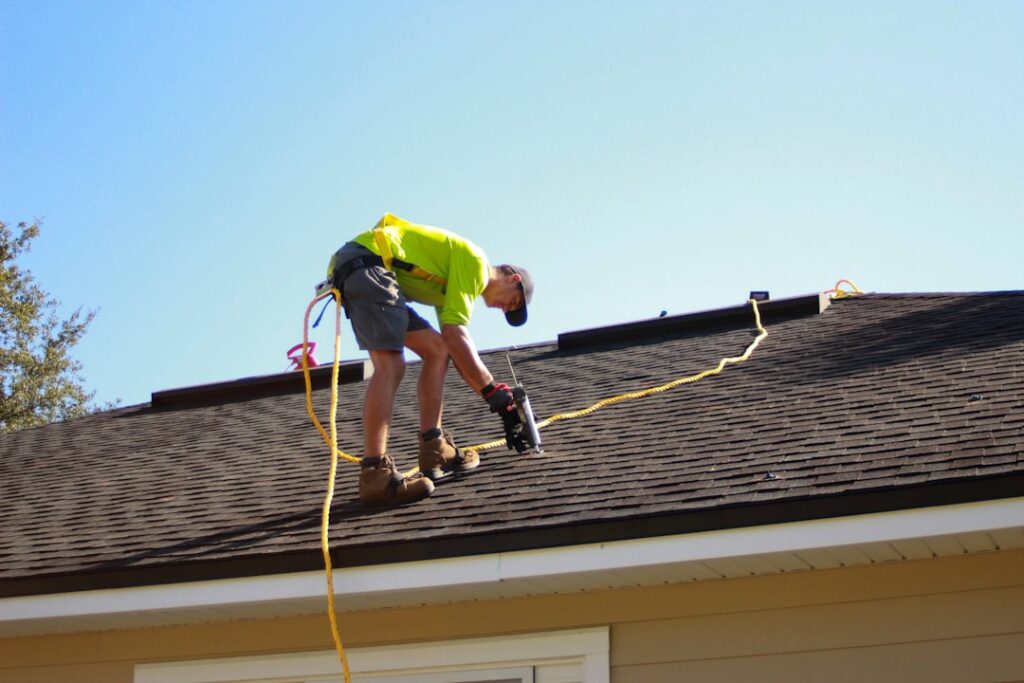
Ninety percent of commercial roof leaks start at a detail — a flashing, a seam, a drain, a penetration — not in the open field of the membrane. That is good news for building owners, because detail failures are cheap to fix when caught early and brutally expensive when ignored: a $500 commercial roof repair deferred for two years routinely becomes $15,000 of saturated insulation. This guide covers the failures that actually happen on low-slope roofs, how a competent contractor fixes each one, and what the invoices should look like. For system basics and membrane types, start with our commercial roofing guide.
Part of our Roofing guide — explore the full guide →
Why Leak Location Is the Hard Part
Water almost never drips where it enters. On a commercial roof it travels laterally along the membrane underside, across insulation facers, and down flute channels in a metal deck before appearing at a ceiling tile 40 feet from the breach. Good contractors work backward from interior evidence to roof details uphill of it, then confirm with moisture scanning — infrared cameras read wet insulation as heat-holding areas after sunset, and capacitance meters verify on contact. Expect to pay $250 to $500 for basic leak detection on a mid-size roof; it is money well spent, because patching the wrong spot is the most common reason “repaired” roofs keep leaking.
The Seven Most Common Problems
1. Failed Seams and Flashings
The number one failure on every membrane type. EPDM seam tape lets go after 15 to 20 years; TPO welds crack where a rushed installer ran the welder too cool; base flashings pull away from walls as membranes shrink. The fix is straightforward — clean, prime, and apply new cover tape or heat-weld a membrane strip over the failed seam. Typical cost: $400 to $1,200 per repair area.
2. Punctures and Foot-Traffic Damage
HVAC technicians drop screws, drag panels, and step on the same path to every unit. A dropped fastener under a boot punches a clean hole in 45-mil membrane. Patches (a round-cornered membrane target welded or adhered over the hole) run $300 to $800. The prevention is cheap: walkway pads along service routes cost $5 to $8 per square foot and pay for themselves in one avoided leak.
3. Ponding Water
Water still standing 48 hours after rain accelerates every aging mechanism and voids most warranties. Small depressions get corrected with tapered insulation crickets ($1,000 to $3,000 per area). Chronic ponding usually traces to clogged or insufficient drainage — sometimes the fix is simply adding a drain or scupper for $2,500 to $5,000, which is drastically cheaper than replacing water-damaged membrane later.
4. Blisters and Membrane Shrinkage
Blisters — trapped air or moisture lifting the membrane — get cut out and patched if larger than a dinner plate, monitored if small. EPDM shrinkage is more serious: the field tightens over decades and pulls flashings off parapets (“bridging”). Repair means cutting the tension and installing new perimeter flashing, often $2,000 to $8,000 per wall — and it is a sign the roof is entering its endgame.
5. Clogged Drains and Scuppers
Leaves, tennis balls, and construction debris block drains, and a 20,000 square foot roof can load over 12,000 gallons per inch of rain with nowhere to go. Structural overload is a real risk. This is a maintenance item, not a repair: clear drains every spring and fall and after major storms. A $300 service visit prevents the one failure mode that collapses roofs.
6. Flashing Failures at Penetrations
Pipe boots crack, pitch pockets dry out and split, and abandoned equipment curbs get capped badly. Each penetration is a leak candidate. Fixes range from $200 for a new pre-molded pipe boot to $1,500 for reflashing a curb. During any repair visit, have the crew top off every pitch pocket on the roof — pourable sealer is cheap insurance.
7. Storm and Hail Damage
Hail bruises membranes and shatters aged, brittle EPDM; wind peels loose edge metal and can propagate into a full blow-off. After any hailstorm over 1 inch, get a documented inspection within days — storm damage is typically an insurance claim, and adjusters respond better to fresh, dated photo evidence than to damage discovered a year later.
Emergency Repairs: Stopping Active Leaks
When water is coming in during a storm, the goal is containment, not permanence. Inside the building, move or cover inventory first, punch a small relief hole in any bulging ceiling tile to drain water in a controlled spot, and put buckets under drips before calling anyone — the first hour of response is worth more than the next day of roofing. Contractors use peel-and-stick modified bitumen patches, reinforced sealant, or tarping to stabilize, at $500 to $2,500 for an emergency call — more on nights and weekends. Two owner rules: photograph everything for insurance before and after, and insist the temporary patch is documented and scheduled for permanent repair. Roofing asphalt slathered over a TPO membrane is not a fix; plasticizer incompatibility means that “repair” will need to be cut out entirely later.
What Repairs Cost, and When Repair Stops Making Sense
Reasonable 2026 benchmarks: minor detail repairs $400 to $1,500; moderate work like reflashing several penetrations or correcting a ponding area $1,500 to $5,000; major section work — replacing wet insulation and membrane over part of the roof — $5,000 to $25,000. Track every invoice, because the repair-versus-replace decision is cumulative. The working rule: when annual repair spend exceeds 5 to 10 percent of replacement cost, when more than 25 percent of the insulation scans wet, or when the membrane is past its design life and failures are spreading rather than isolated, stop patching. Our commercial roof replacement guide covers systems and budgeting for that decision.
Repair Methods by Membrane Type
The right patch depends on what is up there, and mismatched materials fail fast. TPO and PVC repair by hot-air welding a patch of the same membrane — but TPO oxidizes, so aged membrane must be cleaned and sometimes primed before a weld will bond; a competent tech performs a test weld and probes it. EPDM repairs use primer and peel-and-stick EPDM cover tape; the classic failure is skipping the primer or patching a dirty surface. Modified bitumen takes torch- or self-adhered mod-bit patches, and built-up roofs get four-course repairs — alternating layers of flashing cement and reinforcing fabric. Metal roofs are their own trade: fastener replacement with oversized gasketed screws, seam sealant rated for movement, or butyl tape and rivets at laps. If a bidder cannot name your membrane and its repair chemistry on the phone, keep dialing — the wrong sealant smeared on the right roof is the most common repair-of-a-repair we see.
Hiring for Repairs
Use a commercial-specialty contractor even for small work — heat-welding TPO and priming EPDM are trade skills a residential crew rarely has, and a bad patch voids the area around it. If the roof is under an NDL manufacturer warranty, repairs must be performed by a certified contractor and reported, or you jeopardize the coverage; check the warranty file before authorizing anyone. Ask for photo documentation of every repair, before and after. Many owners do best on a maintenance agreement: $500 to $2,000 per year buys semiannual inspections, drain cleaning, and minor sealant work, and puts a responsible party on the roof twice a year.
The Owner’s Playbook
Keep a roof file: warranty documents, a roof plan marking every repair with dates and costs, and inspection reports. Walk the roof — or pay someone to — every spring and fall, after every major storm, and after any trade works up there; our commercial roof inspection guide details exactly what to look for. Restrict roof access and log it, because uncontrolled foot traffic is a leading damage source. Owners who run this simple program typically get 25-plus years from a 20-year roof; owners who wait for ceiling stains get 15 and pay more along the way.