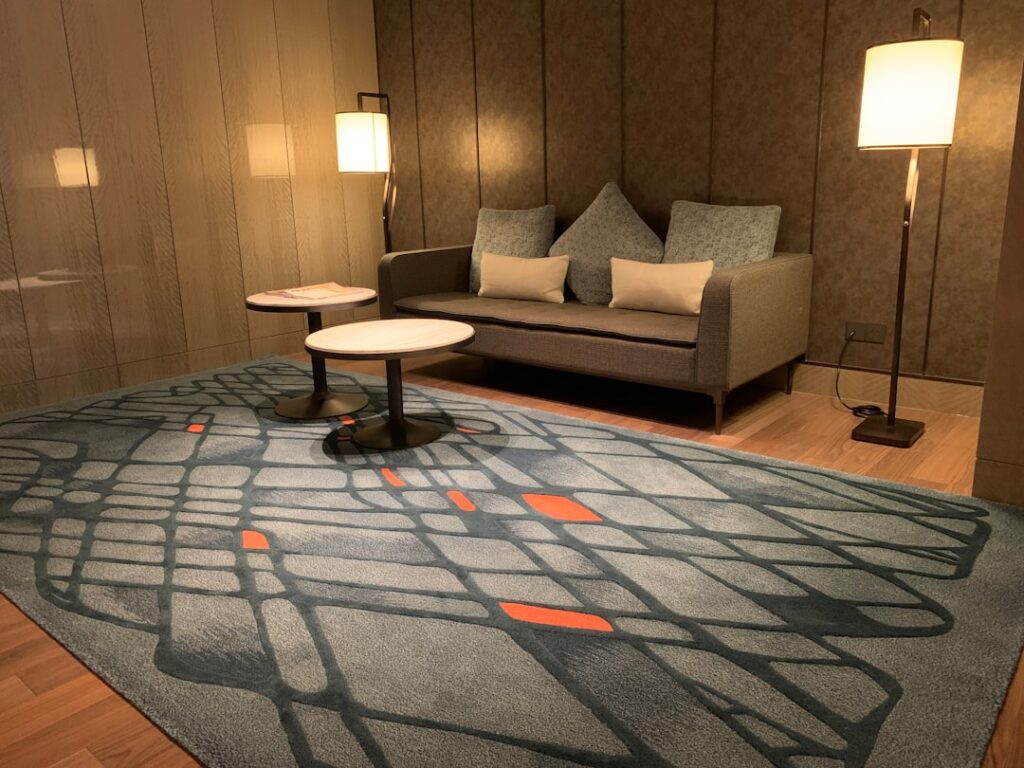
A rug that survives your living room will fall apart in a lobby within a year. That is the hard lesson behind commercial flooring: foot traffic in a busy office or store can exceed a home’s by twenty to fifty times. A commercial rug is engineered for that punishment, with denser construction, tougher fibers, and stain treatments residential products simply do not carry. Whether you are outfitting a retail entrance, a break room, or a high-traffic hallway in a large home, knowing what separates commercial-grade from consumer-grade will save you money and headaches.
What Makes a Commercial Rug Different
The difference comes down to construction density and fiber engineering. A commercial rug packs more yarn into every square inch, sits on a stiffer backing, and is treated for soil, static, and sometimes fire resistance. Where a home rug might last three to five years under moderate use, a commercial-grade product is built to hold up for eight to fifteen years in a setting where hundreds of people walk across it daily. That durability shows up in the specs, so learning to read them matters more than picking a color.
Understanding Face Weight
Face weight is the single most useful number on a commercial rug spec sheet. It measures the amount of fiber, in ounces, in one square yard of the rug’s surface, counting only the pile you actually walk on. Higher face weight generally means a denser, more durable rug.
- 20 to 26 oz: Light commercial use, such as private offices or low-traffic showrooms.
- 28 to 36 oz: Moderate to heavy office traffic, conference rooms, and corridors.
- 40 oz and up: Heavy retail, hospitality lobbies, and entrance zones.
Do not treat face weight in isolation. A high face weight with loose, tall tufts can crush faster than a lower-weight, tightly looped construction. Pair the number with pile density and tuft twist for a real picture of durability.
Traffic Ratings Explained
Manufacturers rate carpet and rugs on a durability scale, often called the PAR or Appearance Retention Rating, typically running from 1.0 to 5.0. For a commercial rug, look for a rating of 3.5 or higher, which indicates the product is built for heavy traffic. Ratings of 4.0 and above are appropriate for the busiest zones, such as store entrances and airport-style corridors. Anything below 3.0 belongs in a home, not a commercial floor. Many suppliers also label products explicitly as “heavy commercial,” “commercial,” or “light commercial,” which maps roughly to those PAR ranges.
Nylon vs Olefin vs Wool
Fiber choice drives both performance and price in any commercial rug. The three you will encounter most are nylon, olefin (polypropylene), and wool, and each has a clear best-use case.
- Nylon: The most resilient synthetic. It bounces back from crushing, resists abrasion, and cleans well. Type 6,6 nylon is the premium tier. Best for high-traffic offices and hallways. Expect $3 to $8 per square foot installed.
- Olefin (polypropylene): Highly stain- and moisture-resistant and cheap, but it crushes and does not recover like nylon. Great for entrance mats and areas exposed to spills or the outdoors. Roughly $1.50 to $4 per square foot.
- Wool: Naturally flame-resistant, luxurious, and durable, but expensive and harder to maintain. Reserved for executive suites, hotels, and upscale showrooms. Often $8 to $20-plus per square foot.
For most commercial settings on a budget, solution-dyed nylon delivers the best balance of durability, stain resistance, and value. Solution-dyed means the color runs all the way through the fiber, so it resists bleaching from harsh cleaners and sunlight.
Entrance Mats and Walk-Off Rugs
The hardest-working commercial rug in any building is the entrance mat. Up to 80 percent of the dirt inside a facility is tracked in on shoes, so a proper walk-off system pays for itself in reduced cleaning and protected floors. Plan for at least 12 to 15 feet of matting from the door so shoes complete several steps on the mat before hitting the finished floor.
- Scraper mats: Coarse, often rubber-backed, placed outside or just inside the door to knock off heavy grit.
- Wiper mats: Absorbent, plush-surfaced mats placed further inside to dry shoes and capture fine dust.
- Logo and rental mats: Branded entrance rugs, frequently supplied through a mat-rental service that swaps and launders them weekly.
Maintenance for Offices and Retail
A commercial rug lives or dies by its cleaning schedule. High-traffic zones should be vacuumed daily with a commercial upright, and entrance areas even more often. Plan on spot-treating spills immediately and running interim low-moisture cleaning monthly in busy areas. Deep hot-water extraction (steam cleaning) should happen quarterly to twice a year depending on traffic. Skipping deep cleaning lets abrasive grit grind into the fibers, wearing them down far faster than foot traffic alone.
Rotate loose-laid rugs periodically to even out wear, and keep a stock of matching carpet tiles if you use a modular system, since tiles let you swap out a damaged square instead of replacing an entire run. Address matting and crushing early; once fibers are permanently flattened in a traffic lane, no cleaning will restore them.
Backing and Construction Types
The back of a commercial rug matters as much as the face. Broadloom carpet and area rugs typically use a woven, unitary, or double stick backing, while modular products rely on a rigid PVC, bitumen, or cushion backing that keeps tiles flat and dimensionally stable. For loose-laid commercial rugs, a hard, low-profile backing with a non-slip surface is essential; soft residential backings curl at the corners and become trip hazards in a matter of weeks under heavy foot traffic.
Construction style also drives durability. Loop pile, especially a tight level loop, resists crushing far better than cut pile and is the standard for high-traffic commercial zones. Cut pile feels plusher and looks more upscale, which suits executive offices and hospitality, but it shows footprints and wear lanes sooner. A cut-and-loop combination splits the difference and can hide soil with its patterned texture, a practical choice for busy corridors where appearance retention is a concern.
Static, Fire, and Safety Ratings
Commercial environments carry code requirements that home rugs never face. Look for a permanent anti-static treatment (rated at or below 3.5 kilovolts) in offices full of electronics, and confirm the rug meets flammability standards such as a passing Class 1 or Class 2 flooring radiant panel rating for the building type. Slip resistance is the other safety pillar: entrance and wet-zone rugs should carry a high coefficient of friction and a firm, gripping backing. These ratings are not optional box-checking; in a public space they are what protect you from liability when someone slips or a fire marshal inspects the building.
Sizing and Buying Tips
Measure the traffic path, not just the room. A commercial rug should cover the full walking lane plus a border, so runners in corridors and generously sized area rugs in lobbies work better than something that forces people to step on and off. For loose rugs on hard floors, always use a commercial-grade non-slip pad or double-sided tape rated for the substrate, since a sliding rug in a public space is a liability. When buying in volume, ask suppliers about broadloom versus modular carpet tiles; tiles cost a bit more upfront but slash long-term replacement costs.
Final Thoughts
Choosing the right commercial rug is about matching construction to traffic. Check the face weight, demand a traffic rating of 3.5 or higher, and lean toward solution-dyed nylon for the best mix of durability and value. Build a real walk-off system at every entrance, commit to a regular cleaning schedule, and your investment will keep looking sharp for a decade rather than fraying within a year. In commercial spaces, the specs on the label matter far more than the pattern on the surface.