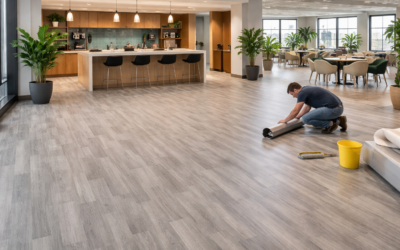
If you have ever stood in a hospital corridor and noticed the floor running seamlessly under the wall base, you were looking at heat-welded sheet flooring — the gold standard for facilities that cannot tolerate dirt or moisture in seams. Commercial sheet flooring covers wide-roll vinyl, rubber, and linoleum products installed in 6-foot or 12-foot widths with chemically or heat-welded joints, used heavily in healthcare, education, laboratories, and food service. It outperforms tile and plank formats in any environment that gets scrubbed, autoclaved, or sees rolling equipment all day. This guide walks through the materials, installation, and real-world cost.
Why Sheet Beats Tile in Commercial Settings
The single biggest reason facilities pick sheet over LVT or VCT is seam count. A 1,000 sq ft operating room finished in 12-inch VCT has roughly 360 linear feet of seams. The same room in 6-foot sheet vinyl with heat-welded joints has under 170 feet, and every one of those seams is sealed, not just butted together. Bacteria, blood, and chemical spills have nowhere to hide.
That seamless quality matters anywhere infection control, contamination, or hygiene drives the design. It is also why commercial kitchens, dialysis centers, pharmaceutical clean rooms, and school cafeterias all default to sheet products despite higher upfront cost than tile.
The Three Main Sheet Materials
Most commercial sheet floors are one of three materials, each with a defined sweet spot.
- Homogeneous vinyl sheet — One solid color or pattern through the full thickness. Common brands include Tarkett iQ Optima, Armstrong Medintech, and Forbo Eternal. Repairs are nearly invisible because the wear surface and the body are the same material. Costs $4 to $8 per sq ft for material.
- Heterogeneous vinyl sheet — Layered construction with a printed decor layer and a clear wear layer. More design options including wood-look and stone-look prints. Material runs $3.50 to $7 per sq ft.
- Linoleum sheet — Natural product made from linseed oil, wood flour, and jute backing. Marmoleum is the dominant brand. Naturally antimicrobial and biodegradable. Material runs $4 to $9 per sq ft.
Rubber sheet is a fourth option used in fitness facilities, transit platforms, and stairs, but it serves a different niche and competes more with rubber tile than with vinyl.
Where Each Material Wins
Healthcare environments — patient rooms, ORs, exam corridors — almost always go with homogeneous vinyl because of cleanability and consistent color through the thickness. Schools default to heterogeneous vinyl for cost and design flexibility. Laboratories and clean rooms split between homogeneous vinyl and welded epoxy, with welded vinyl winning on comfort and acoustics. Linoleum has a strong following in LEED projects and progressive school districts because of its renewable raw materials.
Heat-Welded vs Cold-Welded Seams
The seam treatment determines whether you have a true sealed floor.
Heat welding uses a hand-held or auto-welding tool to melt a matching colored rod into a routed groove between two sheets, creating a chemically continuous joint. Done correctly, the seam is fully sealed and visually nearly invisible. This is the spec for healthcare, labs, and clean rooms.
Chemical (cold) welding uses a solvent applied along butted seams, fusing the edges as it cures. Faster and lower cost, but the seam is not as durable under wet scrubbing. Acceptable for retail, offices, and light commercial — not appropriate for environments with frequent autoclave-temperature cleaning.
Coved Base — The Detail That Separates Spec Grades
True commercial sheet floors use a coved base detail where the sheet curves up the wall 4 to 6 inches and caps with an aluminum or vinyl edge strip. This eliminates the floor-to-wall seam, which is exactly where dirt and bacteria accumulate. Coving adds $4 to $7 per linear foot to the install but is mandatory for most healthcare codes and best practice anywhere hygiene matters.
Pre-formed cove sticks, integrated cove backing, and field-formed coving are all valid methods. Field-formed coving requires skilled installers — a sloppy radius at the cove will telegraph through any cleaning protocol.
Installation Costs and Timeline
Installed commercial sheet flooring typically runs as follows:
- Heterogeneous vinyl, chemical welded: $7 to $11 per sq ft installed
- Homogeneous vinyl, heat welded, no cove: $9 to $14 per sq ft installed
- Homogeneous vinyl, heat welded with cove: $11 to $17 per sq ft installed
- Linoleum sheet, heat welded with cove: $12 to $19 per sq ft installed
Substrate prep is non-negotiable. Concrete slabs must test below 3 lbs per 1,000 sq ft per 24 hours of moisture vapor emission and 75% relative humidity per ASTM F1869 and F2170. Failures here are the leading cause of bubbling, adhesive failure, and warranty disputes. Budget $2 to $5 per sq ft for substrate prep on any slab where moisture testing comes back high.
Maintenance That Preserves the Warranty
Most commercial sheet manufacturers void warranties if you use the wrong cleaners. The basics:
- Daily dust mop, damp mop with neutral pH cleaner
- Auto-scrub two to five times per week depending on traffic
- No high-alkaline strippers on no-wax homogeneous floors
- Burnish only with manufacturer-approved pads
- Recoat with manufacturer floor finish per the published schedule
Many newer homogeneous vinyl products use a factory-applied PUR coating that eliminates the need for traditional wax stripping cycles. Tarkett iQ and Armstrong Medintech both ship with this surface treatment, which can save thousands per year in maintenance labor on large facilities.
When to Pick Something Else
Sheet flooring is not always the answer. For low-traffic offices with no moisture concerns, LVP or carpet tile is cheaper and easier to repair locally. For heavy industrial floors with chemical exposure or forklift traffic, urethane cement or epoxy coatings outperform sheet by a wide margin. Sheet shines in the middle — places where hygiene, acoustics, comfort underfoot, and seamless cleanability all matter at once.
Bottom Line
Commercial sheet flooring earns its premium in healthcare, education, labs, and food service because no other product matches its combination of seamless cleanability and traffic durability. Spec heat-welded seams, coved base where hygiene matters, and proper substrate prep, and you will own a floor that performs as designed for 15 to 25 years with reasonable maintenance.
Prefer to explore on your own?
See how new flooring looks in your actual room in seconds — free, no signup.
Try the free Floor Studio →