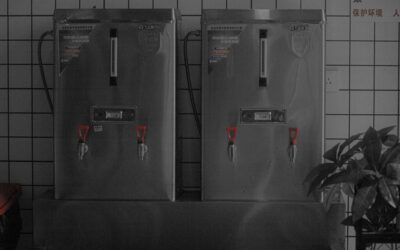
A restaurant that loses hot water at the dish pit shuts down, and that is why commercial hot water is a very different game from the tank in your basement. Commercial water heater installation deals with far higher demand, larger tanks or high-recovery tankless banks, dedicated venting, and a stack of code and permit requirements that a residential job never touches. Getting commercial water heater installation right means sizing for peak demand, choosing the correct fuel and venting, and hiring a licensed pro, because the stakes and the codes are both higher. This guide covers what to expect.
Commercial vs Residential Water Heaters
The difference is scale and duty. Residential tanks typically hold 40 to 80 gallons and use burners around 40,000 BTU. Commercial units run from 75 gallons to several hundred, with gas burners from 75,000 to over 500,000 BTU, built to recover, or reheat, a full tank quickly under constant draw. They are also engineered for continuous heavy use rather than the intermittent demand of a home.
That heavier duty drives everything downstream: larger gas lines, bigger vents, stronger structural support for the weight, and stricter code compliance. You cannot simply scale up a residential install; the whole system is engineered around peak demand.
Sizing for Peak Demand
Undersize a commercial heater and the business runs cold at the worst moment; oversize it and you waste money on equipment and standby energy. Sizing starts with peak-hour demand, the maximum gallons of hot water used in the busiest hour, not the daily total.
- Restaurants: heavy demand at dish machines, prep sinks, and handwashing, often needing 180°F for sanitizing dish machines
- Hotels: big morning and evening spikes as guests shower
- Salons and laundromats: steady, high-volume warm water draw
- Offices and retail: lighter, more predictable demand
A pro calculates first-hour rating and recovery rate against your peak-hour demand. Recovery rate, the gallons per hour the unit can heat through a given temperature rise, matters as much as tank size in high-turnover settings. Two smaller units in parallel are often better than one giant tank, adding redundancy so a failure does not shut you down.
Gas, Electric, or Tankless
Fuel choice depends on your utility rates, available gas supply, and demand pattern.
- Gas storage tanks — fast recovery, lower operating cost where gas is cheap, but need venting and combustion air
- Electric storage tanks — simpler venting (none for combustion), good where gas is unavailable, but higher operating cost and often slower recovery
- Commercial tankless — heat on demand, endless hot water, compact, often banked in multiples for high flow; higher upfront cost
- Condensing units — high-efficiency gas models that reclaim heat from exhaust, 90 percent-plus efficient, but need condensate drainage
Many commercial kitchens pair a high-recovery gas heater with a booster heater at the dish machine to reach the 180°F sanitizing temperature required by health code, since keeping the whole system that hot is inefficient and scalding-hazardous.
Venting and Combustion Air
Gas units demand correct venting, and this is where amateur installs fail inspection. Standard atmospheric units use Category I venting up through a chimney or B-vent, while high-efficiency condensing units use sealed PVC or polypropylene venting that can run horizontally. The vent must be sized to the BTU load and pitched correctly, and the equipment room needs adequate combustion air.
Get this wrong and you risk backdrafting, carbon monoxide, and a failed inspection. Condensing units also produce acidic condensate that must drain to an approved location, often through a neutralizer, so plan the drain during rough-in.
Code, Permits, and Inspection
Commercial installs are permitted and inspected work, full stop. Expect requirements around:
- Permits pulled before work begins, plus mechanical and plumbing inspections
- Temperature and pressure relief valves piped to a safe discharge point
- Seismic strapping and structural support for the heavy tanks in applicable regions
- Backflow prevention and expansion tanks on the cold supply
- Health department standards for sanitizing temperatures in food service
- ASME rating for larger pressure vessels in many jurisdictions
Because of all this, commercial water heater installation is not a DIY project. It requires a licensed commercial plumber, and often a mechanical contractor for the venting, working from a permitted plan.
The Installation Process
- Load calculation and permit. The contractor sizes the system to peak demand and pulls permits.
- Remove and prep. The old unit is drained, disconnected, and removed; the space is prepped for the new footprint and weight.
- Set the unit. The heater is positioned on proper support, with clearances for service and combustion air.
- Connect utilities. Gas or electric supply sized to the load, cold and hot water lines, expansion tank, and recirculation loop if used.
- Vent and drain. Install code-compliant venting and condensate drainage for condensing units.
- Test and inspect. Fill, purge air, check for leaks, verify temperatures, and pass the required inspections before the system goes live.
What It Costs
Commercial installs vary widely by capacity and complexity. Equipment alone ranges from roughly $1,500 for a modest 75-gallon gas unit to $8,000 or more for large or condensing systems, and tankless banks can run higher. Labor, venting, gas-line upgrades, permits, and code work commonly add $2,000 to $8,000 or more.
Total projects frequently land between $4,000 and $15,000, with large or high-recovery systems exceeding that. It is real money, but the cost of downtime, a restaurant that cannot sanitize dishes or a hotel with cold showers, dwarfs the install. Size it correctly for peak demand, choose the right fuel and venting, and hire a licensed commercial plumber, and the system will deliver reliable hot water day in and day out for the life of the equipment.
Recirculation Loops and Delivery
In a large building, the water heater is only half the system; getting hot water to distant fixtures fast is the other half. Without a recirculation loop, a fixture 100 feet from the heater can run for 30 to 60 seconds before hot water arrives, wasting water and frustrating users. A recirculation loop uses a dedicated return line and a small circulator pump to keep hot water constantly moving through the building’s piping, so it is instant at every tap.
The loop needs to be insulated to hold temperature and controlled to run efficiently, often on a timer or an aquastat that pumps only when the loop cools below a setpoint. Sizing the pump and return line correctly matters, since an oversized pump wastes energy and an undersized one leaves fixtures cold. In hospitals, gyms, and hotels, a properly designed recirculation system is as important as the heater itself for user satisfaction and water conservation.
Maintenance and Lifespan
Commercial water heaters work hard, and a maintenance schedule is what separates a unit that lasts 10 to 15 years from one that fails in 6. Sediment builds up faster under heavy use, insulating the burner from the water and cutting efficiency, so tanks should be flushed regularly to clear it.
- Flush the tank on a schedule, often quarterly in hard-water areas, to remove sediment
- Inspect the anode rod annually and replace it before it is consumed, since it protects the tank from corrosion
- Test the T&P relief valve to confirm it operates and is not seized
- Descale tankless units with a vinegar or descaling-solution flush per the manufacturer, typically once or twice a year
- Check venting and combustion for blockages and proper draft during annual service
A service contract with a commercial plumber usually pays for itself by catching small problems before they become failures. Hard water is the biggest enemy, so if your area has high mineral content, consider a water softener or scale-reduction system ahead of the heater to protect it.
Planning for Redundancy
For any business where hot water is mission-critical, build in redundancy from the start. Two smaller units piped in parallel let you keep running at reduced capacity if one fails, and they let you service one without shutting down operations. This staged approach also matches output more closely to demand, since you can fire only the capacity you need during slow periods and bring the second unit online at peak. The modest extra upfront cost buys insurance against the far larger cost of an unexpected shutdown. Ask your contractor to design the system so either unit can be isolated with its own shutoff valves, allowing service on one while the other keeps the business running. For operations that cannot tolerate any interruption, some owners also keep a spare heater or key parts on hand so a failure becomes a same-day fix rather than a multi-day wait for delivery.