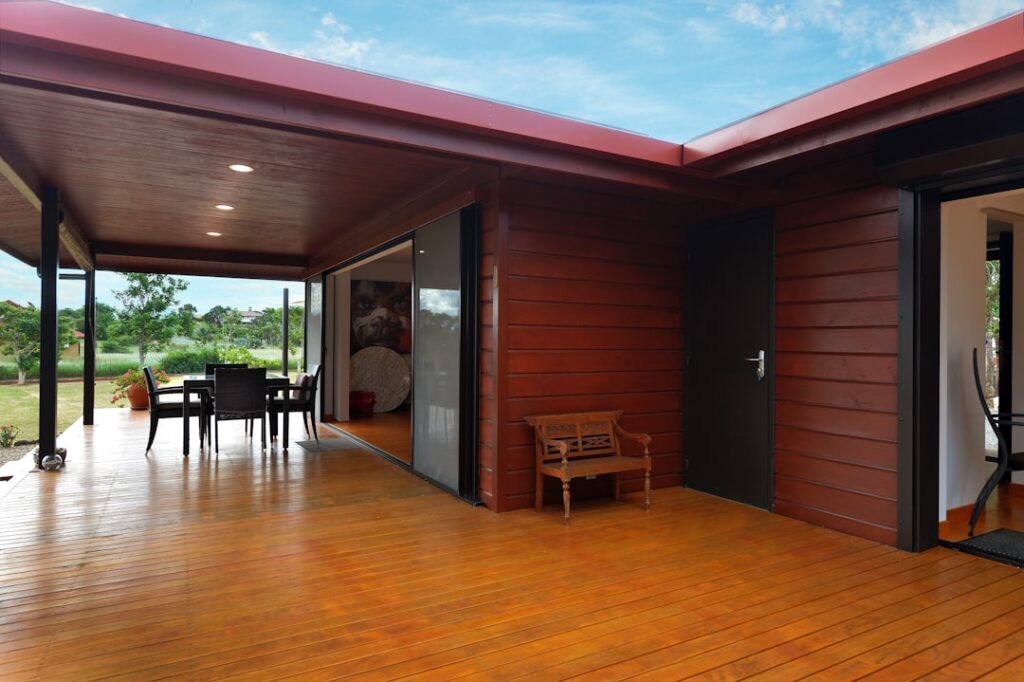
Your front porch works harder than almost any surface on the house. It bakes in the afternoon sun, soaks up rain, holds foot traffic, and forms the first impression every visitor gets. A composite decking front porch stands up to all of it without the annual sanding, staining, and splinter-hunting that wood demands. Made from a blend of recycled wood fibers and plastic, composite boards deliver the warm look of timber with a fraction of the upkeep. This guide covers whether composite is right for a porch, what it costs, and how it goes down.
Part of our Decks & Outdoor guide — explore the full guide →
- Composite vs. Wood for a Front Porch
- Grooved vs. Solid Boards, and Porch Considerations
- Capped vs. Uncapped Composite
- What a Composite Porch Costs
- Installing Composite Over a Porch Frame
- Choosing a Color That Complements the House
- Maintenance and Longevity
- Is It Right for Your Porch?
- Composite vs. PVC and Other Alternatives
- Railings, Steps, and Finishing Details
- Frequently Asked Questions
Composite vs. Wood for a Front Porch
The porch is a showcase, so the material choice matters more here than on a back deck. Composite wins on maintenance and longevity; wood wins on upfront price and, for some, authenticity.
- Maintenance: composite needs only occasional soap-and-water cleaning; wood needs staining or sealing every 1 to 3 years
- Lifespan: quality composite lasts 25 to 30 years; pressure-treated pine may need board replacement within 10 to 15
- Appearance: modern capped composite mimics wood grain convincingly and won’t gray, cup, or splinter
- Cost: composite costs more upfront but saves on decades of stain, sealer, and labor
For a highly visible front porch that you’d rather not maintain every spring, composite usually pays off in convenience and consistent good looks.
Grooved vs. Solid Boards, and Porch Considerations
A front porch has one design difference from a deck worth noting: many people prefer a porch floor to look like traditional tongue-and-groove porch decking with narrow, gapless boards, whereas decks intentionally leave gaps for drainage. Composite comes in both styles.
If your porch is covered by a roof, water exposure is limited and you can run boards more tightly for that classic porch-floor look. If it’s an open, uncovered porch, follow standard deck spacing (about 1/8 to 3/16 inch gaps) so water drains and boards can expand. Always follow the manufacturer’s gapping spec for your climate, since composite expands and contracts with temperature.
Capped vs. Uncapped Composite
Modern composite decking comes in two grades. Uncapped (first-generation) composite is the older, less expensive type and is more prone to fading and staining. Capped composite wraps the board core in a durable polymer shell that resists stains, scratches, fading, and mold. For a front porch, capped composite is worth the small premium; it holds its color and shrugs off spills far better. Leading brands include Trex, TimberTech, Fiberon, and Deckorators.
What a Composite Porch Costs
Composite decking materials run roughly $4 to $13 per square foot for the boards alone, with premium capped lines at the top of that range. Installed, including framing, fasteners, and labor, a composite porch typically costs $30 to $60 per square foot. For a modest 8-by-20-foot front porch (160 square feet), expect a ballpark of $5,000 to $9,000 installed, depending on your region, the substructure condition, and whether railings and steps are included.
Don’t forget the hidden costs: hidden fasteners, fascia and trim boards to cover the frame edges, and matching composite for steps and railings, which quickly add up but complete the finished look.
Installing Composite Over a Porch Frame
Composite boards install over a standard joist system much like wood, with a few important differences.
- Check joist spacing: composite is less rigid than wood, so joists usually need to be 16 inches on center or tighter, and diagonal patterns require 12 inches
- Ensure a solid, level frame: composite telegraphs any dips in the substructure, so shim and flatten the joists first
- Fasten with the right system: hidden clips for grooved boards give a clean, screw-free surface; face-screwing works for square-edge boards using color-matched composite screws
- Leave proper gaps: follow the spec for end-to-end and side-to-side spacing to allow thermal movement
- Finish the edges: use fascia board or picture-frame the perimeter to hide cut ends
Because composite sags more than lumber over gaps, correct joist spacing is the single most important detail. Get it wrong and the boards feel bouncy underfoot.
Choosing a Color That Complements the House
Front porch flooring sets the tone for curb appeal. Composite comes in warm browns, cool grays, weathered driftwood tones, and multi-tonal streaked looks that mimic exotic hardwoods. Consider your siding and trim: gray tones suit modern and coastal homes, while rich brown and mahogany tones warm up traditional and craftsman exteriors. Order samples and set them on the porch to view in real daylight before committing; screen colors are unreliable.
Maintenance and Longevity
The maintenance pitch is real. To keep a composite porch looking new, sweep off debris and wash it a couple of times a year with soap, water, and a soft brush. Rinse off pollen and dirt that can host surface mold in shaded, damp areas. Avoid pressure washing above the manufacturer’s recommended PSI, which can damage the cap. There’s no sanding, no staining, and no sealing, ever.
Composite resists rot, insects, and splintering, making it especially kid- and bare-foot-friendly on a porch where people sit and linger. In hot climates, note that dark composite can get warm underfoot in direct sun, so lighter tones stay cooler on a south-facing, uncovered porch.
Is It Right for Your Porch?
A composite decking front porch makes the most sense if you want lasting curb appeal with minimal upkeep and you plan to stay in the home long enough to recoup the higher upfront cost through saved maintenance. Choose capped composite, size your joists tightly, pick a color that flatters your siding, and finish the edges cleanly. Do that, and you’ll have a welcoming, low-maintenance front porch that still looks sharp two decades from now.
Composite vs. PVC and Other Alternatives
Composite isn’t the only low-maintenance decking option, so it helps to know where it sits. Cellular PVC decking contains no wood fiber at all, making it fully waterproof and even lighter than composite; it’s a strong choice for a fully exposed porch, though it can feel less natural underfoot and costs more. Traditional tongue-and-groove wood porch flooring, like fir or a rot-resistant species, gives an authentic look but demands regular paint or stain. Composite lands in the middle, offering wood-like warmth, excellent durability, and minimal upkeep at a mid-range price. For most covered front porches, capped composite is the sweet spot; for fully exposed, wet locations, PVC edges ahead.
Railings, Steps, and Finishing Details
The floor is only part of the porch. To complete the look, match composite or PVC railing systems to the decking; most brands offer coordinated railing lines in the same colors. Steps take the heaviest wear on a porch, so build them from the same capped composite and use closed risers for a finished appearance. Cover the exposed frame ends with fascia board and picture-frame the perimeter with a border board so no cut ends show. Post sleeves that slip over structural 4×4 or 6×6 posts hide the pressure-treated lumber and give columns a clean, painted-white or wrapped look that ties the whole porch together.
Frequently Asked Questions
Can composite decking be used on a covered front porch?
Yes, and a roof over the porch actually reduces water and UV exposure. On a covered porch you can run boards more tightly for a traditional porch-floor look, but always follow the manufacturer’s gapping spec.
How much does a composite front porch cost?
Materials run about $4 to $13 per square foot for boards; installed with framing and labor, expect $30 to $60 per square foot. A 160-square-foot porch commonly totals $5,000 to $9,000.
Does composite decking get hot in the sun?
Darker colors absorb more heat and can feel warm underfoot on a sunny, uncovered porch. Lighter tones stay cooler, and a porch roof keeps any composite comfortable.
How do I maintain a composite front porch?
Sweep off debris and wash the boards a couple of times a year with soap, water, and a soft brush. Rinse off pollen and dirt in shaded areas to prevent surface mold. There’s no sanding, staining, or sealing required, which is the whole point of choosing composite over wood.