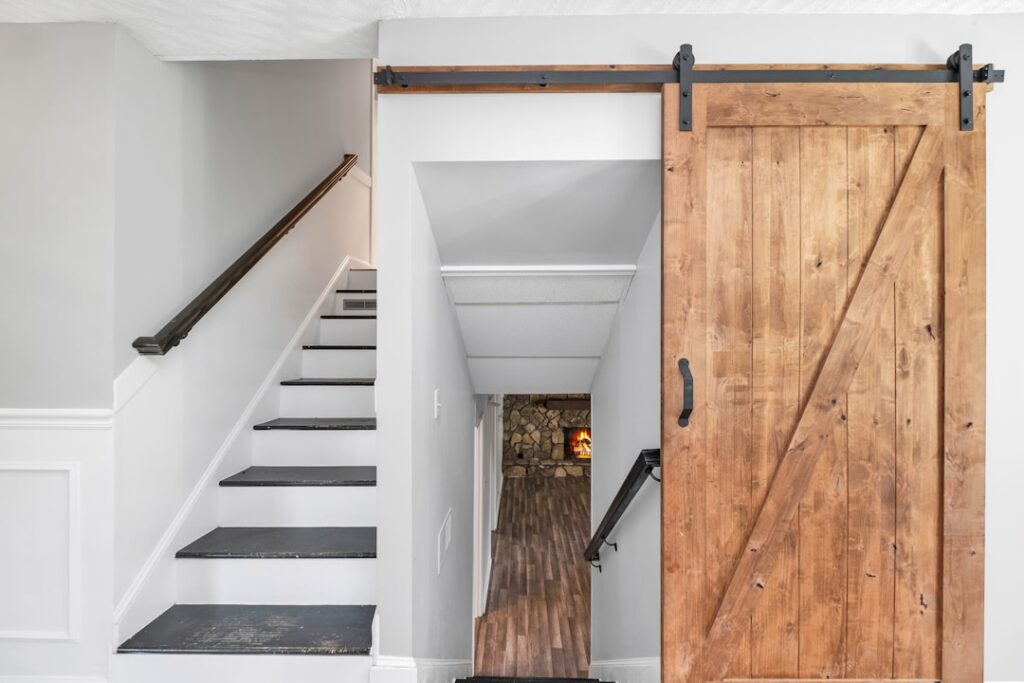
The exposed steel track and rustic rollers that defined the barn door trend are quietly going out of style. In their place, homeowners are choosing concealed barn door hardware — systems that tuck the track and trolleys behind a fascia board or inside a soffit so the door appears to glide with no visible mechanism at all. The result is the space-saving convenience of a sliding door with the clean, architectural look of built-in millwork. If you love how barn doors solve tight spaces but never loved the industrial hardware bolted to your wall, this is the upgrade you’ve been waiting for. Here’s how it works and how to get it right.
Part of our Windows & Doors guide — explore the full guide →
What “Concealed” Actually Means
Standard barn door hardware puts everything on display: a black steel rail, exposed wheel hangers, and bolt heads marching across the top of the door. Concealed systems hide that machinery in one of two ways. The first uses a fascia — a wood or MDF board mounted in front of the track so you see a clean horizontal band instead of steel and wheels. The second, more premium approach recesses the entire track into a pocket or soffit above the opening, so the door seems to float with nothing visible overhead. Either way, the mechanical parts disappear and the door becomes the focal point instead of the hardware.
This matters most in refined spaces — primary bathrooms, home offices, closets in a modern build — where exposed rustic hardware would clash with the design. A concealed setup reads as intentional architecture rather than a trend applied to the wall.
How Concealed Systems Work
Under the fascia, the mechanics are similar to any top-hung sliding door: the door hangs from trolleys (wheeled carriages) that ride inside an aluminum or steel track. The difference is the track geometry. Concealed tracks are usually a U-channel or box profile that fully encloses the wheels, and the door hangs from brackets that reach up and back into that channel. A fascia board then clips or screws onto the front, hiding everything while leaving a slim reveal for the door to pass.
Because the wheels are enclosed, these systems tend to run quieter and collect less dust than open rollers. Soft-close dampers are common on quality units, easing the door to a stop instead of letting it slam. The floor guide still lives at the bottom, keeping the door from swinging, and it’s typically a small pin in a channel routed into the door’s bottom edge so nothing shows on the floor.
Popular Concealed Hardware Systems
The market ranges from budget fascia kits to European-engineered flush systems. A few names come up repeatedly among installers.
- Krownlab and Goldberg Brothers fascia systems — premium U.S. hardware with clean fascia covers and soft-close, in the $500 to $900 range.
- Johnson Hardware 2610F and 111FD — reliable, widely available fascia-mount and pocket systems favored by contractors, often $150 to $350.
- Hafele and Hettich European systems — fully concealed flush tracks that recess into a soffit for the true floating look, generally $400 to $800.
- Big-box fascia kits — entry-level options from brands like National Hardware or generic imports at $120 to $250 that hide the track behind a wood board.
Match the system’s rated capacity to your door. A solid-core interior door weighs 60 to 100 pounds; a heavy solid-wood slab can top 120. Buy hardware rated well above your door’s weight so the wheels and track aren’t running at their limit.
Planning the Opening and Wall
Concealed barn door hardware demands more planning than the surface-mounted kind because the track has to attach to something solid and often needs to sit at a precise height. You need a continuous mounting surface above the door — either the wall studs with proper blocking or a header — and the track length must be roughly twice the door width so the door can slide fully clear of the opening.
- Add solid blocking between studs before drywall if you’re building or renovating, so the track has a continuous anchor.
- Confirm you have wall space beside the opening equal to the door’s width for it to park.
- Account for the fascia depth — the door hangs an inch or two off the wall, so plan clearance around light switches, trim, and base molding.
- Check ceiling height; a taller fascia looks proportionate on tall walls but can crowd a low ceiling.
Installation Overview
Installing a concealed system takes most DIYers three to five hours. The critical step is mounting the track dead level — even a small tilt makes the door drift open or closed on its own. Start by finding and marking your studs, then fasten the track’s mounting rail with lag bolts into studs or blocking, checking level continuously. Hang the door on its trolleys, adjust the height with the built-in bolts so the door clears the floor by about a half inch, and set the floor guide. Finally, attach the fascia board or cover.
Two tips save headaches. First, dry-fit the fascia before final assembly to confirm the reveal is even along the whole run. Second, if your system has soft-close dampers, install and test them before the fascia goes on so you can adjust the activation point without pulling the cover off later. Professional installation runs $200 to $400 in labor, and it’s money well spent on premium recessed systems where the track integrates with framing.
Cost Breakdown
Your total lands in three buckets: the door, the hardware, and installation. Expect a quality slab door at $150 to $500, concealed hardware at $150 to $900 depending on the tier, and installation at $0 for DIY or $200 to $400 for a pro. A realistic mid-range project — a solid-core door with a good fascia system installed by a handyman — runs $600 to $1,100. Fully recessed soffit systems in a custom build push toward $1,200 or more once framing and finishing are included.
Soft-Close, Soft-Open, and Other Upgrades
The features tucked inside a concealed system separate a door that feels cheap from one that feels engineered. Soft-close dampers are the upgrade worth paying for — a small hydraulic or spring mechanism catches the door in the last few inches and eases it shut instead of letting it bang against the jamb. On premium systems you can add soft-close at both ends, so the door decelerates gently whether you’re opening or closing it. That single feature transforms the daily experience of using the door.
Other worthwhile additions include a synchronized system if you’re hanging a double door, so both panels move together and meet cleanly in the middle, and a privacy lock, which matters if the door is going on a bathroom or bedroom. Standard barn doors are notorious for not locking; better concealed kits offer discreet floor or edge-mounted latches that solve it. Anti-jump blocks are another small but important part — they keep the trolleys seated in the track if the door is bumped hard, preventing it from derailing.
Common Mistakes to Avoid
Concealed hardware is less forgiving than surface-mount, and a handful of errors account for most of the frustration installers see.
- Skipping the blocking — mounting the track into drywall anchors alone will eventually pull loose under the door’s weight. Anchor into studs or solid blocking, every time.
- Getting the track out of level — even a fraction of an inch of tilt makes the door drift open or closed on its own. Check level continuously as you fasten.
- Undersizing the hardware — buying a kit rated at the door’s exact weight leaves no margin; the wheels wear fast. Choose hardware rated well above your slab’s weight.
- Forgetting the floor guide — without it, the door swings and scrapes the wall. Install and adjust it so the door tracks true without binding.
- Ignoring clearance for trim and switches — the fascia holds the door an inch or two off the wall, so plan around base molding, casing, and light switches before you commit.
Take the extra hour to get the blocking, level, and guide right, and a concealed door rewards you with years of smooth, quiet, trouble-free operation.
Concealed vs. Exposed: Which Fits Your Home
Exposed hardware still makes sense in farmhouse, industrial, and rustic interiors where the steel and rollers are part of the aesthetic — and it’s cheaper and simpler to install. Concealed barn door hardware belongs in transitional and modern spaces where you want the function without the visual clutter. If your home leans contemporary, or the door lives in a polished space like a primary suite, spend the extra money to hide the track. The look is dramatically more sophisticated, and once it’s installed correctly, it operates smoothly and quietly for years with nothing but an occasional wipe of the guide channel.