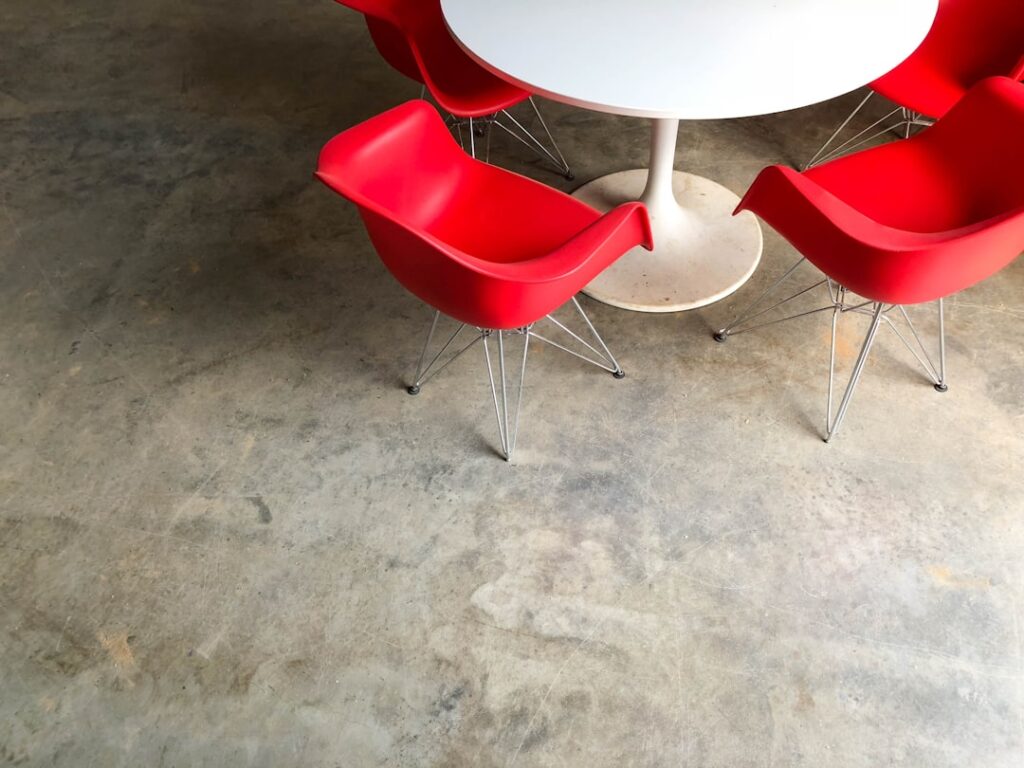
Polished concrete is the defining floor of modern lofts and minimalist kitchens, yet almost nobody who wants the look actually wants the slab — cold, hard, crack-prone, and a genuine project to grind and seal. Concrete-look vinyl, marketed overseas as concrete effect vinyl flooring, has become the practical substitute: luxury vinyl tile printed with cement visuals that installs in a day, stays warm underfoot, and shrugs off water. The category has matured fast, and the gap between a convincing mineral-matte surface and an obvious gray plastic rectangle comes down to a handful of specs. Here is how to buy the good stuff.
- What Concrete-Look Vinyl Actually Is
- Why Fake the Concrete Instead of Polishing the Real Thing
- Formats: Large-Format Tile, Plank, and Sheet
- Wear Layer and Core Specs That Matter
- Getting a Look That Reads as Real Concrete
- Where It Works Best (and Where It Doesn’t)
- What Concrete-Look Vinyl Costs
- Buying Checklist
What Concrete-Look Vinyl Actually Is
Underneath the visual, this is standard luxury vinyl construction: a printed décor film carrying a high-resolution cement image, a clear polyurethane-coated wear layer on top, and a core below — flexible PVC in glue-down products, rigid stone-polymer composite (SPC) or wood-polymer composite (WPC) in click-together planks and tiles. The photographic layer reproduces trowel marks, aggregate shadows, subtle mottling, and the faint color drift that makes real concrete visually alive.
Format is where concrete visuals differ from wood-look vinyl. Because concrete has no planks in nature, the most convincing products come as large-format tiles — 12 by 24, 18 by 36, even 24 by 48 inches — that mimic saw-cut panels, or as sheet vinyl with no seams at all. Plank-shaped concrete visuals exist and install easily, but the repeating plank seams undercut the monolithic look most buyers are chasing.
Why Fake the Concrete Instead of Polishing the Real Thing
Grinding and polishing an existing residential slab costs $3 to $8 per square foot, assumes the slab is sound and crack-free, and produces a permanently hard, cold surface that demands area rugs to live with. Upstairs rooms and wood-framed floors cannot take a real cement topping without engineering gymnastics; a self-leveling overlay adds 10 to 15 pounds per square foot, while vinyl adds roughly one.
Vinyl sidesteps every one of those constraints. It installs over wood subfloors, old vinyl, and imperfect slabs; it is warm enough for bare feet in January; dropped glassware usually bounces; and a cracked slab underneath stays invisible above. You surrender the genuine article’s depth and its century-long lifespan — vinyl is a 10-to-25-year floor — but for most homes the practical wins are decisive.
Formats: Large-Format Tile, Plank, and Sheet
Match the format to the room and the installer:
- Click-lock SPC tiles: The DIY favorite. Rigid cores bridge minor subfloor flaws, and 12-by-24-inch or larger formats float over underlayment with no adhesive. Best all-around choice for kitchens, basements, and living areas.
- Glue-down LVT: Thinner (2 to 3mm), cheaper per square foot, and the most stable under rolling loads and furniture. Requires a flat, properly prepared substrate and is the standard commercial spec.
- Sheet vinyl with cement visuals: Seamless in rooms under 12 feet wide, fully waterproof as a surface, and the budget leader — though visuals lag behind premium LVT and repairs mean patching.
Groutable vinyl tiles also exist for buyers who want defined joint lines; most concrete-look installations skip grout and butt tiles tight for the monolithic modern read.
Wear Layer and Core Specs That Matter
Wear layer thickness, measured in mils, is the single best predictor of how long the visual survives. Twelve mil suits bedrooms and low-traffic rooms, 20 mil is the sweet spot for busy family kitchens and pets, and 22 to 28 mil crosses into light-commercial territory. Beneath the number, insist on a urethane finish with ceramic bead or aluminum oxide reinforcement — that coating, not the PVC, is what resists micro-scratching that dulls a matte cement visual into a scuffed one.
Core choice shapes comfort and stability. SPC cores are dense and dimensionally stable through temperature swings, ideal for sunrooms and slab-on-grade rooms with big windows; WPC cores are thicker, softer underfoot, and quieter, at a premium of roughly $0.50 to $1 per square foot. Total thickness of 5mm to 8mm with an attached acoustic pad covers most residential situations well. Check the indentation rating if you have heavy furniture — cheap thin cores dent under a loaded bookcase leg and never recover.
Getting a Look That Reads as Real Concrete
Realism lives in three details. First, pattern repeat: concrete’s charm is randomness, so a décor that prints only four unique tile faces betrays itself across a 20-foot room. Ask how many unique visuals the line includes and dry-lay a dozen pieces before installing. Second, finish: genuine polished concrete sits between dead-matte and a soft satin; high-gloss vinyl reads as laminate countertop, not cement. Third, edges: for a monolithic look choose square, micro-bevel-free edges and tight seams, or go the other direction deliberately with grouted joints imitating saw-cut panels.
Color strategy deserves a moment too. Pale greige and warm putty tones hide dust and water spots far better than dark charcoal, which shows every footprint the way a black car shows pollen. Mid-tone gray with visible mottle is the most forgiving daily driver, and it flatters both warm wood cabinetry and stark white walls — half the reason the concrete look works in so many interiors.
Where It Works Best (and Where It Doesn’t)
Basements are the killer application. Below-grade slabs rule out laminate and most hardwood, while SPC concrete visuals are unbothered by slab moisture within reason and make low-ceilinged spaces feel intentionally industrial. Kitchens, laundry rooms, and full bathrooms follow close behind, since surface water is a non-event and the aesthetic suits hard-working rooms. Open-plan main floors benefit from running one continuous visual with no transitions, something large-format vinyl does more affordably than tile.
Skip it in rooms with floor-to-ceiling southern glass unless the product carries a high heat-stability rating — dark visuals under direct sun can exceed floating-floor temperature limits and cause expansion issues. Screened porches and unconditioned spaces void most warranties outright. And if resale value in a luxury market is the goal, note that appraisers still count vinyl as vinyl, however handsome the print.
What Concrete-Look Vinyl Costs
Material runs $2 to $4 per square foot for solid mid-range SPC with a 20 mil wear layer, $4 to $7 for premium lines with large formats and low pattern repeat, and $1 to $2.50 for sheet goods and thin glue-down tiles. Professional installation adds $1.50 to $3.50 per square foot for click-lock floating floors and $2 to $4.50 for glue-down work, where substrate prep is the wildcard — skim-coating a rough slab can add $1 to $2 per square foot on its own.
A realistic all-in budget for a 250-square-foot kitchen lands between $900 (DIY, mid-range material) and $2,800 (installed premium product). Compare that with $2,500 to $4,500 to grind and polish a same-size slab that may not even be pollable, and the value case is plain. Concrete effect vinyl flooring also amortizes gently: when the style cycle moves on in 15 years, replacing a floating floor is a weekend, not a demolition.
Buying Checklist
- Choose large-format tile or sheet for the truest concrete read; accept planks only for easy handling.
- Specify a 20 mil wear layer minimum for main living areas, with a ceramic-bead urethane finish.
- Confirm at least 8 to 10 unique décor faces per carton and a matte-to-satin sheen.
- Match core to conditions: SPC for slabs and sun, WPC for comfort upstairs.
- Buy 10 percent overage from matching lot numbers, and keep two spare tiles for repairs.
- Verify warranty terms for pets, sunlight, and commercial use if any apply to you.
Get those six items right and the floor delivers exactly what the loft photos promised — the cool, seamless calm of cement with none of the cold, the cracks, or the concrete truck.