Every peeling epoxy floor, every failed overlay, every coating that let go in sheets shares one ancestor: a slab that never got mechanically profiled. A concrete grinder is the tool that fixes that — diamond segments abrading the surface to remove sealers, level high spots, erase mastic, and open the pores so the next product can actually bond. The category spans a $40 attachment for the angle grinder you already own up to 700-pound planetary machines, and choosing the right class for the job matters more than brand. Here’s how the types break down, what renting costs, and the technique and dust-control rules that keep the work safe.
Part of our Epoxy, Concrete & Garage Floors guide — explore the full guide →
- Handheld Grinders: The Spot-Work Champions
- Walk-Behind Machines: Floors at Scale
- Diamond Tooling: Grit and Bond in One Minute
- Rental Costs and What Jobs Cost
- Silica Dust: The Part You Cannot Skip
- Technique for a Flat, Even Grind
- A Worked Example: Prepping a Two-Car Garage
- Buying Instead of Renting
- Grinder, Scarifier, or Just a Sander?
Handheld Grinders: The Spot-Work Champions
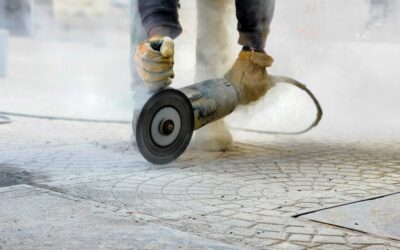
A 4 1/2- or 7-inch angle grinder fitted with a diamond cup wheel ($25–$60) handles the small stuff: grinding down a trip lip at a sidewalk joint, smoothing a patched spot, dressing form marks off a wall, easing a high corner before flooring goes down. A 7-inch grinder with a turbo-row cup wheel removes material shockingly fast — figure a square foot per minute of aggressive stock removal. The mandatory companion is a dust shroud ($30–$80 from DeWalt, Bosch, or Diablo) hooked to a vacuum, both because the dust cloud is otherwise blinding and because OSHA’s silica rules effectively require it. Handhelds are miserable for whole floors, though; grinding a 400 sq ft garage on your knees with a 7-inch wheel is a full brutal day and the finish will be wavy. Their natural ceiling is about 25 to 50 square feet.
Walk-Behind Machines: Floors at Scale
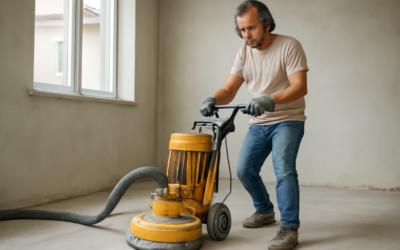
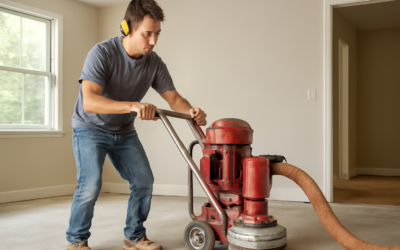
Whole-floor work belongs to walk-behind grinders. Rental fleets carry two tiers. Single-disc rotary grinders (Edco style, 10–11 inch) are the budget workhorse — fine for cleaning up laitance and light coatings. The better tier is the planetary grinder, where three or four smaller diamond heads spin inside a rotating carrier: flatter results, faster removal, and swappable tooling that runs from 16-grit metal-bond segments for coating removal up through resin pads for actual floor polishing. Machines like the Husqvarna PG 280 or Lavina 20 are what the one-day-floor pros run. Two specialty cousins round out the family: edge grinders for the 4 inches next to walls that big machines can’t reach, and scarifiers — flailing carbide cutters, not diamonds — for thick mastics and 1/8-inch-plus removal jobs where grinding would take all week.
Diamond Tooling: Grit and Bond in One Minute
Tooling determines results more than the machine does. Grit works like sandpaper: 16–30 grit for coating removal and heavy stock, 60–80 to profile for epoxy (the CSP-2 surface coating manufacturers spec), 120+ heading toward polish territory. Bond runs opposite to intuition — hard concrete needs soft-bond diamonds that wear and expose fresh grit, while soft or rain-damaged concrete needs hard-bond tooling that doesn’t wear away in an hour. Tell the rental counter your slab’s age and hardness and take their bond advice; running the wrong bond either glazes the diamonds (no cutting, lots of frustration) or eats $150 of tooling by lunch.
Rental Costs and What Jobs Cost
Expect these numbers at Home Depot Tool Rental, Sunbelt, or United: a 7-inch grinder with shroud, $40–$60 per day; single-disc walk-behind, $90–$150 per day; planetary walk-behind, $150–$300 per day plus diamond tooling wear charges of $50–$150; scarifier, $100–$200 per day. Add a HEPA dust extractor at $50–$90 per day — not optional. A DIY garage grind (two-car, ~450 sq ft) therefore runs $250–$450 in rentals for a weekend, versus $1–$2 per sq ft to hire the grinding out. If the goal is a full grind-and-coat or polished floor, pro pricing starts making sense fast; if the goal is prep for a coating you’re applying yourself, the rental math wins.
Silica Dust: The Part You Cannot Skip
Grinding concrete generates respirable crystalline silica, and long-term exposure causes silicosis — a progressive, incurable lung disease. This is why OSHA’s Table 1 rules exist, and homeowners should follow the same playbook:
- Run every grinder under a shroud connected to a HEPA dust extractor with auto filter cleaning — a shop vac with a bag and HEPA filter is the DIY floor minimum
- Wear at least an N95, preferably a P100 respirator, plus eye and hearing protection
- Wet grinding suppresses dust too, but creates slurry you must vacuum and dispose of — never hose it into storm drains
- Seal off doorways with plastic when grinding indoors; the fines travel the whole house otherwise
Technique for a Flat, Even Grind
Keep the machine moving — a grinder parked in one spot for three seconds digs a dish you’ll see through every coating. Work in overlapping side-to-side passes, covering the floor in one direction, then make the second pass perpendicular to the first, exactly like mowing a lawn in a crosshatch. Let the machine’s weight do the cutting; leaning on it stalls the diamonds and glazes them. On handheld work, keep the cup wheel at a 5- to 10-degree angle and feather the edges of the ground area so repairs blend. Check progress with the palm of your hand and a straightedge, not your eyes, and vacuum between passes so you can see what’s actually happening. Test any pre-1980 resilient flooring mastic for asbestos before touching it with a grinder — that’s a lab test and, if positive, an abatement job, full stop.
A Worked Example: Prepping a Two-Car Garage
Here’s how the pieces assemble on the most common DIY grinding job. Saturday morning: clear the garage completely, degrease oil spots with a poultice or degreaser and rinse (grinding smears oil deeper if you skip this), and let it dry. Pick up a planetary grinder with 30/40-grit metal-bond tooling matched to your slab hardness, an edge grinder or 7-inch handheld with shroud, and a HEPA extractor. Grind the field in overlapping passes — a 450 sq ft floor takes 2 to 4 hours of machine time — then do the perimeter and around the water heater with the handheld. Vacuum everything, check the profile (the surface should feel like 80-grit sandpaper and a water drop should soak in within a minute), patch cracks and spalls, and vacuum again. Sunday is coating day. Total rental outlay lands around $350; the alternative — coating over an acid-etched, steel-troweled slab — is how you buy the same weekend again in two years, plus the cost of removing failed epoxy.
Buying Instead of Renting
Ownership makes sense at the handheld tier and almost never above it. A 7-inch variable-speed grinder-polisher ($150–$250), a dust shroud, and an assortment of cup wheels covers a lifetime of trip-lip grinding, patch dressing, and small prep jobs — and doubles for stone and tile work. Walk-behind machines cost $3,500–$15,000 plus tooling, need 220V power in many cases, and sit idle 360 days a year in a homeowner’s garage; that’s what rental fleets are for. The middle case is the serial renovator: if you’re polishing or coating floors in multiple properties, a used single-disc machine at $1,000–$2,000 pays off around the fourth floor. Whatever you run, buy tooling fresh per job rather than hoarding worn segments — diamonds are consumables, and dull tooling turns a 3-hour grind into an 8-hour one.
Grinder, Scarifier, or Just a Sander?
Match aggression to the task. Thin sealers, light adhesive residue, and profiling for coatings: grinder. Thick mastic, traffic coatings, more than 1/8 inch of removal: scarifier first, grinder to finish. Smoothing drywall-mud-level residue or scuffing a sound sealer between coats: an orbital sander with 60-grit won’t touch concrete itself but handles surface films. And if the actual problem is a sunken slab rather than a rough one, no amount of grinding fixes grade — that’s a leveling job, not a grinding job. Used within its lane, a concrete grinder turns the worst slab in the house into a substrate any coating will grip for a decade.