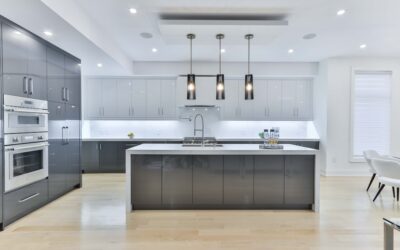
Corners are the most underused real estate in any kitchen, and the wrong cabinet there wastes 40 percent of the available cubic feet. A well-designed corner kitchen pantry turns that dead zone into the most-used storage in the room. The decisions that matter come down to layout, mechanism (rotating, swing-out, or pull-out), interior height, and how you intend to organize what goes inside.
Part of our Kitchen Remodeling guide — explore the full guide →
- The Three Layouts That Actually Work
- Lazy Susan vs Swing-Out: Pick the Right Mechanism
- Interior Dimensions That Matter
- Door Style and Hardware Considerations
- Walk-In Corner Pantry Design
- Lighting Inside Corner Pantries
- Organization Inside the Pantry
- Cost Breakdown for Common Pantry Setups
- Frequently Asked Questions
The Three Layouts That Actually Work
A 45-degree angled pantry sits diagonally across the corner with a single tall door, often 24 to 30 inches wide. It is the most spacious option (typically 36-by-36 inches of footprint) and offers full-depth shelves all the way to the back wall. Downside: it consumes more wall length than a 90-degree pantry.
A 90-degree blind corner pantry uses two perpendicular cabinet runs that meet in the corner. Without a smart mechanism, the back becomes inaccessible. With a lazy Susan, swing-out, or magic corner pullout, you can use the full volume.
The third option is a walk-in corner pantry built into a chase or framed nook. These run 4-by-4 feet to 5-by-7 feet and offer the most storage at the highest cost ($3,500 to $12,000 depending on finish level).
Lazy Susan vs Swing-Out: Pick the Right Mechanism
A lazy Susan rotates 360 degrees and is the simplest, cheapest option. Modern versions from Rev-A-Shelf and Hafele have soft-close, two- or three-tier wire baskets, and run $80 to $300. They work best for canned goods, small jars, and items you can identify by their tops.
Swing-out and magic corner mechanisms (Hafele LeMans II, Kessebohmer, Blum) cost $400 to $900 but bring shelves out to the front of the cabinet so you can see and reach everything. They handle larger items (cereal boxes, bags of rice) and are the better choice for serious cooks. Test the action in a showroom before buying; some swing-outs require two hands and feel awkward.
Interior Dimensions That Matter
For a tall corner pantry, aim for 84 to 96 inches of interior height. That gives you 8 to 12 shelves at 8-inch spacing, with two of them taller (12 to 14 inches) for cereal boxes and large kitchen appliances. Adjustable shelving on 32mm euro-spaced pegs is non-negotiable; needs change over time.
Shelf depth should be 11 to 13 inches for visibility. Anything deeper and items in the back disappear. If you need more capacity, go with two shelf rows of different depths rather than one deep shelf.
Door Style and Hardware Considerations
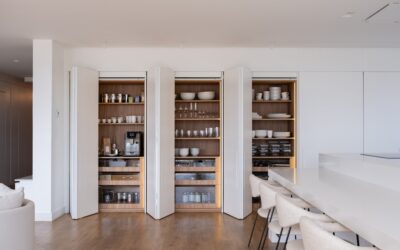
A bi-fold door (two narrow panels hinged together) is common on 45-degree pantries. It folds out of the way and clears traffic flow. A single full-height door looks cleaner but swings into the kitchen and can block walkways. Pocket doors are an elegant solution but require deeper cabinet construction and add $300 to $600 in hardware.
Soft-close hinges (Blum or Salice) are standard on quality cabinetry now and prevent slamming. For a corner pantry door over 24 inches wide, use four hinges instead of three to prevent sagging over time.
Walk-In Corner Pantry Design
If you have the floor space, a walk-in corner pantry is the single best storage upgrade in a kitchen. Plan for 36 to 42 inches of interior width minimum so you can stand inside with the door closed. Three walls of shelving from floor to ceiling provides 60 to 90 linear feet of shelf space in a 5-by-5 footprint.
Add a counter at 36 inches with an outlet for a coffee maker, microwave, or stand mixer. Pull the small appliances out of your main kitchen and you reclaim a meaningful amount of counter space.
Lighting Inside Corner Pantries
The biggest complaint about any corner kitchen pantry is dark interiors. LED puck lights or a battery-powered motion-sensor strip from Brilliant Evolution or Mr. Beams ($25 to $60) solves it instantly. For hardwired solutions, look at door-activated puck lights wired to a single switch in the cabinet box.
Color temperature should be 3000K to 4000K so labels read accurately. Avoid yellow 2700K bulbs in pantries; they distort food colors.
Organization Inside the Pantry
Empty shelves waste vertical space. Add risers or step shelves so cans behind cans are visible. Clear airtight containers (OXO Pop or Rubbermaid Brilliance) standardize package sizes and pull together a chaotic shelf in five minutes. Use shelf liners to prevent staining and make cleanup faster.
Group items by use, not type: a baking zone (flour, sugar, baking powder, vanilla), a breakfast zone (cereal, oatmeal, granola), a snack zone, and a dinner zone. The organization mimics how you actually cook and saves real time.
Cost Breakdown for Common Pantry Setups
A 36-inch blind corner cabinet with a basic lazy Susan, in stock cabinetry from Home Depot or Lowe’s, runs $400 to $700. A semi-custom 45-degree corner pantry with a swing-out mechanism and quality finish from KraftMaid or Schrock costs $1,800 to $3,500. A custom 36-by-84-inch corner pantry with motion lighting, drawer banks, and high-end interior fittings from a local cabinetmaker is $4,500 to $7,500.
A walk-in pantry framed into a kitchen remodel adds $3,000 to $12,000 depending on whether you include outlets, lighting, and millwork.
Frequently Asked Questions
What is the best corner kitchen pantry layout?
For most kitchens, a 45-degree angled pantry with a swing-out mechanism gives the best balance of storage capacity and accessibility without dedicating a lot of floor space.
How deep should a corner pantry be?
Interior shelves should be 11 to 13 inches deep for good visibility. Walk-in corner pantries can go 18 to 24 inches deep if combined with pullout shelves or step risers.
Are lazy Susans outdated?
No, but the old wood ones with no sides are. Modern lazy Susans with full bottoms, raised edges, and soft-close mechanisms are still a smart, budget-friendly choice for many kitchens.
Can I add a corner pantry to an existing kitchen?
Yes. Replacing a blind corner base or wall cabinet with a corner pantry is a single-cabinet swap if dimensions match, or a small framing project if you are converting a closet or nook.