Stuffing a pantry into the corner beside a refrigerator looks like obvious storage gold on the floor plan — until the pantry door collides with the fridge door and you can not reach the back shelf. A properly executed corner pantry next to fridge layout takes more planning than a row of base cabinets because four geometries have to coexist: pantry door swing, fridge door swing, walking clearance, and visual sightlines into both. Get the door arc and depth right and you gain the most useful 12 square feet in the kitchen. Get it wrong and you create the most frustrating corner in the house.
Part of our Kitchen Remodeling guide — explore the full guide →
Why the Layout Works (When It Works)
Pairing the pantry with the refrigerator creates a single food-storage zone — cold and dry storage within two steps of each other. National Kitchen and Bath Association (NKBA) guidelines support this zoning because it shortens grocery unloading trips and groups like-with-like for retrieval.
The fridge wall typically becomes the deepest cabinet wall, since a counter-depth fridge runs about 24 inches deep and a standard fridge 30 to 36 inches deep. A 24-inch deep pantry tucks into the corner alongside without creating a jutting bump-out, especially if cabinets above the fridge are also pulled forward to 24 inches.
Minimum Clearance Requirements
NKBA Kitchen Planning Guideline 6 specifies a minimum 42 inches of clear walkway in a single-cook kitchen and 48 inches in a two-cook kitchen. Measure from the front face of the fridge handle (when closed) to the opposite cabinet face or wall.
Pantry door swing is the second clearance to plan. A standard 24-inch pantry door swings through 24 inches of arc. The fridge door, hinged on the side away from the pantry, swings 90 degrees minimum. Walk the layout in tape on the floor before ordering cabinets — many homeowners discover that a hinge-left fridge has to swap to hinge-right to avoid conflict with the pantry.
Walk-in vs Reach-in Configurations
A walk-in corner pantry needs at least 4×4 feet of footprint to be usable, with 24 inches of clear floor space inside and shelves on two walls. The third wall (entry) has the door. Walk-ins shine in larger kitchens because they hold a Costco haul comfortably and let you close the door on visual clutter.
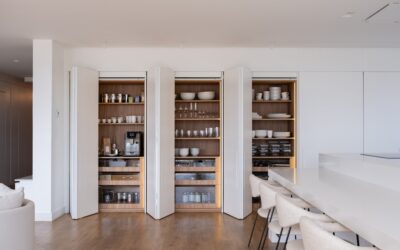
A reach-in corner pantry is a 24-inch deep cabinet with bifold or French doors and pull-out shelves. It uses 6 to 9 square feet of floor and is far easier to retrofit into an existing kitchen than a walk-in. Brands like Diamond, KraftMaid, and Decora all offer corner pantry units in the $1,200 to $2,800 range.
Shelf Depths That Actually Work
The biggest pantry mistake is shelves that are too deep. A 16-inch shelf swallows two cereal boxes deep, and the back box is forgotten until it expires. Better proportions:
- Top shelves (least accessible): 8 to 10 inches deep for canned goods and small jars.
- Eye-level shelves: 12 inches deep for boxes and bottles.
- Lower shelves: 14 to 16 inches deep for appliances and bulk bags.
- Floor area: Reserve 18 to 24 inches for water cases, dog food, and recycling bins.
Adjustable shelf pins (5mm metal) let you reconfigure as your shopping habits change. Pull-out wire baskets from Rev-A-Shelf or Hafele add accessibility for under $80 per drawer.
Door Style Choices
A single 24- or 30-inch hinged door is the simplest solution. It can hold a full-length mirror or chalkboard on the inside and clears the fridge swing easily on the right configuration.
French double doors (two 15-inch leaves) cut the swing radius in half — useful in tight kitchens. Pocket doors slide into the wall cavity and are the ultimate space-saver but require 5 inches of stud cavity for the hardware, plus careful planning around electrical and plumbing.
Barn doors look stylish but rarely seal well, letting kitchen humidity and odors into stored food. Skip them for pantry use unless you commit to a dehumidifier inside the pantry.
Lighting the Pantry
Walk-in pantries should have a dedicated overhead fixture, ideally a flush-mount LED with a motion sensor switch like the Lutron Maestro MS-OPS2 ($28 at Home Depot). Reach-in pantries benefit from LED strip lights on the underside of each shelf — Philips Hue Lightstrip or Lutron Caseta-compatible strips with a magnetic reed switch trigger when the door opens.
Choose 3000K to 3500K bulbs for accurate food color identification. Avoid 5000K daylight bulbs in pantries; they make produce look stale.
Pairing with the Fridge Itself
The fridge choice affects pantry design. Counter-depth fridges (KitchenAid KRFC704FPS, GE Profile Series, Samsung Bespoke) project only 1 to 2 inches past adjacent cabinet faces, making the pantry-fridge corner look intentional rather than cluttered.
Standard-depth fridges save $400 to $1,200 over counter-depth equivalents but project 6 inches past cabinets, making any pantry next to them look recessed. Plan an end panel on the fridge side at full depth, or skip the corner pantry next to fridge layout in favor of a separate pantry wall.
Organizing the Interior
Even the best pantry geometry fails without organization. Decant pasta, rice, flour, and cereal into clear OXO POP containers, Mason jars, or IKEA 365+ canisters — uniform containers double visible storage by eliminating bag bulk.
Use risers for canned goods to see the back row at a glance. Lazy Susans (mDesign or Copco, $15 to $35 each) work for oils, vinegars, and spice jars. Label everything with a Brother P-Touch or chalk-ink marker — the household member who did not put it away has to find it.
Cost to Build a Corner Pantry
Adding a reach-in corner pantry unit during a kitchen remodel runs $1,400 to $3,600 including the cabinet, pull-outs, and trim. A walk-in pantry built into existing space (stealing a coat closet, for example) runs $2,500 to $6,500 with framing, drywall, electrical, and shelving.
The ROI is hard to measure on resale, but real estate agents consistently rate “good pantry storage” among the top three kitchen features buyers ask about in 2026 listings. Build the pantry that fits your daily cooking, not the one that scores best on Pinterest.