Walk into any kitchen showroom and you will find a wall of beautifully styled boxes that all face forward. Then there is the awkward inside corner, where two cabinet runs meet at 90 degrees and 12 cubic feet of storage hangs in the balance. The right corner unit cabinet turns that dead zone into one of the most useful spots in your kitchen. The wrong one becomes a black hole where you lose a Crockpot for three years. Picking between a lazy Susan, a blind corner with pull-outs, or a diagonal pie-cut comes down to budget, base cabinet depth, and how much you hate crawling on the floor.
Part of our Kitchen Remodeling guide — explore the full guide →
The Four Main Corner Configurations
Manufacturers build corner cabinetry in four distinct ways, each with different access and storage trade-offs:
- Diagonal corner (pie-cut): Cabinet face sits at 45 degrees, opens with one big door, often holds a lazy Susan
- Blind corner: One side runs into the other, the back of the cabinet is hidden behind the adjacent run
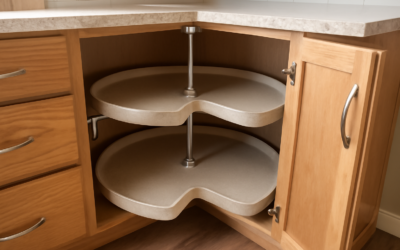
- L-shaped lazy Susan: Two doors meet at the corner, hinged together, spinning shelves inside
- Super Susan or Magic Corner: Pull-out hardware swings shelves out of a blind corner into reach
Diagonal units eat 36 to 39 inches along each adjacent wall and need a minimum 36-by-36-inch footprint. Blind corners use just 24 inches of one wall and overlap behind, making them better for small kitchens.
Standard Sizing You Will Encounter
Base cabinets run 34.5 inches tall before the countertop, with most corner units at 36, 39, or 42 inches wide on each face. Wall corner cabinets are typically 24 inches square or 24-by-30 inches. Depth stays at 24 inches for base and 12 inches for wall.
If you are working with a 10-by-10 kitchen, expect at least one corner unit cabinet on the base and one in the wall section. KraftMaid, Merillat, and Wellborn all publish corner sizing in 3-inch increments to match standard frame layouts. Custom shops will tweak to 1-inch precision but charge a 25 to 40 percent premium for the privilege.
Lazy Susan vs Pull-Out Hardware
A lazy Susan is two stacked round shelves that spin on a center pole, accessible from a 36-inch diagonal door. Rev-A-Shelf and Hafele both sell replacement Susans from $89 to $240, with kidney-shaped versions that hug the cabinet walls better than full circles. The trade-off is wasted space at the corners of the cabinet box and items falling off the back of the shelves.
Pull-out hardware like the Blum LeMans II or Kessebohmer Magic Corner extends shelves out of a blind corner so you can see and reach everything. Expect to pay $380 to $720 for the hardware alone, plus installation labor of about 90 minutes per unit. Worth it if you are tall, have bad knees, or hate kneeling on tile.
Brand Pricing at a Glance
Costs vary widely by cabinet line and door style. Here is a representative range for a 36-inch diagonal base corner with a Susan:
- IKEA SEKTION: $245 to $310, requires assembly, decent quality particleboard
- Home Depot Hampton Bay: $389 to $499 in-stock
- Lowe’s Diamond Now: $419 to $589
- KraftMaid (Lowe’s special order): $649 to $1,150
- Merillat Classic: $585 to $980
- Wellborn semi-custom: $720 to $1,400
- Local custom shop: $1,100 to $2,200
A wall corner unit cabinet runs roughly 40 to 50 percent of the base price. Add another $180 to $440 if you upgrade the susan to soft-close, Blum hinges, or a Magic Corner pull-out.
Installation Considerations
Hanging a corner cabinet requires careful framing. The wall studs need to land in places that allow the cabinet to be screwed solidly, which sometimes means adding a 2×6 ledger in the wall during framing. If you are remodeling, open the drywall and add blocking before the rock goes back on.
For base units, level the box on shims before screwing it to the wall. A 36-inch diagonal weighs roughly 90 pounds empty and will pull out of the wall under load if you skip the ledger. Use #10 by 3-inch construction screws into studs, not drywall anchors, and put a screw every 16 inches.
What Fits Inside, Realistically
A typical 36-inch lazy Susan base holds about 6 cubic feet of usable storage. That works out to:
- Two stockpots up to 12 inches diameter
- A Crockpot, blender, and stand mixer base
- Or roughly 30 dinner plates plus 24 cereal bowls on the upper shelf
Blind corners with pull-outs hold about 4 cubic feet of accessible storage despite a larger total interior. The extra inaccessible space behind the adjacent run swallows whatever falls back there, which is why most builders avoid blind corners without pull-out hardware.
Avoiding the Common Mistakes
The biggest installation error is forgetting filler strips. A corner unit cabinet sits between two perpendicular runs, and your countertop, doors, and adjacent cabinets all need clearance to open without binding. Use a 3-inch filler on at least one side, sometimes both. Without it, the lazy Susan door clips the dishwasher handle every time you open it.
Another mistake is sizing the corner for a small Susan in a big footprint. If you have 39 inches available on each side, use a 39-inch unit with a 32-inch kidney Susan rather than a 36-inch unit with a 28-inch round. The extra storage is free; the larger cabinet costs maybe $40 more.
When to Skip the Corner Entirely
If your kitchen is over 200 square feet and you have a separate pantry, you can frame out the corner with a small dead box behind the cabinet faces and gain a tiny amount of broom-closet space accessed from the back. Some designers also turn corners into open shelving displays for cookbooks and decorative pieces. That works in modern and farmhouse kitchens but eats real storage.
For most kitchens, though, a properly sized corner unit cabinet with the right hardware is the single best storage upgrade you can make. Spend the extra $300 on a soft-close Magic Corner if your budget allows; you will not regret it on day one or year ten.