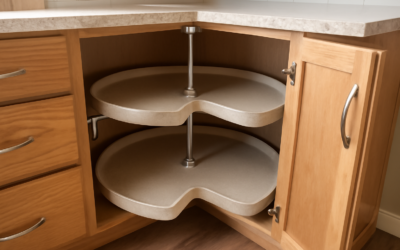
Corner carousels are great until a shelf cracks, the pole slips or the spinning stops and every can lands in the back of the cabinet. At that point the question becomes whether to repair it or pull it out and put in something better. Knowing how to remove a lazy susan depends on how it is mounted: pole-mounted units come out by collapsing the center pole, while shelf-mounted units unscrew from fixed shelves inside the cabinet.
The basic process is the same for most units. Empty the cabinet, remove or tape back the doors if they are attached to the carousel, identify the mounting style, release the pole or remove the screws holding each tray, and work the shelves out through the door opening one at a time. Plan for 30 minutes to an hour, plus extra time if the trays are larger than the opening and need to be tilted or partly disassembled.
- How to Remove a Lazy Susan: Identify the Type
- Tools You Will Need
- Step 1: Empty the Cabinet and Handle the Doors
- Step 2: Remove a Pole-Mounted Lazy Susan
- Step 3: Remove a Shelf-Mounted Lazy Susan
- Step 4: Handle Oversized Trays
- Step 5: Clean and Inspect the Corner
- What to Put in Its Place
- Troubleshooting
- Cost and Time
- When to Call a Pro
- Frequently Asked Questions
Removing a carousel also opens up options. You can replace it with an identical unit, convert the space to fixed shelves, or install a blind corner cabinet pull out that uses more of the corner.
How to Remove a Lazy Susan: Identify the Type
Open the cabinet and look at the center of the trays and above the top shelf with a flashlight.
- Pole-mounted lazy susan. A metal or plastic pole runs from the cabinet floor to the ceiling of the cabinet through the center of each tray. Brackets at the top and bottom hold the pole, and the pole is usually adjustable in length with a spring, a set screw or a threaded section.
- Shelf-mounted lazy susan. Each tray sits on its own bearing or turntable, screwed to a fixed shelf in the cabinet. No center pole.
- Kidney-shaped carousel. Trays with a curved notch, used in L-shaped corner cabinets with bifold doors. Often pole-mounted.
- Pie-cut (D-shaped) carousel. Round trays with a quarter missing. The doors are often attached to the trays and spin with them, which adds a step to removal.
- Full round carousel. Complete circles that spin freely behind a standard or angled door.
Tools You Will Need
- Phillips and flat screwdrivers, or a drill/driver
- Adjustable wrench or a hex key set for pole set screws
- Flashlight or headlamp
- Utility knife for cutting caulk or paint around brackets
- Gloves to protect hands from sharp edges
- Painter’s tape and bags for screws
- Knee pad or folded towel, since much of the work is on the floor
Step 1: Empty the Cabinet and Handle the Doors
Clear every tray. Wipe out crumbs and spills so you can see brackets and screws. If the doors are on hinges attached to the cabinet frame, open them fully and, if they block access, remove them by releasing their hinges. Support each door as you remove it so it does not drop.
On pie-cut carousels, the bifold doors are typically screwed to the trays at the front. Look inside for screws through the tray edge into the back of the doors or for brackets connecting them. Remove those screws while a helper or a stack of books holds the doors, then lift the doors free. Label the doors with tape so they can go back on the same way if you reinstall the unit.
Step 2: Remove a Pole-Mounted Lazy Susan
- Find the adjustment. Look at the top of the pole. Many have a spring-loaded or telescoping section that shortens when pushed or twisted. Others have a set screw on a collar or a bolt through the top bracket.
- Release the pole. Loosen the set screw or bolt, or twist the pole to shorten it. A spring-loaded pole compresses when you push up on the pole while lifting the top tray.
- Free the top end. Once the pole is shorter, tilt the top away from the upper bracket. Some upper brackets are screwed to the cabinet ceiling and need removal first.
- Lift out of the bottom socket. Raise the pole slightly to clear the bottom pivot, then tilt the whole assembly forward.
- Work it out the door. Rotate the trays so the widest dimension aligns with the diagonal of the opening, and maneuver the unit out. If it will not fit, remove the trays from the pole first; most are held by a collar, clip or screw on the pole and slide off.
- Remove the brackets. Unscrew the top and bottom brackets from the cabinet.
Keep fingers clear of the spring section as you release it. Spring-loaded poles can extend suddenly.
Step 3: Remove a Shelf-Mounted Lazy Susan
- Start with the top tray. Spin it until you can see the screws holding the turntable bearing to the fixed shelf. Some units have access holes in the tray for this purpose.
- Remove those screws and lift the tray off. Some trays separate from the bearing first, leaving the bearing screwed to the shelf to remove separately.
- Repeat for the bottom tray.
- Decide whether to keep the fixed shelves. They are often part of the cabinet structure, so check whether they are screwed, dadoed into the sides or resting on cleats before removing them.
Step 4: Handle Oversized Trays
Original carousels are sometimes installed before the countertop or face frame, so they are larger than the door opening. Options include tilting the tray on edge and angling it out, removing the tray’s raised rim if it is a separate piece, or, as a last resort, cutting a damaged plastic or particleboard tray into pieces with a jigsaw. Wear eye protection and gloves when cutting, and only cut a tray you intend to replace.
Step 5: Clean and Inspect the Corner
With the carousel out, vacuum the cabinet floor, wipe surfaces and check for water damage from leaky plumbing or dishwashers nearby. Swollen particleboard or dark stains should be addressed before installing anything new. Fill old screw holes with wood filler if the new organizer will mount in different positions.
What to Put in Its Place
- A new lazy susan of the same type. Measure the cabinet interior, opening and height, and the original tray diameter. Pole-mounted replacements are the most common and easiest to fit.
- A blind corner pull-out. Swing-out or pull-and-glide shelving that brings items from the dead corner out through the door. Good for blind corner cabinets where a round carousel wastes space.
- Fixed shelves. Simple and cheap, but the back of the corner becomes hard to reach.
- Corner drawers. Requires a cabinet change and is a larger remodel.
Troubleshooting
- Pole will not shorten. Look for a set screw hidden under a cap or a locking collar under the top tray. Corrosion can seize threads; spray penetrating oil and wait.
- Screws spin without loosening. The particleboard is stripped. Pull up on the tray while unscrewing, or cut the screw head off with an oscillating tool.
- Doors are attached and heavy. Get a helper to hold them while the screws come out so they do not twist hinges or fall.
- The bottom bracket is under a cabinet floor panel. Some units anchor below a removable panel. Lift it to reach the screws.
Cost and Time
Removal itself costs nothing beyond a few minutes and basic tools. A replacement pole-mounted carousel typically costs $50 to $200 depending on size and materials, while blind corner pull-out systems can range from about $150 to several hundred dollars. A handyman or cabinet installer usually charges an hourly rate and can remove and replace a unit in one to two hours.
When to Call a Pro
Call a cabinet installer if the carousel will not come out without cutting the face frame, if the corner cabinet has structural damage, or if you are converting to a pull-out system that requires precise mounting. Knowing how to remove a lazy susan yourself saves the removal fee, and it gives you a clear look at the corner so you can choose the right organizer for the space.
Frequently Asked Questions
How do you remove a lazy susan with a pole?
Shorten the pole by loosening its set screw, twisting the telescoping section or compressing the spring, tilt the top away from the upper bracket, lift it out of the bottom socket and work the unit out the door.
Can I remove a lazy susan without taking off the doors?
Often you can if the doors are hinged to the cabinet frame and open wide. On pie-cut units the doors are attached to the trays, so they must be unscrewed first.
What if the lazy susan trays are too big for the door opening?
Tilt the trays on edge, slide them off the pole individually, or remove a separate rim. Cut a tray apart only if you plan to replace it.
What can replace a lazy susan in a corner cabinet?
A new carousel, a blind corner pull-out, fixed shelves or a corner drawer unit. Pull-outs make better use of blind corner cabinets.
How do I measure for a replacement lazy susan?
Measure the interior width and depth, the door opening and the interior height from floor to cabinet ceiling. Compare with the old tray diameter and the pole length range.