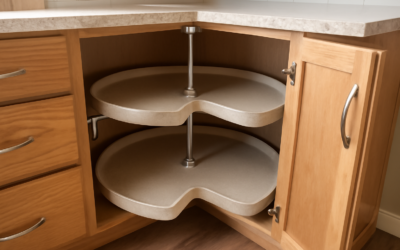
Corner cabinets hide a surprising amount of storage, and a worn-out lazy susan wastes most of it. Replacement trays are sold by diameter, shape and pole height, and the wrong combination either rubs the cabinet walls or catches the door every time it spins. Learning how to measure a lazy susan cabinet properly means checking four things: the door opening, the interior diameter, the door clearance and the height available for each shelf. With those numbers you can choose between a kidney, pie-cut, D-shape or full-round unit with confidence.
Plan on about 20 minutes. Empty the cabinet, pull out the old shelves if they lift off, and bring a flashlight, because corner cabinets are dark and awkward to measure.
How to Measure a Lazy Susan: Know Your Corner Cabinet First
Corner base cabinets come in a few common configurations, and each one suits a different tray shape.
- Diagonal corner (angled front): a single door across the corner at 45 degrees. These usually take a full-round or D-shape tray.
- L-shaped corner with bi-fold doors: two doors hinged together that open as a pair. The classic match is a pie-cut tray with a 90-degree notch, where the doors attach to the tray and spin with it.
- L-shaped corner with a single door: often fitted with a kidney-shaped tray, which has a scooped-out section that clears the door when it swings open.
- Blind corner: a cabinet that extends behind its neighbor with a narrow opening. Lazy susans rarely fit here; pull-out corner systems work better.
Look at the cabinet face and the old hardware before measuring. The shape of the existing tray tells you a lot about what the cabinet was designed for.
Tools You Need
- 25-foot tape measure
- Flashlight or headlamp
- Pencil and paper, or a phone for notes and photos
- Small level (to check whether the cabinet floor is flat)
- Screwdriver for removing the old center pole, if needed
Step-by-Step Measurements
1. Measure the door opening
Measure the width of the opening from the inside edges of the face frame. On L-shaped cabinets, measure each leg of the opening separately. On diagonal cabinets, measure straight across. The tray has to pass through this opening during installation unless it can be assembled inside the cabinet, so note the smallest width you find.
2. Measure the interior width and depth
Measure from the inside of the face frame to the back corner along each wall. Standard 36-inch corner cabinets have about 33 to 34 inches of interior width per wall. Measure at shelf height and at the floor, since back panels and plumbing can steal space.
3. Calculate the maximum diameter
The tray must spin without touching the walls, the back corner or the face frame. Measure the shortest distance across the cabinet in any direction where the tray will rotate, then subtract about 1 inch for clearance. For a typical 36-by-36-inch corner base, that usually means a 28-inch or 32-inch tray. Mark the center point where the pole will sit, and measure from it to the nearest obstruction; double that distance and subtract clearance to find the safe diameter.
4. Check door clearance
Close the door and measure how far the back of the door, hinges and any door-mounted hardware project into the cabinet. For a kidney tray, the notch must clear this projection with room to spare. For a pie-cut tray, the doors mount to the tray itself, so measure the door width and confirm it suits the tray’s notch.
5. Measure shelf heights
Measure from the cabinet floor to the underside of the countertop or the top rail of the face frame. Base cabinets usually offer 28 to 31 inches of interior height. Most two-shelf units use an adjustable pole, often ranging from about 22 to 30 inches. Decide how much space you want under the top shelf for tall items like cereal boxes or stockpots, and check the minimum and maximum pole height of the product.
6. Locate obstacles
Look for plumbing, gas lines, electrical boxes, dishwasher hoses or a sink drain in the corner. Corner sinks are common, and a lazy susan cannot spin through a P-trap. Measure where each obstacle sits relative to the center point.
Recording Your Numbers
Corner cabinets are awkward enough that it pays to write everything on a single sketch. Draw the cabinet from above as a simple L or angled shape, mark the center point where the pole will stand, and write each measurement next to the wall or opening it belongs to. Add the interior height, the door width and the hinge projection, then circle any obstacle such as a drain line or shutoff valve. Take a photo of the empty cabinet from the front and from each side, with the tape measure extended in the shot so the scale is obvious later.
Bring that sketch and the photos when you shop, or keep them open on your phone while comparing product listings. Specification sheets usually list overall diameter, the depth of the kidney scoop or pie cut, the pole height range and the weight rating per shelf. Comparing those figures directly against your sketch is the fastest way to rule out trays that will not fit, and it keeps you from relying on vague labels like “fits standard corner cabinets,” which can mean several different sizes.
Choosing a Shape and Size
- Full-round: best for diagonal cabinets with a single wide door. Usually 18 to 32 inches in diameter.
- Kidney: fits L-shaped cabinets with a hinged single door. The scoop clears the door. Common sizes are 24, 28 and 32 inches.
- Pie-cut: for L-shaped cabinets with bi-fold doors that ride on the tray. The 90-degree cut faces outward, and the doors fold into the notch.
- D-shape: a flat-front tray that sits behind a straight door on some corner and diagonal cabinets.
- Half-moon or swing-out: better suited to blind corners where a full lazy susan cannot spin.
A lazy susan cabinet organizer made of wood or polymer is the typical upgrade, and many have raised edges that keep jars from sliding off when the tray spins. Wood trays look more traditional; polymer trays clean up easily and resist spills.
Removing the Old Unit (for Measuring Accuracy)
Sometimes you cannot get clean measurements with the old tray in place. Most center-pole units release by unscrewing the top bracket under the countertop rail, then collapsing or lifting the pole. Some older units bolt to the cabinet floor. Remove the shelves, take out the pole, and measure the empty cabinet. Keep the old bracket screws, since they may fit the new hardware.
Watch your hands on sharp sheet-metal edges and on the pole spring if the unit is spring loaded. Pull it out slowly.
Troubleshooting Common Measurement Problems
The tray fits the cabinet but will not pass through the opening. Choose a model that assembles inside the cabinet, or a slightly smaller diameter. Some trays separate from the pole for this reason.
The tray rubs the face frame. The center point is off. Move the pole a little toward the back corner, or step down one size.
The kidney notch catches the door. Measure the door-plus-hinge projection again and look for a tray with a deeper scoop, or switch to a bi-fold door setup with a pie-cut tray.
The cabinet floor is out of level. Shim under the bottom bearing plate so the tray spins evenly. An uneven tray drifts and stops in awkward positions.
There is a sink in the corner. Use a half-moon or swing-out organizer that works around the plumbing, or skip the spinning tray entirely.
Cost Ranges
Basic polymer replacement trays are relatively inexpensive, while hardwood units and kidney or pie-cut sets with full hardware cost more. Premium swing-out and blind-corner systems sit at the high end. If you need new bi-fold doors to match a pie-cut conversion, budget for doors and hinges as a separate line item.
When to Call a Pro
Swapping a tray of the same shape and size is a straightforward DIY job. Bring in a cabinet installer if you need to cut or reframe the cabinet, convert from a single door to bi-fold doors, work around plumbing or gas lines, or replace a damaged cabinet floor. If you discover water damage or mold under the old tray, fix the leak first and have a plumber check the corner sink connections.
Once you know how to measure a lazy susan cabinet, the shopping part is easy: match the shape to the door style, pick the largest diameter that clears every obstruction by about 1 inch, and confirm the pole range fits your interior height. A well-sized tray turns a dead corner into some of the most useful storage in the kitchen.
Frequently Asked Questions
What size lazy susan fits a 36-inch corner cabinet?
A standard 36-by-36-inch corner base usually takes a 28-inch or 32-inch tray, depending on face frame width, hinge projection and any plumbing. Always measure the clearance from the center point to the nearest obstruction.
What is the difference between a kidney and a pie-cut lazy susan?
A kidney tray has a curved scoop that lets a hinged door swing past it. A pie-cut tray has a 90-degree notch, and bi-fold doors mount to the tray and rotate with it.
How much clearance does a lazy susan need?
Plan on about 1 inch of total clearance between the tray edge and the nearest wall, corner or face frame so the tray spins freely.
How do I measure the height for a lazy susan pole?
Measure from the cabinet floor to the underside of the top rail or countertop. Most two-shelf units have an adjustable pole, so confirm your measurement falls within the product’s range.
Can a lazy susan go in a blind corner cabinet?
Usually not, because the opening is too narrow for a full tray to spin. Swing-out or pull-out blind-corner organizers make better use of that space.