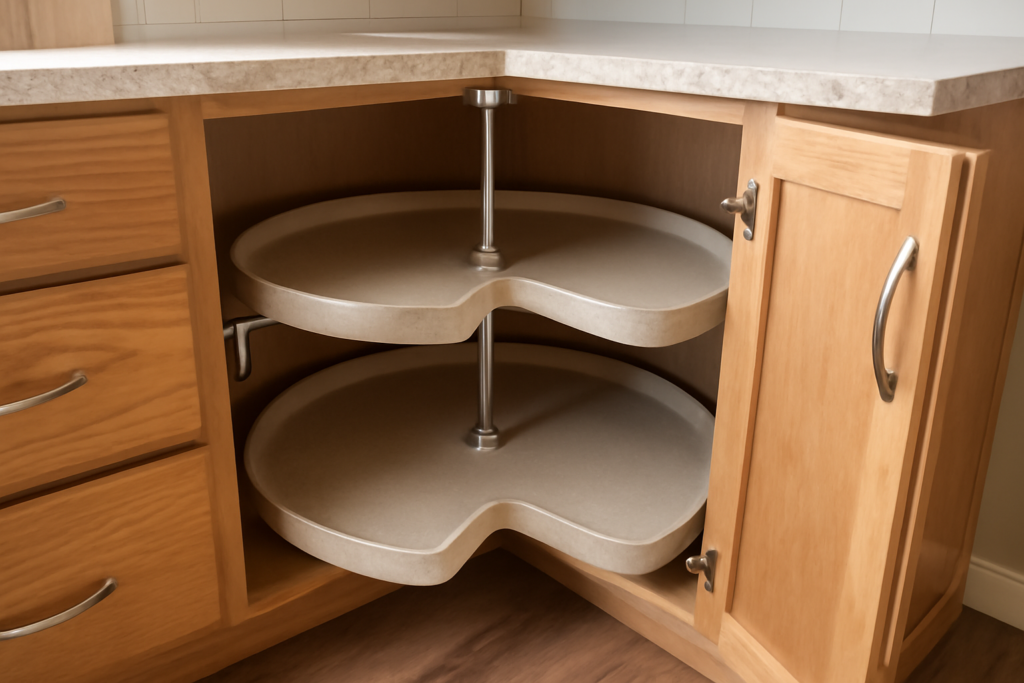
Corner cabinets are some of the most frustrating spaces in any kitchen, swallowing pots and cans into a dark, unreachable void. The right lazy susan cabinet hardware solves that problem by putting your items on a rotating shelf that spins everything to the front with a gentle turn. This guide covers the types, sizes, materials, and installation basics so you can turn wasted corners into some of the most useful storage in your kitchen.
Part of our Kitchen Remodeling guide — explore the full guide →
- What a Lazy Susan Does
- Types of Lazy Susans
- Materials and Build Quality
- Sizing Your Lazy Susan
- What It Costs
- Installation Guidance
- Retrofitting vs. Buying New Cabinets
- Upgrading Old Lazy Susans
- Weight Capacity and Smooth Operation
- Common Mistakes to Avoid
- Getting the Most from Your Corner
- The Bottom Line
What a Lazy Susan Does
A lazy susan is a rotating shelf system installed inside a cabinet, most often a corner base or upper cabinet. Instead of reaching blindly into the deep recesses of a corner, you simply spin the shelf and every item comes to you. The hardware consists of the rotating trays, a central spindle or bearing mechanism, and the mounting components that let it turn smoothly under load.
This simple concept dramatically improves accessibility. Corner cabinets that once held forgotten appliances now provide easy storage for pots, canned goods, baking supplies, or dishes. Because everything is visible and reachable with a turn, a lazy susan can be one of the most-used features in a well-organized kitchen.
Types of Lazy Susans
Several styles suit different cabinet configurations:
- Full-round: A complete circular tray used in cabinets with a bi-fold or single door and no center post interfering, offering maximum capacity.
- Kidney-shaped: A curved tray designed to fit cabinets with a face-frame corner, clearing the door opening.
- Pie-cut: A tray with a wedge removed so it folds around the two doors of an L-shaped corner cabinet that open together.
- D-shaped or half-moon: Flat-backed trays that mount to a blind corner cabinet and swing out.
- Independently rotating shelves: Each tier spins on its own bearing for flexible loading.
The style you need depends on your cabinet’s door configuration, so identify whether you have a diagonal corner, an L-shaped bi-fold, or a blind corner before shopping.
Materials and Build Quality
Lazy susan trays come in several materials, each with trade-offs:
- Plastic or polymer: Affordable, easy to wipe clean, and resistant to spills, but can look less premium.
- Wood: Warm and attractive, common in higher-end cabinets, though harder to clean if something spills.
- Wire: Chrome or coated steel racks that let crumbs fall through, sturdy and modern-looking.
- Laminate-covered particleboard: A budget middle ground often found in stock trays.
The bearing mechanism matters most for long-term performance. Look for a smooth, heavy-duty bearing that supports significant weight and spins effortlessly even when the trays are loaded with heavy cans and cookware.
Sizing Your Lazy Susan
Getting the size right is essential. Full-round and kidney trays commonly come in diameters of 18, 20, 24, 28, and 32 inches. To find your size, measure the interior width and depth of the cabinet, then subtract clearance so the tray spins freely without catching on the walls, door hinges, or face frame. Aim for at least an inch of clearance all around.
Also consider the height between shelves and the pole length, since many systems use a telescoping center pole that adjusts to the cabinet height. Measure the vertical space to ensure your tallest items fit between tiers. Ordering the wrong diameter is the most common mistake, so measure twice before buying.
What It Costs
Lazy susan hardware spans a wide price range:
- Basic plastic two-tier full-round: $30 to $70.
- Kidney or pie-cut sets: $60 to $150.
- Wire or wood premium systems: $100 to $250.
- Blind-corner swing-out organizers: $150 to $400.
Higher prices reflect better bearings, sturdier trays, and smoother operation. For a corner you use daily, investing in a quality bearing and durable trays pays off in years of smooth, quiet rotation. Retrofitting an existing cabinet is far cheaper than replacing it, making this an excellent value upgrade.
Installation Guidance
Installing a lazy susan is a manageable DIY project for most homeowners. Full-round systems typically use a center pole that mounts to the cabinet floor and the underside of the shelf above, with the trays clipping onto the pole at adjustable heights. You will need a drill, a level, and basic measuring tools.
Start by cleaning out the cabinet and finding the center point. Mount the lower bracket to the cabinet floor, secure the upper bracket, install the pole, then attach the trays and adjust their height. For pie-cut and kidney models attached to the doors, alignment is more involved because the trays must clear the doors as they open. Test the rotation with a load before considering the job finished, and adjust for any rubbing.
Retrofitting vs. Buying New Cabinets
One of the appealing things about lazy susan hardware is that you rarely need new cabinets to get the benefit. Most corner cabinets can be retrofitted with an aftermarket rotating shelf system for a fraction of the cost of replacement. If your existing corner cabinet is an empty void or has fixed shelves you cannot reach, adding a full-round or pie-cut lazy susan transforms it for well under a couple hundred dollars.
New cabinets only make sense if the cabinet itself is damaged or if you are remodeling the whole kitchen. When ordering new cabinets, you can specify factory-installed lazy susans, blind-corner pull-outs, or magic-corner swing-out systems that are engineered for a perfect fit. These built-in options operate more smoothly than some retrofits but cost considerably more. For most homeowners, retrofitting an existing corner is the smart, budget-friendly path to reclaiming that wasted space.
Upgrading Old Lazy Susans
If your kitchen already has a lazy susan but it wobbles, sticks, or has warped shelves, you can often upgrade just the hardware rather than living with a frustrating unit. Replacement bearing kits, sturdier trays, and telescoping poles are sold individually, letting you rebuild the mechanism for a smooth spin. Swapping a tired laminate tray for a modern wire or solid tray also refreshes the look and improves cleanability.
A common complaint with older units is a bent or worn center pole that causes the shelves to tilt and rub. Replacing the pole and bearing assembly usually solves this and costs far less than a new organizer. Before assuming your corner cabinet is hopeless, check whether a simple hardware upgrade can restore effortless rotation.
Weight Capacity and Smooth Operation
The heart of any lazy susan is its bearing, and matching the bearing to your intended load is what separates a unit that spins for decades from one that binds within a year. Light-duty bearings handle spices and canned goods, while heavy-duty bearings are needed if you plan to store stacks of dishes, mixing bowls, or small appliances. Manufacturers rate their systems by weight capacity, so check that figure against what you intend to store.
Smooth operation also depends on proper installation and clearance. A tray that is level, centered, and free to rotate without contacting the cabinet walls or hinges will spin with a light touch. Periodically wiping the bearing and keeping the trays free of spilled liquids that can gum up the mechanism keeps the rotation effortless. When you invest in a quality bearing and install it correctly, a lazy susan becomes one of the most satisfying, frequently used features in the kitchen.
Common Mistakes to Avoid
- Ordering the wrong diameter and having the tray rub or fail to fit.
- Choosing the wrong shape for your cabinet’s door configuration.
- Overloading a cheap bearing that then binds or sags.
- Failing to level the center pole, causing wobble.
- Ignoring clearance around hinges and the face frame.
Getting the Most from Your Corner
Once installed, organize the trays by weight and use. Keep heavy items like canned goods and small appliances on the lower tray and lighter items up top for stability. Group similar items together so a single spin brings your baking supplies or spices into reach. Wipe the trays periodically and check the bearing occasionally to keep everything turning smoothly.
The Bottom Line
The right lazy susan cabinet hardware transforms a kitchen’s most wasted space into some of its most convenient storage. The keys to success are identifying your cabinet type, measuring carefully for the correct size, choosing a durable bearing, and installing it level. Whether you retrofit an existing corner or upgrade a builder-grade tray, a quality lazy susan makes daily cooking easier and reclaims storage you did not know you had. It is a small, affordable project with an outsized payoff in everyday convenience.