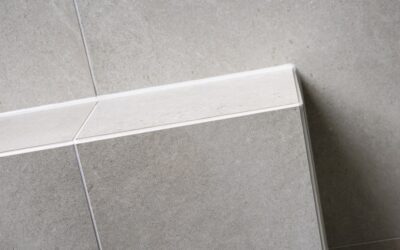
The difference between a tile job that looks professional and one that looks unfinished usually comes down to the edges. Corner round tile is the family of trim pieces that caps exposed tile edges and outside corners with a smooth, rounded profile instead of a raw, sharp cut. If you have ever run your hand along a beautifully tiled shower or backsplash and felt a soft, rolled edge rather than a gritty exposed rim, that is corner round tile doing its quiet job. This guide breaks down bullnose, quarter round, pencil liners, and the modern metal alternatives so you can finish your project cleanly.
Part of our Tile & Grout guide — explore the full guide →
Why Edge Trim Matters
Field tile, the main tile that covers your wall or floor, has an unglazed, unfinished edge on all four sides. When that edge sits in the middle of an installation it disappears under grout and the next tile. But wherever tile stops, at an outside corner, the top of a wainscot, the end of a backsplash, or the edge of a curb, that raw edge is exposed. Left uncovered, it looks unfinished and the sharp bisque can chip or cut.
Trim tile solves this by giving you a piece with one or more finished, rounded edges. It protects the vulnerable rim, softens sharp corners so nobody catches a hip or a hand on them, and gives the whole installation an intentional, framed look. Skipping trim is the single most common reason a DIY tile job reads as amateur even when the field tile is set perfectly.
Bullnose: The Classic Rounded Edge
Bullnose is the most familiar corner round tile. It is a field tile with one edge glazed and rolled over into a smooth quarter-circle profile. Single bullnose has one finished edge, used to cap the top of a backsplash or the side of a niche. Double bullnose has two adjacent finished edges and wraps an outside corner where two exposed edges meet.
Bullnose comes in sizes that match common field tile, like a 3×6 or 4×4 bullnose that sits flush against the same tile in the field. The key is availability: many trendy tiles, especially large-format porcelain and handmade looks, are sold without matching bullnose. Before you fall in love with a tile, confirm whether the line includes trim pieces, because retrofitting an edge finish later is far harder than planning for it.
When bullnose is not available for a tile you love, you still have options short of switching tiles. Some fabricators can grind and polish the cut edge of a field tile to create a smooth, finished profile on site, a service that works especially well with through-body porcelain that carries its color all the way through. The polished-edge look is more subtle than a rolled bullnose and reads modern. It costs extra and takes a skilled hand, but it lets you finish an edge in the exact tile you chose rather than settling for a mismatched trim in a different color.
Quarter Round and Pencil Trim
Quarter round is a narrow, rounded strip that looks like a quarter of a dowel in cross section. It runs along an edge or into an inside corner to create a soft, finished transition, and it is especially useful where the field tile has no matching bullnose. Because quarter round is a separate slim piece, it comes in many colors and materials, so you can match it closely or choose a contrasting accent.
Pencil liner, or pencil trim, is a thin rounded bar, usually about half an inch to three-quarters of an inch wide, that reads like a drawn line across the tile. It caps edges the way quarter round does but also works as a decorative border, separating a field of subway tile from a mosaic accent band or framing a niche. Pencil liners in a contrasting glaze or a metallic finish add a crisp detail line that lifts a simple layout. Both quarter round and pencil trim let you finish edges even when your main tile offers no dedicated bullnose.
Metal Trim: The Schluter Alternative
The modern alternative to ceramic corner round tile is metal edge profile, best known by the Schluter brand though several companies make it. These are L-shaped or rounded metal strips, in anodized aluminum, brushed nickel, brass, or matte black, that tuck under the tile edge and present a clean, crisp finished line at the corner. One leg sits in the thinset behind the tile; the visible face covers the exposed edge.
Metal profiles have surged in popularity for a few reasons. They give a sharp, contemporary look that suits modern baths and kitchens. They solve the availability problem, since they work with any tile whether or not bullnose exists for it. And they are more durable at outside corners than a glazed bullnose, which can chip if struck. The tradeoff is aesthetic: a metal edge reads modern and industrial, while a rounded bullnose reads soft and traditional. Match the trim style to the look you are after.
Where Each Trim Type Fits Best
Choosing the right edge treatment depends on the location and the style you want.
- Backsplash top edge: single bullnose or a metal profile gives a clean cap where tile meets painted wall.
- Outside shower corners: double bullnose or a rounded metal profile protects the vulnerable edge from chips.
- Niche and shelf edges: pencil liner or quarter round frames the opening crisply.
- Wainscot cap: a chair-rail or pencil trim finishes the top of a partial-height wall.
- Curb and step edges: bullnose softens the corner underfoot and hides the tile’s raw side.
What Corner Round Tile Costs
Trim tile almost always costs more per piece than the field tile it matches, because it is manufactured in smaller runs with an extra glazing step. Ceramic bullnose commonly runs $4 to $12 per linear foot. Pencil liners and quarter round in standard glazes fall in a similar range, while decorative or metallic liners can hit $15 to $30 per linear foot. Metal Schluter-style profiles run roughly $8 to $25 per 8-foot length depending on finish, with brass and matte black at the top end.
Because trim is sold by the linear foot and only edges need it, the total is usually a small fraction of the project. Still, budget for it deliberately. It is a classic mistake to order all the field tile and forget the trim, then discover the bullnose is backordered for weeks while your walls sit half finished.
Installation Tips for Clean Edges
Plan trim before you set the first field tile, because the edge pieces often need to go in as you build the wall, not after. For metal profiles, embed the perforated leg in thinset under the field tile so the finished face lands flush; a common error is setting the profile too proud or too deep, leaving a lip. Miter the corners of metal profiles at 45 degrees for a clean wrap, or use the manufacturer’s matching corner pieces.
For bullnose and liners, dry-fit the whole run first so cuts fall in inconspicuous spots and grout joints line up with the field. Keep the grout line between trim and field the same width as everywhere else, and caulk rather than grout any change-of-plane corner so it can flex without cracking. Get the edges right and even a simple, inexpensive tile looks like custom work.
Prefer to explore on your own?
See how new flooring looks in your actual room in seconds — free, no signup.
Try the free Floor Studio →