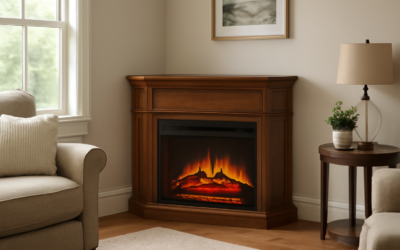
Tucking a fireplace into a corner solves the oldest furniture problem in American living rooms — finding a focal point that does not fight the TV for attention. A well-designed corner wall fireplace handles 1,200 to 1,800 sq ft of supplemental heat while making a 12×14 ft room feel intentional instead of awkward. Today’s options range from a $399 plug-in electric model that installs in an afternoon to a full gas insert with stone surround that hits $9,500 with finished tile work.
Why a Corner Placement Works
A corner unit naturally angles toward two walls of seating, which means sofas, recliners, and a TV can all share the room without anyone craning their neck. The 45-degree facing pulls the eye into the corner and makes a square room feel longer on the diagonal. For open-concept floor plans, a corner fireplace divides the kitchen and living zones visually without a single wall stud.
The mechanical advantage is real too. Corner placement uses a wall section that is normally dead — too short for a sofa, too narrow for a buffet — and gives it the highest function in the room. You also gain easier venting because two exterior walls meet at most corners, simplifying the path to a sidewall termination or a chase up through the attic.
Three Fuel Types: Pros and Real Costs
- Electric: $399 to $1,799 unit, 4,600 to 5,200 BTU, no venting required, 120V/15A circuit; brands include Dimplex, Touchstone, Modern Flames
- Gas (direct-vent): $1,800 to $4,500 unit plus $1,200 to $3,000 install; 25,000 to 40,000 BTU; Heat & Glo, Napoleon, Mendota
- Wood-burning (zero-clearance): $1,400 to $3,800 unit plus $3,500 to $6,000 chimney; Superior, Pacific Energy, Lopi
- Gas log set in masonry corner: $599 to $1,400 logs; only works if you have an existing masonry hearth
- Ethanol (vent-free): $999 to $2,200; 4,000 to 6,000 BTU; freestanding, no install required but produces water vapor
Electric is the runaway favorite for retrofits because it requires zero venting and almost any drywall corner becomes installation-ready with framing tweaks. Gas direct-vent is the standard for new construction because the heat output justifies the install cost.
Clearance and Code Requirements
Combustible material clearance is the spec that catches DIYers. Most zero-clearance gas fireboxes require 6 inches above the unit before any wood mantel can sit. Mantel depth matters: a 12-inch mantel needs 12 inches of clearance to the firebox top opening; a 10-inch mantel needs only 10. Your unit’s installation manual gives an exact diagonal-clearance chart — follow it to the eighth-inch or your insurance carrier may deny a claim later.
For wood-burning units, NFPA 211 requires 36 inches between any combustible surface and the unvented opening unless the unit is specifically tested zero-clearance. Side wall clearance to drywall typically runs 8 to 12 inches; many local codes layer additional requirements for the floor protection (a non-combustible hearth pad extending 16 inches in front and 8 inches to each side).
Sizing the Unit to the Room
Pick BTU output based on insulation quality and ceiling height. A modern, well-insulated 14×16 ft room with 8-ft ceilings (1,792 cubic ft) needs 8,000 to 10,000 BTU for primary heat or 4,000 to 6,000 BTU for ambiance. Doubling the room volume to 3,500 cubic ft pushes the requirement to 20,000+ BTU.
For the visual proportion, the firebox opening should be 32 to 50 inches wide in most living rooms, with 36 to 42 inches being the sweet spot. Anything larger overwhelms the corner; anything smaller looks like a built-in safe. The Dimplex IgniteXL 50 Bold is a great electric option at $1,099 for a 50-inch wide x 23-inch tall opening, and the Modern Flames Spectrum Slimline 50 covers similar ground for $899.
Framing the Corner Cavity
Frame the chase with 2×4 lumber set 1/2 inch wider than the unit on every side. Most direct-vent gas units need a chase 18 to 22 inches deep at the base, narrowing as it rises. Use 5/8-inch Type X drywall on all chase surfaces, taped and mudded with USG Sheetrock Brand 90-minute compound for fire-resistance.
Run the vent pipe at a minimum 1/4-inch-per-foot pitch upward toward the termination. Heat & Glo and Napoleon both publish termination tables — a typical sidewall termination needs 12 inches of horizontal clearance to corners of the house, 7 ft of vertical clearance above grade, and 4 ft of separation from any operable window. Use the manufacturer-approved pipe (Simpson DuraVent DVL for most direct-vent applications).
Finishing the Surround
The surround is where a corner wall fireplace becomes a design feature. Stacked ledgestone in a single piece per face — Norstone XL Charcoal at $11 per sq ft or Eldorado Stone Cliffstone at $14 per sq ft — wraps the corner with no visible seam thanks to L-shaped corner pieces. Apply over a moisture barrier and metal lath using Laticrete 4-XLT thinset mortar.
For a modern look, switch to a single slab of 12×24 inch porcelain like MSI Lagoon or Daltile Marble Attache. The grout joints disappear, and the tall format minimizes cuts. A floating wood mantel — 4×6 inch white oak from Forever Joint Tops, $89 per linear foot — installs on a hidden steel rod bracket epoxied into the framing.
Mantel and TV Placement
Many homeowners try to mount a TV directly above a corner fireplace. It works for electric units (which throw heat forward, not up) but rarely for gas. The vent collar of a typical direct-vent unit sends 200°F+ heat plume up the back wall and will damage electronics within 18 months. If you must mount a TV above gas, install a 6-inch deep mantel as a heat deflector and use a tilt-down articulating mount like the Sanus VMF620.
For an electric corner fireplace, a TV can sit as close as 8 inches above the unit. The Touchstone Sideline 50 throws less than 95°F at the top vent on full heat, well below TV operating limits.
Total Project Budgets
A weekend DIY plug-in electric corner install — Dimplex Multi-Fire XHD plus a $400 stone-look MDF surround kit from Touchstone — lands at $1,200 to $1,800. Mid-range direct-vent gas with a tile surround, gas line run, and finish carpentry runs $5,800 to $8,400. A full custom wood-burning zero-clearance with a stacked stone hearth to ceiling and stained mantel pushes $11,000 to $18,000. Whatever fuel you choose, pull a permit — most cities require an inspection before drywall closes the chase, and skipping that step voids your homeowner’s coverage on any fire-related claim down the road.