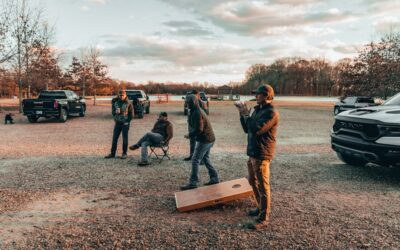
Most backyard cornhole games are set up by eye, and most of them end up too short. Regulation cornhole court dimensions put the front edges of the two boards 27 feet apart, inside a rectangular lane about 8 feet wide and 40 feet long. Pace it out instead of measuring and you will usually land somewhere around 22 to 24 feet, which makes the game easier and makes your practice useless the first time you play at a bar league or tournament.
The short answer, then: measure 27 feet from the front edge of one board to the front edge of the other, face the boards toward each other, and leave a 3 foot wide pitcher’s box on each side of each board. For young kids, cut the distance to somewhere between 12 and 21 feet depending on age and arm strength. Everything else in a good layout is about level ground, clear space around the lane, and marking the foul lines so nobody argues about where to stand.
- Regulation Cornhole Court Dimensions at a Glance
- Board Spacing: Why 27 Feet Matters
- Shorter Distances for Kids and Casual Play
- Pitcher's Box and Foul Lines
- How to Lay Out a Backyard or Patio Lane
- Level Ground and Surface Tips
- Indoor and Tight-Space Setups
- Common Layout Mistakes and Fixes
- Cost to Set Up a Cornhole Court
- Frequently Asked Questions
Court layout is a different question from board construction. The boards themselves are 2 feet by 4 feet with a 6 inch hole, but where you put them, how much room surrounds them and how flat that ground is decides whether the game plays fairly. Good cornhole court dimensions are mostly about that surrounding space.
Regulation Cornhole Court Dimensions at a Glance
Organized cornhole leagues use the same basic layout, and it works just as well on a lawn as it does in a gym. When people search for corn hole dimensions, these are the numbers that matter for a regulation lane.
| Measurement | Regulation | Notes |
|---|---|---|
| Board front to board front | 27 ft | The main throwing distance |
| Back edge to back edge | 35 ft | 27 ft plus two 4 ft boards |
| Overall court | 8 ft wide x 40 ft long | Minimum recommended playing area |
| Pitcher’s box | 3 ft wide x 4 ft deep | One on each side of each board |
| Foul line | Front edge of the board | Extended across both pitcher’s boxes |
| Board size | 2 ft x 4 ft | Hole 6 in diameter |
Those figures add up neatly. Two boards that are 4 feet long, separated by 27 feet of open ground, give you 35 feet from back edge to back edge. A 40 foot lane leaves roughly 2.5 feet behind each board for bags that slide off and for players walking around to collect them. The 8 foot width covers the 2 foot board plus a 3 foot pitcher’s box on each side.
Board Spacing: Why 27 Feet Matters
The throwing distance is always measured from front edge to front edge, never center to center or hole to hole. That detail trips up a lot of people. If you measure hole to hole, you will set the boards about 33 feet apart, because each hole sits 9 inches below the top of its board. That is far too long and will frustrate casual players.
Use a 50 foot tape measure, hook it on the front edge of the first board, and run it straight to the front edge of the second. Then check that the boards are square to each other. A simple trick is to stretch a string from the center of the top edge of one board to the center of the top edge of the other. If the string runs down the middle of both boards, they are aligned. If it angles off, rotate one board until it lines up.
Corn toss dimensions are easy to fudge by a foot or two without noticing, so mark the board positions once you have them right. On grass, a pair of landscape flags or golf tees pushed in at the front corners lets you reset the boards in seconds after mowing. On a patio, a small dot of outdoor paint or a strip of tape at each corner does the same job.
Shorter Distances for Kids and Casual Play
Standard cornhole game dimensions assume adult players, and twenty-seven feet is a long toss for a small child. A 1 pound bag thrown that far takes real arm strength, and kids who can never reach the board lose interest quickly. Shortening the lane keeps everyone playing.
- Ages 4 to 6: 10 to 12 feet, front edge to front edge. Some families set a single board even closer and let the youngest players stand wherever they like.
- Ages 7 to 9: 15 to 18 feet. Most kids at this age can land bags on the board but still miss the hole often enough to keep it interesting.
- Ages 10 to 12: 18 to 21 feet. Youth and junior divisions commonly play at 21 feet.
- Teens and adults: 27 feet, the full regulation distance.
For mixed groups, a handy option is a second throwing line. Keep the boards at 27 feet for adults and mark a forward line, around 21 feet from the opposite board, for kids or anyone who wants an easier throw. Everyone shares the same boards and the same scoring, and nobody has to move equipment between turns.
Pitcher’s Box and Foul Lines
The pitcher’s box is the area where a player stands while throwing. Each board has two of them, one on the left and one on the right, and each box is 3 feet wide and 4 feet deep, matching the length of the board. In a doubles game, one player from each team stands at each end, and partners throw from opposite ends of the lane.
The foul line runs along the front edge of the board and extends across both pitcher’s boxes. A player’s foot cannot cross that line before the bag leaves the hand. Players also have to stay inside their own box while throwing, and they cannot step onto the board or walk past the front of it to retrieve bags until the inning is over.
Marking these lines helps a lot once games get competitive. On grass, a line of field marking paint or a length of rope pinned with landscape staples works well. On concrete or pavers, painter’s tape lasts a single event, while outdoor floor tape or exterior paint lasts a season. Keep the lines flat to the ground so nobody catches a toe on them.
How to Lay Out a Backyard or Patio Lane
Setting up a permanent or semi-permanent court takes about half an hour once you have the space picked out, and getting the corn hole court dimensions right the first time saves you from re-measuring every weekend. Here is the process step by step.
- Pick the site. Look for a stretch of ground at least 40 feet long and 8 feet wide, ideally 10 feet wide so spectators and coolers have room. Avoid low spots where water collects, steep grades, and areas under trees that drop branches or sap.
- Check overhead clearance. Bags travel in an arc, so watch for low branches, string lights, clotheslines and patio umbrellas. Aim for at least 12 feet of clear height over the middle of the lane.
- Mark the centerline. Drive a stake at each end and stretch a mason’s line between them. This line becomes your reference for aligning both boards.
- Place the first board. Set it on the centerline with the hole end facing away from the throwing area. Mark the front corners.
- Measure 27 feet. From the front edge of the first board, run the tape along the centerline and mark the front edge position of the second board.
- Square the boards. Center the second board on the line and confirm both boards face each other directly.
- Mark the pitcher’s boxes and foul lines. Measure 3 feet out from each side of each board and mark the box edges and the foul line extension.
- Level and test. Set a level across each board, adjust as needed, then throw a few rounds to confirm bags slide consistently.
Level Ground and Surface Tips
Uneven ground causes more cornhole headaches than any other layout problem. A board that tips to one side drains bags toward the low corner, and a board that rocks will bounce bags off unpredictably. The goal is a stable base and a board surface that sits level side to side.
On grass, mow the lane short and check each board position with a 2 or 4 foot level. If one corner sits low, slide a thin composite shim or a flat paver under the leg rather than stacking loose wood that can shift. For a permanent backyard lane, many homeowners cut the turf out of a 2 by 4 foot rectangle at each end and set a pad of compacted gravel topped with pavers, so the boards always rest on a flat, firm surface.
Patios and driveways are flatter but often slope slightly for drainage, usually about 1/4 inch per foot. That slope matters less along the length of the lane than across it. If your patio slopes sideways, orient the lane so the boards run downhill and uphill instead of across the pitch, or shim the low side of each board.
Avoid placing the boards on loose gravel or mulch without a solid base. They sink unevenly, and the bags pick up debris that changes how they slide. Turf mats and outdoor rugs make a neat staging area on hard surfaces, but keep them flat and secure so the edges do not curl.
Indoor and Tight-Space Setups
Garages, basements and event halls can all host a cornhole game, though full cornhole court dimensions, with a 40 foot lane, do not always fit. A two-car garage is typically 20 to 24 feet deep, which means a regulation game will not fit unless you open the door and run the lane down the driveway. Basements vary widely, but many have only 7 to 8 feet of ceiling height, which flattens the throwing arc and changes how the game plays.
When you are short on room, shorten the distance consistently rather than crowding the sides. A 20 or 21 foot lane is a perfectly good game and matches junior play. Keep at least 3 feet of clearance on each side of the boards so players are not throwing next to walls or furniture. If the floor is finished hardwood, laminate or vinyl, set the boards on a rubber mat or felt pads so the legs do not scratch the surface, and keep the bags off any finish that could be dented by repeated impacts.
Common Layout Mistakes and Fixes
Even experienced players fall into a few habits that throw off a court. Watch for these problems.
- Measuring hole to hole. This sets the boards about 6 feet too far apart. Always measure front edge to front edge.
- Boards angled toward each other. Use a string line down the center to confirm alignment.
- Not enough side room. Players throwing from cramped pitcher’s boxes change their stance and their aim. Keep at least the full 3 feet on each side.
- Sloped or soft ground. Shim or set pavers under the board positions so the playing surface stays level and firm.
- Sun in the eyes. If you can, run the lane north to south so players at both ends are not staring into a low afternoon sun.
- Crowding the back. Spectators standing right behind a board get hit by sliding bags. Keep the 2 to 3 feet behind each board clear.
Cost to Set Up a Cornhole Court
A temporary lawn setup costs almost nothing beyond the game itself. A tape measure, a few landscape flags and a level cover the basics. A decent cornhole board set with eight bags runs from budget-friendly to premium depending on materials, with solid wood boards costing more than lighter composite or plastic sets.
A permanent backyard lane with paver pads at each end typically costs a modest amount in gravel, sand and pavers if you do the work yourself, and more if a landscaper builds a dedicated level strip or artificial turf lane. Professional turf installation for a full 8 by 40 foot court is the most expensive option, but it delivers a consistent, low-maintenance surface for years. For most families, a level lawn and a good set of boards cover everything they need.
If your yard has significant slope, drainage problems or you want a built-in lane with lighting, a landscaper can grade the area and add a level pad. Any lighting that needs new outdoor wiring should go to a licensed electrician, while plug-in solar or low-voltage path lights are an easy DIY addition.
Frequently Asked Questions
How far apart are cornhole boards supposed to be?
Regulation play sets the front edges of the boards 27 feet apart. That gives 35 feet from back edge to back edge. Juniors often play at 21 feet, and young kids at 10 to 18 feet.
How much space do you need for a cornhole court?
Plan for a lane at least 8 feet wide and 40 feet long. A 10 foot width gives extra room for spectators, and about 12 feet of overhead clearance keeps the throwing arc clear.
Do you measure cornhole distance from the hole or the front of the board?
Measure from the front edge of one board to the front edge of the other. Measuring hole to hole sets the boards several feet too far apart.
Where do you stand when throwing in cornhole?
Stand in the pitcher’s box beside the board, a 3 by 4 foot area on either side. Your foot cannot cross the foul line, which runs along the front edge of the board.
Can you play cornhole on a sloped yard?
You can, but level the boards side to side with shims or paver pads. Orienting the lane so the slope runs along its length, rather than across it, keeps bags from drifting toward one corner.