An outdoor shuffleboard court turns a strip of backyard concrete into a four-season game space that grandparents and grandkids actually use together. Regulation courts run 52 feet long by 6 feet wide and require a smooth concrete slab finished with a hard-troweled steel surface and weatherproof acrylic court paint. Plan on $3,500 to $8,500 in materials and labor for a backyard build, depending on whether you pour the slab yourself or hire a concrete crew. The build is straightforward, but the surface finishing makes or breaks playability.
Part of our Windows & Doors guide — explore the full guide →
- Regulation Dimensions and Layout
- Site Selection and Drainage
- Slab Specifications That Matter
- Surface Coatings and Court Paint
- Wax, Sand, or Beads for Glide
- Cues, Discs, and Storage
- Lighting for Evening Play
- Maintenance and Long-Term Care
- Beginner Scoring Rules
- Weatherproofing Cover Options
- Frequently Asked Questions
Regulation Dimensions and Layout
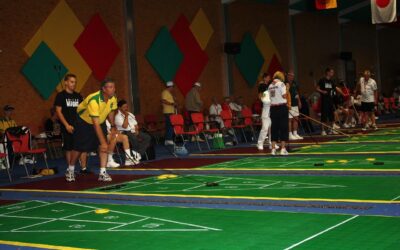
The National Shuffleboard Association sets the standard at 52 feet long by 6 feet wide for the playing surface, plus a 6-foot run-off at each end and a 24-inch alley on each side. That puts the total footprint at 64 by 10 feet. The scoring triangle at each end measures 9 feet from baseline to apex, scored as 10 points at the tip, two zones of 8 and 7, and a 10-off zone behind the baseline. Striping uses 3/4-inch wide acrylic lines painted with a court template.
Backyard scaled-down builds at 39 feet by 6 feet work for casual play but skew the geometry of scoring. Save 13 feet of yard and accept the compromise if you must.
Site Selection and Drainage
Pick a level spot with at least 1 percent slope along the long axis for drainage. East-west orientation is best because shadows from the sun are short across the playing area. Avoid placing the court under deciduous trees; fallen leaves stain the surface and acorns chew up the wax glide layer. Set back at least 8 feet from fences and structures to give players room to walk around without stepping on the playing surface.
Slab Specifications That Matter
Pour a 4-inch slab over a 4-inch compacted gravel base. Use a 4,000 PSI mix with #4 rebar on 18-inch grid placed mid-depth. Steel troweling is non-negotiable; broom finishes catch the disc and ruin glide. Hire an experienced concrete finisher who has poured at least three courts before; the finishing window is short and the wrong technique leaves divots that telegraph through paint. Cost for materials only on a 64 by 10 foot pad runs $1,800; finished labor adds $2,500 to $4,200.
- 4-inch gravel base, compacted: 8 cubic yards
- 4,000 PSI concrete: about 8 cubic yards at $145/yard
- #4 rebar, 18-inch grid: 240 linear feet
- Sawcut control joints every 8 feet to prevent random cracks
- Vapor barrier under slab in regions with high water table
Surface Coatings and Court Paint
After the concrete cures 28 days, etch with muriatic acid, neutralize, and apply two coats of SealKrete Original Multi-Surface Sealer at $35 per gallon. Follow with Sherwin-Williams H&C Concrete Stain or California Acrylic Concrete Coating in light tan or pale green to reduce glare. Stripe the triangles using a court template and SportMaster CourtPaint, which is the same product used on tennis and pickleball courts. Total coating materials run $250 to $400.
Wax, Sand, or Beads for Glide
Outdoor courts use silicone-coated salt or shuffleboard powder for glide. Sun Glo Speed Powder is the de facto standard at $25 per pound; one pound covers four to six games. Avoid the talc-based interior shuffleboard wax used on table shuffleboards. Reapply powder before each play session, sweep with a soft-bristle broom afterward, and cover the court with a UV-stable tarp between uses to keep the beads from blowing away. Court discs from Sun Glo, four red and four yellow, run $90 a set in regulation 6-inch diameter.
Cues, Discs, and Storage
Regulation cues measure 6 feet 3 inches long with a curved head that cradles the disc. Sun Glo, American Shuffleboard, and Imperial all sell tournament-grade cues at $80 to $140 each. Store cues hanging vertically in a covered bin or wall rack to prevent warping. Discs live in a weatherproof case; UV degrades the plastic edges over 5 to 8 years even with covers. Budget $300 to $450 for a full set of cues, discs, powder, and a court-grade broom.
Lighting for Evening Play
Two 30-watt LED flood lights mounted 12 feet high at each end cover the court at roughly 30 footcandles, enough for clean visibility on the score zones. Lithonia Lighting OFL 30LED runs about $90 each at Home Depot. Hardwire on a separate 15-amp circuit with a switch near the patio door, or use solar-powered flood fixtures from Aootek if running conduit is impractical. Add an ambient string of Edison bulbs at the perimeter for atmosphere.
Maintenance and Long-Term Care
Pressure wash twice a year at 1,500 PSI maximum with a 25-degree tip held 18 inches off the surface; higher pressure pits the acrylic coating. Touch up paint stripes annually using a 1-inch foam roller and the original SportMaster product to maintain color match. Inspect control joints for cracking; route and seal any growing fissures with Sikaflex Self-Leveling Sealant in matching color. Plan to recoat the entire surface every 4 to 6 years for $400 to $700 in materials, which keeps the outdoor shuffleboard court playing fresh for decades.
Beginner Scoring Rules
Games run to 50, 75, or 100 points based on player preference. Each player or team gets four discs per round. Discs that come to rest entirely within a scoring zone count for that zone’s value; discs touching a line score the lower value. Discs landing in the 10-off zone behind the baseline subtract from the player’s score. Players or teams alternate shooting until all eight discs are played, then total points and replay from the opposite end. Knocking opponents’ discs off the surface is part of strategy, not a foul.
Weatherproofing Cover Options
Northern climates need a winter cover or risk freeze damage to the acrylic coating. A custom 64-by-10 foot vinyl tarp from Tarpsplus runs around $280 with grommets every 24 inches. Anchor with 12-inch ground stakes through the tarp grommets into landscape beds beside the court. For warmer climates, a simple shade cover during summer protects the paint from UV degradation; SunDeck retractable shade structures at $1,800 to $3,500 give players relief during 95-degree afternoons. Either way, never leave standing water on the surface overnight; squeegee after every rain.
Frequently Asked Questions
What are outdoor shuffleboard court dimensions in meters?
A regulation playing surface of 52 by 6 feet is about 15.85 by 1.83 meters. With the 6-foot run-off at each end and the 24-inch alleys, the full 64 by 10 foot footprint works out to roughly 19.5 by 3.05 meters. A scaled backyard court of 39 by 6 feet is about 11.9 by 1.83 meters.
Can you paint a shuffleboard court on an existing patio or driveway?
Yes, if the slab is long enough, close to level, and smooth. Most driveways and patios have a broom finish, which grabs the discs, so the surface usually needs grinding or a smooth resurfacing layer before sealing and painting. Wide cracks and heaved sections also need repair first, since any lip at a joint stops a sliding disc.
Can you build an outdoor shuffleboard court with pavers?
Pavers are a poor choice for the playing surface because the joints between them catch the discs and the units shift slightly over time, creating small lips. A continuous steel-troweled concrete slab is the standard for good glide. Pavers work well for the walkways and seating areas around the court instead.
How long does it take to build an outdoor shuffleboard court?
Plan on four to six weeks from start to first game. Excavation, gravel base, forms, and the pour usually take a few days, but the slab then needs about 28 days to cure before etching and coating. Sealer, color coats, and striping add several more days, depending on drying times and weather.