
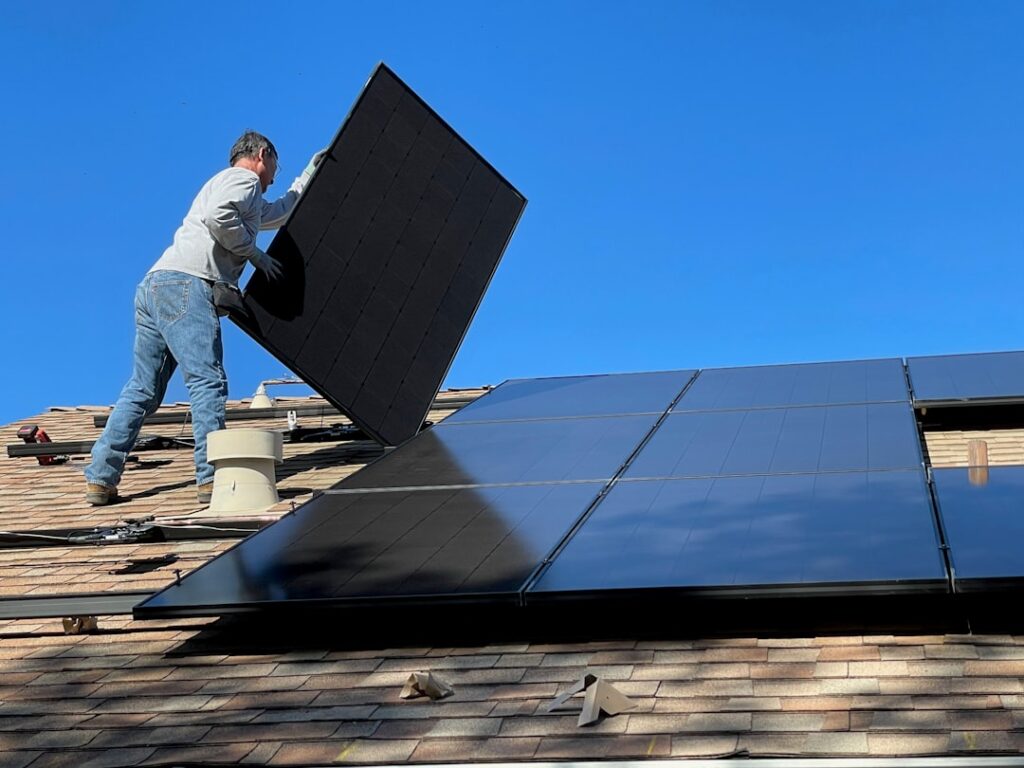
Solar has never been cheaper per watt, yet the total check still gives homeowners sticker shock. The cost of installing solar panels on a roof in 2026 runs $15,000 to $28,000 for a typical residential system before any incentives, with most homes landing near $20,000 for a 7 to 8 kilowatt setup. After the federal tax credit and local rebates, real out-of-pocket cost often drops to $11,000 to $19,000. This guide breaks the number down by system size, splits materials from labor, and shows exactly what pushes your quote up or down.
Part of our Roofing guide — explore the full guide →
- The Per-Watt Number That Drives Everything
- Materials: Where the Money Sits
- Labor and Soft Costs
- The Federal Tax Credit and Incentives
- What Drives Your Price Up
- What Keeps Your Price Down
- How to Size Your System Correctly
- Roof Orientation and Shading
- Buying vs. Leasing vs. a PPA
- Maintenance and Long-Term Costs
- Payback and Whether It's Worth It
The Per-Watt Number That Drives Everything
Solar pricing is quoted in dollars per watt, and it is the figure to compare across bids. In 2026 the national average for a fully installed residential system sits around $2.75 to $3.50 per watt before incentives. Multiply that by system size in watts and you have the gross cost.
- 6 kW system: roughly $16,500 to $21,000.
- 8 kW system: roughly $22,000 to $28,000.
- 10 kW system: roughly $27,500 to $35,000.
- 5 kW system: roughly $13,750 to $17,500.
When you get a quote, divide the total by the system wattage to find the per-watt price. Anything under $3.00 is competitive; much above $3.75 and you should shop more bids unless the roof is unusually complex.
Materials: Where the Money Sits
Equipment makes up roughly 40 to 50 percent of a solar quote. The panels themselves are the headline, but the balance-of-system components add up:
- Solar panels: $0.70 to $1.20 per watt, so $4,900 to $8,400 for an 7 kW array.
- Inverter (string or microinverters): $1,000 to $3,000; microinverters cost more but perform better on shaded or complex roofs.
- Racking and mounting hardware: $1,000 to $2,500.
- Wiring, conduit, and electrical components: $500 to $2,000.
- Monitoring system: $200 to $500.
Higher-efficiency panels cost more per watt but produce more power from limited roof space, which matters if your roof is small or partly shaded. On a large, sunny roof, standard-efficiency panels often deliver better value.
Labor and Soft Costs
Labor for the physical installation typically runs $3,000 to $6,000 and covers the crew mounting racking, setting panels, running conduit, and tying into your electrical panel. It usually takes a two to four person crew one to three days.
But labor is only part of the non-equipment cost. Solar carries substantial soft costs that surprise buyers: permitting and inspection fees ($400 to $1,500), utility interconnection fees ($100 to $600), design and engineering, and the installer’s overhead and profit. These soft costs can add up to 25 to 35 percent of the total, which is a big reason U.S. solar costs more than in some other countries where permitting is streamlined.
The Federal Tax Credit and Incentives
Incentives dramatically change the real cost, so never compare solar on the gross price alone. The federal residential clean energy credit has historically covered 30 percent of the total system cost as a tax credit, which on a $20,000 system is a $6,000 reduction in what you actually pay. Program details and expiration dates shift with legislation, so confirm the current credit and eligibility before you sign.
On top of the federal credit, many states offer rebates, property tax exemptions, sales tax exemptions, and net metering that pays you for excess power. Some utilities add their own rebates. Stacked together, incentives can cut the net cost by 30 to 50 percent, which is what turns a 12-year payback into a 7 or 8-year one.
What Drives Your Price Up
Several roof and site factors push a quote higher. A steep or multi-plane roof is slower and more dangerous to work on, raising labor. Older or worn roofing may need replacement first, because nobody wants to remove and reinstall panels in five years; a re-roof adds $8,000 to $20,000 of its own. Tile, slate, or metal roofs need specialized mounting hardware that costs more than a simple asphalt shingle attachment.
Electrical upgrades are another common surprise. If your main panel is undersized or outdated, an upgrade to accommodate solar runs $1,500 to $4,000. And adding battery storage, increasingly popular for backup and rate arbitrage, adds $10,000 to $18,000 for a whole-home battery.
What Keeps Your Price Down
On the other side, some conditions make solar cheaper. A simple, single-plane asphalt roof with good south-facing exposure and no shading is the easiest and cheapest to install. A modern, adequately sized electrical panel avoids upgrade costs. Buying a right-sized system rather than overbuilding keeps the total in check.
Getting three or more competitive bids reliably saves money, because installer pricing varies widely for the same equipment. Larger installers sometimes offer better per-watt pricing through volume, while smaller local outfits may beat them on soft costs and service.
How to Size Your System Correctly
Buying the right-size system is the difference between a smart investment and wasted money on either end. Undersize it and you still pay the utility for the power you did not offset; oversize it and you spend on panels whose production the utility may not fully credit. The starting point is your annual electricity usage in kilowatt-hours, found by adding up twelve months of utility bills.
A rough rule is that each kilowatt of solar produces about 1,200 to 1,600 kilowatt-hours per year depending on your region’s sun. So a home using 12,000 kWh a year needs roughly an 8 to 10 kW system to offset most of its usage in a sunny climate, or more in a cloudy one. A good installer runs this math using your actual bills, your roof’s orientation and shading, and local sun data, then sizes the array to match. Be wary of any quote that pushes a far larger system than your usage justifies, and equally wary of one too small to make a dent in your bill.
Roof Orientation and Shading
Two roofs of identical size can produce very different amounts of power, and that changes the value of the same dollar spent. South-facing roof planes produce the most in the Northern Hemisphere, with west and east facing planes producing somewhat less but still worthwhile, especially west-facing panels that generate during peak afternoon demand. North-facing roofs produce the least and are usually not worth it.
Shading is the silent killer of solar output. Even partial shade from a tree, chimney, or neighboring building on a few panels can drag down the production of a whole string, which is why microinverters or power optimizers, though more expensive, pay off on shaded or complex roofs by isolating each panel. Before signing, make sure your installer has done a shading analysis and accounted for how trees will grow over the system’s 25-year life. A cheaper string-inverter system on a shaded roof can end up producing less power per dollar than a pricier microinverter system, so the lowest bid is not always the best value once orientation and shade enter the picture.
Buying vs. Leasing vs. a PPA
How you finance solar changes both the upfront cost and the long-term return, so it deserves a clear-eyed look. Paying cash gives you the lowest total cost, full ownership, and the entire tax credit and incentive value, and it delivers the fastest payback and highest lifetime savings. A solar loan lets you own the system with little or no money down, still claim the tax credit yourself, and typically comes out ahead over the life of the system even after interest, as long as the loan rate is reasonable.
Leases and power purchase agreements (PPAs) are different animals. With a lease or PPA, a third party owns the panels on your roof and you pay a fixed monthly amount or a per-kilowatt-hour rate for the power. You put nothing down, but you also do not get the tax credit, that goes to the owner, and your lifetime savings are far smaller. Leases and PPAs can also complicate a home sale, since a buyer must assume the contract. For most homeowners who can afford cash or qualify for a decent loan, ownership delivers dramatically better value than a lease. Reserve leases for situations where you cannot use the tax credit and cannot finance a purchase.
Maintenance and Long-Term Costs
Solar’s appeal is partly that it costs very little to run once installed, but “very little” is not “nothing,” and budgeting for the long term keeps your payback math honest. Panels have no moving parts and generally need only occasional cleaning, a few times a year in dusty climates, which you can often do yourself or hire out for $150 to $300 a visit. Rain handles much of it in wetter regions.
The one component you should plan to replace is the inverter. String inverters typically last 10 to 15 years and cost $1,000 to $2,500 to replace, an expense that lands roughly halfway through the system’s life. Microinverters last longer, often matching the panels’ 25-year warranty, which is part of their value despite the higher upfront cost. Panels themselves degrade slowly, losing about 0.5 percent of output per year, so a 25-year-old panel still produces around 85 percent of its original power. Factor a mid-life inverter replacement and occasional cleaning into your cost projections, and solar still comes out as one of the lowest-maintenance major home investments you can make.
Payback and Whether It’s Worth It
The bottom line is not just the install cost but how fast it pays back. In areas with high electricity rates and good sun, a system often pays for itself in 6 to 10 years and then produces essentially free power for the remaining 15-plus years of its 25 to 30-year lifespan. In areas with cheap power or poor sun, payback stretches to 12 years or more.
Run the math on your specific electric bill, sun exposure, and local incentives before deciding. For most homeowners with a decent roof and moderate-to-high electric bills, the cost of installing solar panels on a roof pencils out to real long-term savings, especially once the tax credit brings the net price down to the $12,000 to $18,000 range for a typical system.


