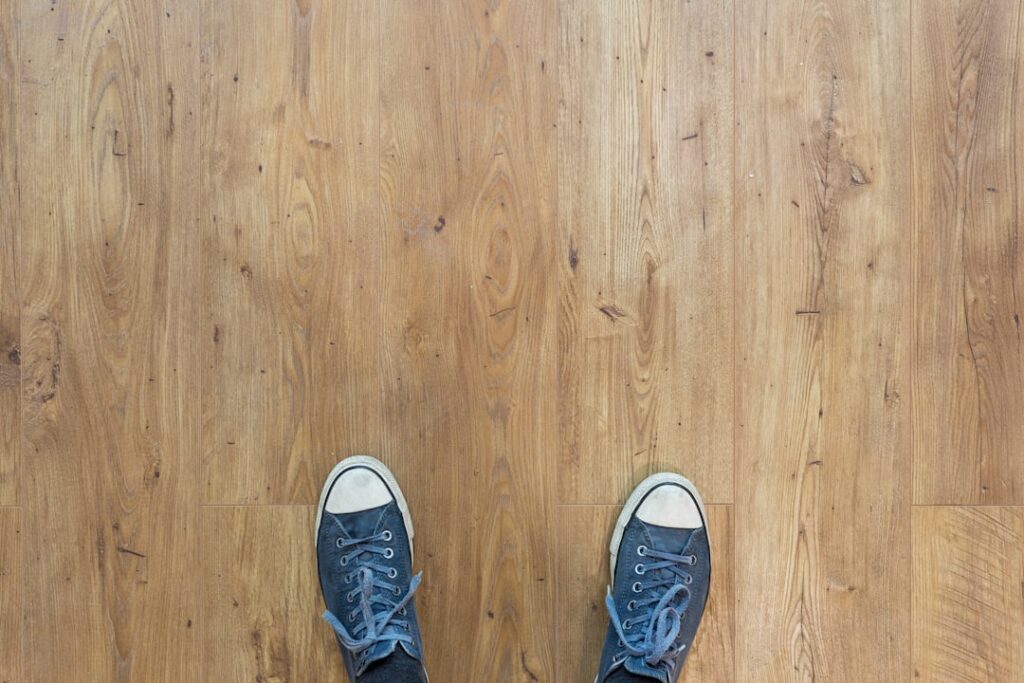
Walk into a thousand farmhouses across America and you’ll find some version of country oak flooring underfoot — wide planks with visible knots, mineral streaks, and the kind of grain variation that turns a kitchen into a centerpiece. The term covers a grade and aesthetic more than a specific product, which means pricing and quality swing wildly depending on what you actually buy. A genuine character-grade white oak plank is a completely different animal from a mass-market laminate stamped to look rustic.
Defining the Country Oak Look
Country oak refers to oak flooring graded for character rather than uniformity. Industry terms include Rustic, Character, Cabin, or No. 2 Common — all describing boards with sound knots up to 1.5 inches, color variation from cream to deep brown, mineral streaks, and small checks. The National Wood Flooring Association defines these grades in NOFMA Common Grade specifications. By comparison, Select and Better grade limits knots to 3/8 inch and demands consistent color.
Pricing by Construction Type
Solid 3/4-inch white oak in character grade runs $4.50 to $7.50 per sq ft unfinished. Pre-finished solid character oak from brands like Bruce, Somerset, and Anderson Tuftex sits at $5.50 to $9 per sq ft. Engineered country oak with a 3mm to 6mm wear layer ranges $5 to $11 per sq ft — Mannington’s Maison Collection and Mohawk’s TecWood Plus both offer wide-plank rustic oak in this band. Installed, expect $10 to $18 per sq ft for solid nail-down and $9 to $16 for engineered glue-down or floating.
What Makes Oak Worth Choosing
Janka hardness on white oak measures 1360, and red oak hits 1290 — both harder than American black walnut and roughly twice as hard as eastern white pine. That density translates to a floor that resists dents from dropped pans, dog claws, and stiletto heels far better than softer species. Oak also takes stain remarkably well thanks to its open pore structure, so you can finish character planks anywhere from light Scandinavian whitewash to dark fumed brown.
Availability is another quiet advantage. Domestic oak supply is deep and stable, which means lead times of one to three weeks on most pre-finished products and easy sourcing for repairs years later.
Pros of the Country Aesthetic
Character-grade oak hides life. Scratches, dings, and the inevitable wear from kids and pets blend into existing knot patterns instead of standing out as defects. Two or three pups and a decade of foot traffic on a select-grade Brazilian cherry floor look tired — the same wear on character oak just adds patina.
Wide-plank country oak (6 to 9 inches) also makes rooms feel larger by reducing seam frequency. Combined with longer board lengths of 4 to 7 feet, the floor reads as continuous rather than chopped.
Cons to Plan For
Character grade has higher waste factors. Plan on 10 to 12 percent waste versus the 7 to 8 percent typical of select-grade material because more boards have unusable knot clusters at the ends. The variation also makes installation slower — your installer has to dry-lay boards thoughtfully to balance color and knot distribution across the room.
Some buyers find the knots and color variation too busy under cabinetry or in small bathrooms. Country oak shines in open kitchens, great rooms, and hallways where the eye has room to read the pattern.
Finish Choices That Match the Style
Matte and satin sheens at 10 to 25 percent gloss suit the rustic aesthetic better than high gloss. Oil-modified finishes from Rubio Monocoat or Loba 2K Invisible Protect deepen the grain without making it look plastic-coated. For high-traffic households, Bona Traffic HD in extra-matte gives a near-raw look with commercial-grade durability and meets GreenGuard Gold certification for indoor air quality.
Wire-brushed and hand-scraped surface textures emphasize the rustic character and hide micro-scratches between refinishes.
Installation Methods
Solid 3/4-inch country oak nails down with 2-inch cleats every 6 to 8 inches into a plywood or OSB subfloor. Acclimate planks 5 to 10 days in the install space at 30 to 50 percent RH and 60 to 80 degrees F. Engineered versions go down as float, glue, or staple depending on subfloor — concrete slabs require glue-down with a moisture-suppressing adhesive like Bostik’s MVP4 or Bona R851 if RH exceeds 75 percent per ASTM F2170 testing.
Brand Picks Worth Considering
Bruce’s American Originals Tinted Tea oak, Mohawk’s Coastal Couture wire-brushed oak, Anderson Tuftex Vintage character white oak, and Mannington’s Maison Avoriaz all hit the country-oak target with good warranty coverage and dealer networks. For a higher-end custom feel, Carlisle Wide Plank’s Heritage White Oak in Tannery finish delivers a museum-grade rustic look at $14 to $18 per sq ft unfinished.
Is It Right for Your Home
If you want a floor that ages gracefully, hides daily life, and reads as warm and lived-in from day one, country oak flooring is hard to beat. Skip it if you favor minimalist or modern interiors where uniform color is part of the design — go select-grade or engineered European oak in pale finishes instead. For everyone else, character oak remains one of the most forgiving, attractive, and resale-friendly flooring choices on the market.
Maintenance Across Decades
Refinishing extends life dramatically. Solid 3/4-inch oak handles 4 to 7 full sand-and-refinish cycles over its lifetime, with each cycle removing about 1/32 inch of material. Most homeowners refinish every 10 to 20 years depending on traffic. In between, screen-and-recoat every 5 to 8 years with Bona Traffic HD or Loba 2K Invisible Protect refreshes the finish without removing any wood — typically $1.50 to $3 per sq ft compared to $3 to $5 for full refinishing.
Common Buying Mistakes
Three errors are worth flagging. First, picking pre-finished smooth surface when wire-brushed or hand-scraped would hide wear better — the rustic textures suit country oak’s character. Second, choosing satin or semi-gloss finishes that fight the rustic aesthetic — matte or extra-matte sheens at 10 to 20 percent gloss read more authentic. Third, ordering exactly the square footage of the room — character grade needs 10 to 12 percent waste factor versus the 7 percent typical of select grade. Order short and you’ll wait 2 to 4 weeks for matching material to ship. Order 10 percent over and the leftover boards become future repair stock for the same floor.
Prefer to explore on your own?
See how new flooring looks in your actual room in seconds — free, no signup.
Try the free Floor Studio →