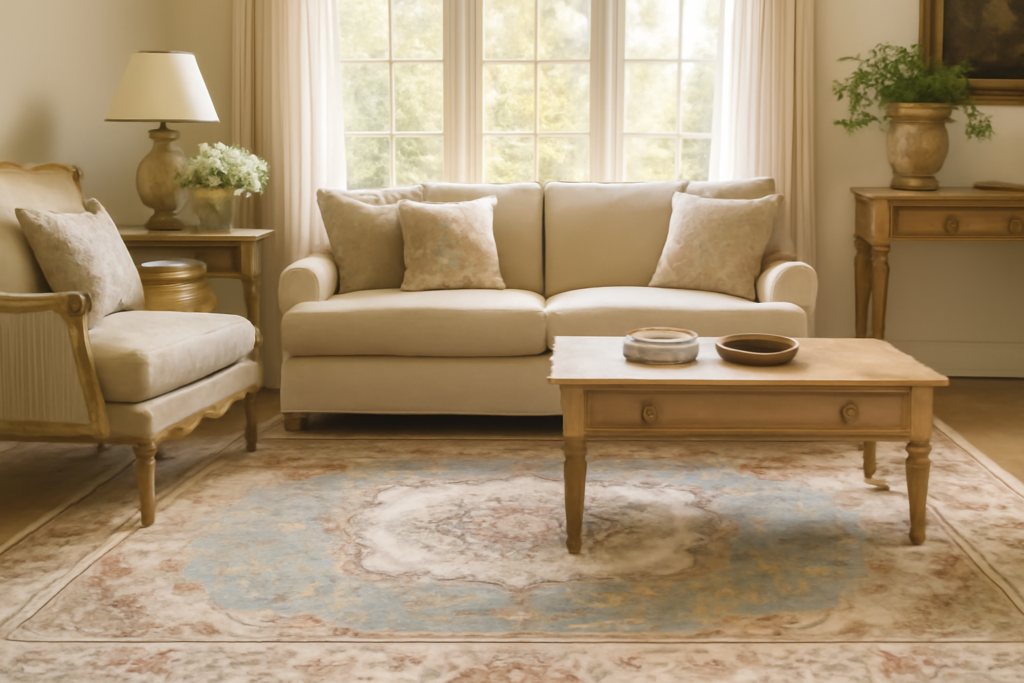
Walk into a farmhouse kitchen with worn oak floors and a faded blue-and-cream floral runner underfoot, and you understand the appeal instantly. A french country rug borrows its look from the sun-bleached textiles of Provence and the aristocratic Aubusson weavings of central France, blending rustic warmth with just enough formality to feel intentional. These rugs anchor a kitchen or living room without demanding it. This guide covers the styles, colors, sizes, fibers, and maintenance you need to know before you spend a dollar.
What Defines the French Country Look
The style pulls from two distinct traditions. Provencal textiles lean casual: think small-scale florals, olive branches, roosters, lavender sprigs, and soft golds against faded indigo. Aubusson and Savonnerie designs run more formal, with large central medallions, scrolling acanthus leaves, and muted rose and sage borders. A true french country rug usually sits somewhere between the two, borrowing the palette of one and the structure of the other.
Distressing matters as much as the pattern. Authentic pieces look gently aged, as if they have spent 40 years catching morning light through a kitchen window. Manufacturers achieve that with low-contrast dyes and intentional color fading, so the rug reads soft rather than crisp. If a rug looks brand new and saturated, it will fight the relaxed vibe you are after, and no amount of styling around it will fully hide the mismatch.
Colors and Patterns That Work
Palette is the fastest way to get this right. The classic combinations include:
- Faded blue and cream — the most recognizable pairing, reads clean and cottage-fresh
- Sage green, gold, and terracotta — warmer and more autumnal, great for dining rooms
- Soft rose, ivory, and taupe — the Aubusson standard, dressier and more feminine
- Lavender and butter yellow — literal Provence, best in sunrooms and bedrooms
For pattern scale, match it to the room. A small galley kitchen handles a tight floral or a simple stripe better than a sprawling medallion, which needs 8 feet of visible field to breathe. Border designs help contain busy floors, while an allover pattern hides crumbs and pet hair between cleanings. When in doubt, choose the lower-contrast option; it ages more gracefully and fights less with your other patterns and furnishings.
Choosing the Right Size and Placement
Sizing trips up more homeowners than color ever will. Under a dining table, the rug should extend at least 24 inches past every edge so chairs stay on the rug when pulled out. For a standard six-seat table, that usually means an 8-by-10-foot rug. In a living room, aim to get the front legs of every seating piece onto the rug; an 8-by-10 or 9-by-12 handles most modern layouts.
Runners are where french country shines. A 2-foot-6-inch by 8-foot floral runner down a kitchen galley or entry hall delivers the look without covering much floor. Leave roughly 4 to 5 inches of exposed flooring on each side so the runner looks placed, not wall-to-wall. Always use a rug pad rated for your floor type; a quarter-inch felt-and-rubber pad adds cushion and stops the runner from creeping across hardwood. When you are torn between two sizes, size up, because an undersized rug that floats in the middle of a room reads as an afterthought.
Materials and Construction
Fiber drives both price and lifespan. Here is how the common options stack up:
- Hand-knotted wool — the gold standard, 30-plus year lifespan, naturally stain-resistant, runs $8 to $25 per square foot
- Machine-woven wool or wool blend — 10 to 15 year lifespan, softer budget hit at $3 to $8 per square foot
- Polypropylene — synthetic, fade-resistant, machine-washable versions available, $1 to $3 per square foot
- Cotton flatweave — light, reversible, easy to launder, but shows wear faster in high traffic
For a kitchen or entry where spills and foot traffic are constant, choose a washable polypropylene or a low-pile wool. Save the hand-knotted wool for a formal dining or living room where it will be admired and protected. A 5-by-8 washable French-style rug from brands like Ruggable or Boutique Rugs typically lands between $150 and $350, while a genuine hand-knotted piece of the same size can run past $1,200. Match the fiber to how hard the room actually lives, not to the price tag alone.
How to Style It in Real Rooms
This rug wants natural materials around it. Pair it with unfinished or lightly waxed oak floors, painted furniture in chalky whites and blues, woven rush seats, and a little wrought iron. Avoid glossy high-contrast finishes; the aged softness of the rug looks orphaned next to a jet-black lacquered console.
Layering is a smart move on a budget. Drop a smaller 3-by-5 floral over a large natural jute or seagrass rug, and you get the pattern you want plus the coverage a big room needs, often for less than one large wool piece. In a bedroom, run the rug lengthwise under the lower two-thirds of the bed so it frames the nightstands and gives your feet something warm to land on in the morning. Pull one muted color out of the rug and repeat it in pillows or ceramics to tie the whole room together.
Cleaning and Long-Term Care
Wool rugs reward routine care. Vacuum weekly with the beater bar off or set high, since aggressive brushing pulls fibers loose over time. Rotate the rug 180 degrees every six months so sun fading and foot traffic wear evenly. Blot spills immediately with a white cloth and cool water; never scrub, which drives the stain deeper into the pile.
For a deeper clean, most wool rugs handle a professional wash every 18 to 24 months at roughly $3 to $6 per square foot. Washable synthetic rugs go straight into a front-load machine on cold, then air-dry flat; skip the dryer, which can shrink the backing. Keep any of these rugs out of standing water and direct sunlight where you can, because prolonged UV exposure at surface temperatures above 120 degrees Fahrenheit accelerates the very fading you paid for, only unevenly.
Where to Buy and What to Avoid
You will find French country rugs everywhere from big-box home stores to specialty rug dealers and online marketplaces. When you shop, ask three questions before you commit: what is the fiber, how is it constructed, and does the color read as softly aged in natural light. Photos on a screen almost always look more saturated than the rug does in a sunlit room, so order a swatch or buy from a retailer with a generous return window. A 30-day return policy is worth more than a small discount on a rug you cannot see in person.
Steer clear of a few traps. Very cheap printed rugs, where the pattern is stamped on a thin surface rather than woven through, look flat and wear away at the traffic lanes within a year or two. Extremely bright, high-contrast florals miss the point of the style entirely. And skip any rug sold without a stated fiber content, because that usually means a low-grade synthetic that will pill and mat. Spend your money on construction and the right muted palette, and the rug rewards you every time you walk into the room.
Is a French Country Rug Right for You?
If your home leans toward farmhouse, cottage, traditional, or transitional, this rug slots in without much effort and hides everyday mess better than a solid color ever will. The muted palette is forgiving, the patterns are timeless, and the price range spans nearly every budget. Where it struggles is in strictly modern, minimalist, or industrial spaces, where its softness can read as dated rather than charming. Buy the best fiber your budget allows for the traffic the room sees, size it generously, and put a quality pad underneath. Do that, and the rug will look better in ten years than it did the day you unrolled it.