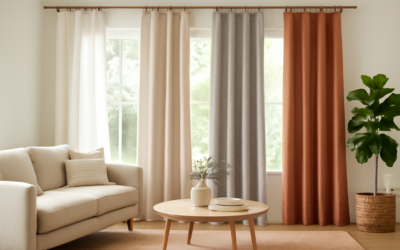
Dining rooms see heavy candlelight, concentrated steam from serving dishes, and more airborne grease than most homeowners expect, which means the fabric and style you choose matter more than they would in a bedroom or living room. Good curtains for dining room windows balance formality, light control, and cleaning practicality in one package. Get any of those three wrong and the curtains look tired within a year.
Match the Curtain Formality to the Room
Formal dining rooms with chandeliers, upholstered chairs, and dedicated china storage suit floor-length drapes with a slight break on the floor. Casual dining spaces that flow into kitchens or living rooms suit cafe curtains, roman shades, or lighter panels. A mismatch creates visual tension that makes the whole room feel off.
A general rule: if your dining table costs more than $2,000 or seats eight or more, go formal. If the room doubles as homework station or kids’ craft zone, go casual. Middle-ground options like pinch-pleat panels in mid-weight linen work for both ends of the spectrum.
Fabric Choices That Hold Up
Grease particles from cooking travel surprisingly far. A dining room 15 feet from the kitchen still collects enough oil residue on fabric to matter over 12 to 24 months. Choose fabrics that clean well.
- Linen and linen blends: Machine washable in most cases. Wrinkle-prone but high-end looking. Runs $60 to $180 per panel at West Elm and Crate and Barrel.
- Cotton twill: Durable, opaque enough for evening privacy, and affordable at $30 to $90 per panel from brands like IKEA and Pottery Barn.
- Polyester faux-silk: Formal look without real silk’s fragility. Machine washable and holds color under sun exposure. $40 to $110 per panel.
- Velvet: Dramatic and sound-dampening but traps dust and requires professional cleaning at $40 to $80 per panel.
Avoid pure silk in dining rooms. Silk fades fast near candles, spots from any liquid splash, and needs dry cleaning only.
Get the Length Right
Length determines whether curtains look custom or rental-grade. Three standard lengths work for dining rooms:
- Floor kiss (84 to 96 inches): The hem just touches the floor. Modern, clean, easy to vacuum around.
- Slight break (96 to 108 inches): Hem rests with a 1 to 2-inch bunch on the floor. Classic, warm, forgiving on uneven floors.
- Puddle (108 inches plus): Hem pools 4 to 8 inches on the floor. Formal and dramatic but a dust magnet.
Measure from the rod to the floor with the rod mounted at the final height before ordering. Round up, never down. A panel that ends 2 inches above the floor looks like a mistake.
Rod Placement for Visual Height
Mounting the curtain rod too low is the single most common dining room mistake. Standard advice says mount the rod halfway between the top of the window casing and the ceiling. For rooms with 8-foot ceilings and standard 80-inch windows, mount the rod 4 to 6 inches above the casing. For 9-foot ceilings, mount 8 to 12 inches above. This makes the window look taller and the room feel bigger.
Rod width should extend 6 to 12 inches past the window casing on each side. This lets the open panels stack entirely off the glass, letting maximum light in during the day.
Light Control and Privacy Layers
Dining rooms rarely need blackout like bedrooms, but evening meals benefit from some light control. A two-layer approach gives the most flexibility:
- Sheer panels behind for daytime diffusion and privacy. Linen sheers from Half Price Drapes run $30 to $60 per panel.
- Heavier drapery panels in front that you close for formal dinners or bright afternoons.
Double curtain rods at $40 to $120 from brands like Umbra or Kirsch make this layering straightforward. Look for rods rated for at least 20 pounds of total panel weight.
Pattern and Color Strategy
Dining rooms usually have fewer pattern opportunities than living rooms. The table, chairs, and rug dominate visually. Curtains can be the accent that pulls the palette together or a quiet backdrop. Three approaches work reliably:
- Tone on tone: Curtains in the same family as the wall color, one or two shades deeper, for a seamless look.
- Contrast solid: Curtains in a color that ties to the rug or artwork. Navy curtains in a warm-wood dining room are a proven combination.
- Subtle pattern: Small-scale prints like ticking stripes or tone-on-tone damask add interest without competing with the table setting.
Avoid large-scale florals or bold geometrics unless the rest of the room is deliberately quiet. Busy curtains plus a busy rug and bold chairs create visual overload.
Hardware Details That Read as Custom
Rod finish should tie to other metals in the room. Brass dining chairs and gold light fixtures pair with brass or antique brass rods. Iron chandeliers and black handles pair with matte black or dark bronze rods. Mixing metals is acceptable in moderation but keep curtain hardware aligned with the dominant finish.
Finials at the rod ends matter more than they seem. Simple ball or cap finials suit modern rooms. Ornate carved or acanthus finials suit traditional spaces. Umbra, Rod Desyne, and Restoration Hardware all offer options from $15 to $150 per pair.
Cleaning and Maintenance Schedule
Dining room curtains collect airborne grease and food particles faster than curtains elsewhere in the house. Follow this schedule to extend life:
- Monthly: Vacuum with the upholstery attachment at low suction to remove surface dust
- Quarterly: Toss cotton and polyester panels in the dryer with a damp washcloth for 15 minutes to loosen wrinkles and freshen fibers
- Annually: Machine wash washable panels on cold gentle, then hang damp to reduce ironing
- As needed: Spot-clean spills with a mild dish soap solution within an hour of staining
For dry-clean-only panels like velvet or heavy drapes, budget one professional cleaning every 12 to 24 months at $5 to $10 per panel foot.