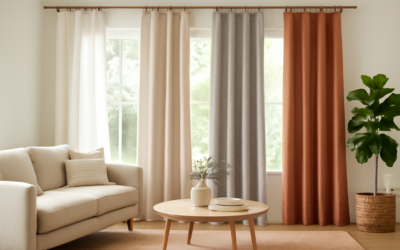
The right curtain transforms a builder-grade window into a designed focal point. The wrong one chops a room visually and broadcasts amateur-hour decorating. The dozens of window curtain styles on the market reduce to a handful of decisions: header type, length, fabric weight, and lining. Once those are dialed in, the showroom price between a $30 panel from Walmart and a $400 custom-pleated panel from The Shade Store often comes down to fabric quality and finished hem detail rather than any meaningful difference in style.
Part of our Windows & Doors guide — explore the full guide →
Header Style Defines the Look
The top edge of the curtain determines how the fabric hangs and reads at scale:
- Rod pocket: sleeve at the top slides over the rod, casual look, hardest to open and close
- Grommet (eyelet): metal-ringed holes slide along the rod, modern look, easy operation
- Tab top: fabric loops over the rod, casual cottage feel, slow operation
- Back tab (hidden tab): tabs sewn to the back hide hardware, clean modern look
- Pinch pleat (French pleat): three-finger pleats spaced evenly, traditional and formal
- Inverted pleat: box pleats facing inward, clean modern aesthetic
- Ripplefold: continuous undulating waves, contemporary high-end look from The Shade Store and Smith & Noble
Pinch pleat and ripplefold deliver the most polished result. Rod pocket and grommet handle DIY installations best for homeowners who want a fast finished look.
Length Choices and Their Effects
The hem position dramatically changes how a room reads:
- Sill length: stops at the windowsill, casual, suits kitchens and bathrooms
- Apron length: 4 inches below the sill, dated 1980s look, generally avoid
- Floor length (kissing): exactly touching the floor, formal and clean
- Trouser break: 1/2 to 1 inch puddle, modern and slightly relaxed
- Puddle (3 to 6-inch puddle): fabric pools on floor, dramatic, traditional
Hang the rod 4 to 6 inches above the window frame (or higher, up to within 3 inches of the ceiling) and extend 4 to 8 inches past the window on each side. This trick makes windows look larger and rooms taller.
Fabric Weight and Light Control
Fabric choice drives both light filtering and visual heaviness:
- Sheer (voile, linen blend): filters light, no privacy, soft layered look
- Light filtering (cotton, linen): filters bright light, some privacy when closed
- Room darkening: blocks 95 to 99 percent of light, full privacy
- Blackout: blocks 100 percent of light, full privacy, blocks UV
Bedrooms benefit from blackout linings to support sleep. Living rooms work best with light filtering or layered sheer plus heavier overlay. Dining rooms can run sheer for ambient light during meals.
Brand Spotlight: The Shade Store Ripplefold
The Shade Store’s Ripplefold curtain system has become the standard in upscale residential design since 2018. The proprietary snap-tape header attaches to a track or rod with consistent 4-inch undulating folds that stack 4 to 6 inches deep when open. Pricing runs $300 to $800 per 100-inch panel in standard fabrics, with custom prints climbing to $1,200 plus. Lead time is 4 to 6 weeks. The clean visual works in modern and transitional homes and stays out of dated trend cycles.
Layering for Depth
Designers consistently layer two or three window treatments:
- Cellular or roller shade: mounted inside the window frame for primary light and privacy control
- Sheer linen or cotton panel: outer layer for daytime filtering
- Heavier drape (pleated or grommet): outermost for evening light blocking and visual weight
The layered approach gives daytime and nighttime modes, blocks more sound, and creates the high-design look that magazines feature.
Rod and Hardware Choices
Curtain rods are not afterthoughts. Hardware finish should coordinate with door and cabinet hardware in the same sightlines:
- Brass and gold: warm, traditional and transitional spaces
- Matte black: modern, farmhouse, industrial
- Brushed nickel: neutral, works with mixed metals
- Antique bronze: craftsman, traditional homes
Diameter matters too: 1.25 to 1.5-inch diameter rods feel substantial in larger rooms; 5/8 to 3/4-inch rods suit smaller windows. Use returns (sections that bend back to the wall) on traditional installs to prevent light leak at the sides.
Measuring Correctly
Bad measurements cause 80 percent of curtain mistakes. Measure:
- Window width: outside frame edge to outside frame edge
- Rod placement width: window width plus 8 to 16 inches total (4 to 8 inches each side)
- Rod placement height: 4 to 6 inches above window frame, or 3 inches below ceiling line for high-impact look
- Floor-to-rod measurement: this is your curtain length (subtract 1/2 inch for floor clearance or add 1 to 6 inches for trouser break to puddle)
Buy panels 2 to 2.5 times the window width for proper fullness. A 60-inch window needs 120 to 150 inches of total panel width.
Pricing Across the Market
Window treatment budgets:
- Big-box ready-made (Walmart, Target, Amazon): $20 to $80 per panel
- Mid-tier ready-made (West Elm, Crate & Barrel, Pottery Barn): $80 to $250 per panel
- Custom standard (The Shade Store, Smith & Noble): $200 to $700 per panel
- Custom designer (Calico, Schumacher, Holland & Sherry): $500 to $2,500 per panel
Add 30 to 60 percent for installation, lining upgrades, and trim work.
Common Mistakes to Avoid
The frequent missteps:
- Hanging rods too low (right above window frame) which shrinks the room
- Buying single panels per window instead of pairs
- Choosing apron-length curtains that float between sill and floor
- Skipping the lining, which leaves panels semi-transparent at night
- Matching curtain color too closely to wall color (creates a flat look)
- Buying lightweight fabric that flutters in HVAC airflow
Final Word
Whether you go ready-made or custom, the best window curtain styles hit the right combination of header type, length, and fabric weight for your room’s purpose. Layer for daytime and nighttime modes, hang high and wide for visual impact, and invest in quality hardware that lasts decades. The result is a finished room that reads designed rather than decorated as an afterthought.