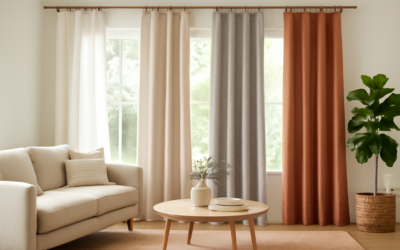
Hanging curtains on window frames that are too short, too narrow, and mounted right at the top of the glass is the single most common decorating mistake — and it makes windows look smaller and ceilings feel lower. Hung correctly, curtains do the opposite: they stretch a window taller, widen a room, soften hard architecture, and add the layer of texture that makes a space feel finished. The difference between amateur and designer-level results is almost entirely in the measuring and mounting, not the fabric. This guide covers exactly how to size, hang, and style curtains so your windows look intentional and your rooms feel bigger.
Part of our Windows & Doors guide — explore the full guide →
Hang Higher Than You Think
The golden rule of curtains is to mount the rod high and wide. Rather than placing the rod just above the window frame, install it closer to the ceiling — typically 4 to 12 inches above the frame, or about two-thirds of the way up the wall between the frame and the crown.
This draws the eye upward and makes both the window and the ceiling read as taller. In rooms with standard 8-foot ceilings, mounting the rod 4 to 6 inches above the frame is plenty; for higher ceilings, go higher still. The fabric should appear to frame a grand window even when the actual glass is modest.
Go Wider Than the Window
Width is just as important as height. Extend the rod 8 to 12 inches beyond each side of the window frame. This lets the curtain panels stack off the glass when open, so they let in maximum light and make the window look significantly wider than it is.
To get full, gathered panels rather than flat, skimpy ones, your combined panel width should be roughly two to two-and-a-half times the width of the area the rod covers. Two panels per standard window almost always looks better and fuller than one.
Getting the Length Right
Curtain length sets the whole tone. There are a few standard looks, each with a different feel:
- Float (just kissing the floor) — the hem sits about 1/2 inch above the floor. The cleanest, most tailored look and the easiest to vacuum around.
- Break (slight puddle) — panels are about 1 inch longer so they just touch and gently break at the floor. Relaxed and forgiving of uneven floors.
- Puddle — 2 to 6 inches of extra fabric pools on the floor for a romantic, formal effect. Best in low-traffic rooms.
The one length to avoid is curtains that hover several inches above the floor or hit at the windowsill in a main living space — that “high-water” look reads as a mistake. Sill-length curtains are fine over kitchen sinks and in some casual settings, but full-length panels almost always look more polished.
Choosing Fabric and Opacity
Match the fabric weight and opacity to the room’s purpose:
- Sheer — soft, light-filtering panels that offer privacy by day while keeping the room bright. Often layered with heavier drapes.
- Light-filtering — cotton, linen, or linen-blend panels that diffuse light and add texture.
- Room-darkening / blackout — lined or specially woven panels for bedrooms and media rooms where you want darkness and insulation.
Heavier fabrics like velvet and lined cotton hang with more weight and drama, while linen and cotton give a casual, breezy feel. For energy efficiency, lined or thermal curtains noticeably cut drafts in winter and heat gain in summer.
Pleat and Header Styles
The top of the curtain — the header — controls how it gathers and what hardware it needs:
- Rod pocket — fabric slides directly onto the rod for a casual, gathered look. Hard to open and close, best for stationary panels.
- Grommet — metal rings create uniform, modern folds and glide easily. Popular and beginner-friendly.
- Pinch pleat — tailored, evenly spaced pleats for a classic, dressy look that hangs beautifully.
- Pencil pleat — tightly gathered header that suits traditional rooms.
- Tab top / back tab — fabric loops or hidden tabs for a clean, contemporary drape.
How to Measure Step by Step
Accurate measurements prevent the most expensive mistakes. Follow this order:
- Decide rod placement — mark a point 4 to 12 inches above the frame and 8 to 12 inches beyond each side.
- Measure for length — from where the rings or rod will sit down to the floor (or your chosen hem point).
- Measure for fullness — multiply the rod span by 2 to 2.5 to find the total panel width you need.
- Mount the brackets — use a level and anchor into studs or with wall anchors; heavy drapes need solid support.
Layering Curtains With Blinds and Shades
Some of the most polished window treatments combine two layers. Mounting curtains over existing blinds or shades gives you the best of both — the blinds handle light control and privacy while the drapes add softness, color, and that frame-the-window effect. A common pairing is sheer or solid panels over cellular shades in a bedroom, or drapes over wood blinds in a living room.
If you layer, keep the curtains as the decorative outer element and let the functional shade sit inside the frame. This stops the window from looking busy and lets each layer do its job. For a cohesive look, repeat a color from the room’s palette in the curtain fabric and keep the shade in a neutral tone.
Common Curtain Mistakes to Avoid
A few recurring errors make even nice fabric look cheap:
- Hanging the rod too low — the single biggest mistake, which shrinks the window.
- Panels too narrow — skimpy, flat curtains that cannot close fully. Buy enough width for fullness.
- Wrong length — high-water hems that float above the floor look unfinished.
- Mounting the rod only as wide as the frame — this blocks light and makes the window look small.
Fix these four and almost any curtain looks intentional and expensive, regardless of what you paid.
Bottom Line
Hanging curtains on a window is less about the fabric you choose and more about how you mount it — high above the frame, wide past the glass, full enough to gather, and long enough to reach the floor. Get those four things right and even budget panels look custom. Pick your opacity for the room’s purpose, choose a header style that suits your decor, and measure carefully before you buy. Done with intention, curtains make your windows look bigger and your whole room feel taller and more complete.