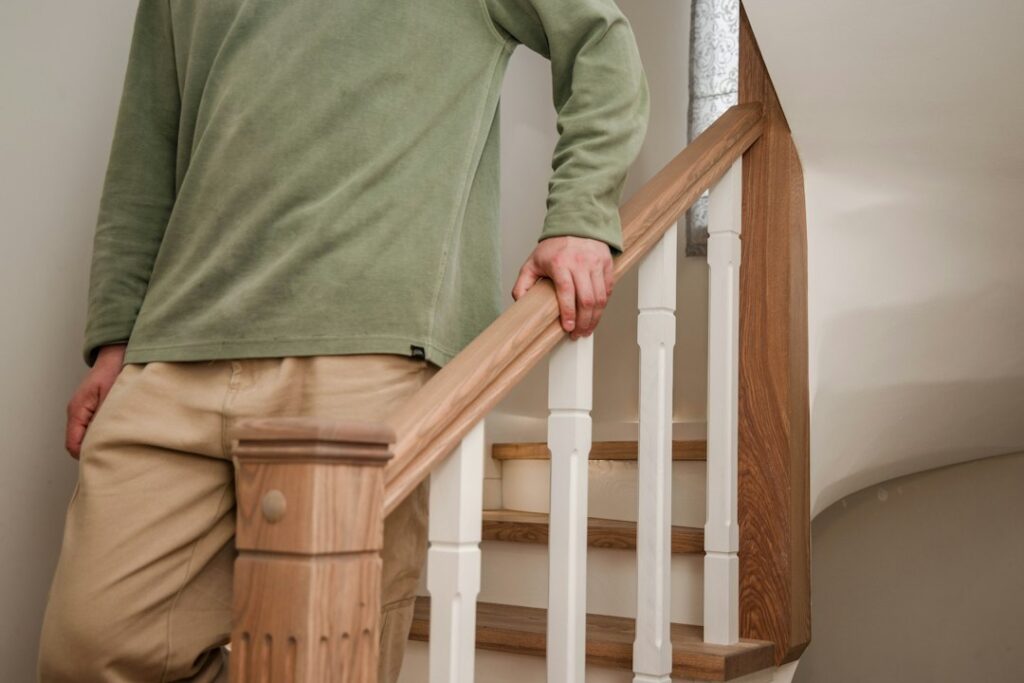
If your staircase turns at a landing, wraps around a corner, or spirals even slightly, a standard straight rail will not work. A curved stair lift uses a rail custom-bent to follow your specific stairs, which is why it costs several times more than a straight unit and takes weeks rather than days to arrive. For many families, it is still far less expensive and disruptive than moving a bedroom downstairs, adding a bathroom, or relocating. Here is what goes into these systems, how they are measured and priced, and what to check before you sign.
Part of our Stairs & Stair Flooring guide — explore the full guide →
- What Makes a Curved Stair Lift Different
- How Curved Rails Are Measured and Built
- Space and Staircase Requirements
- Seat, Safety, and Comfort Features
- What a Curved Stair Lift Costs
- How to Choose a Dealer and Installer
- When to Call a Licensed Professional
- Is a Curved Stair Lift Right for Your Home?
- Frequently Asked Questions
What Makes a Curved Stair Lift Different
A straight stair lift runs on a factory-made aluminum or steel rail cut to length on site. A curved stair lift rail is designed and fabricated for one staircase, bending around each landing, turn, or change in pitch. The carriage that carries the seat must also handle those changes, keeping the seat level as the incline shifts and the rail turns.
You will need a curved system if your stairs have any of the following:
- A 90-degree turn at a landing (L-shaped stairs)
- A 180-degree switchback (U-shaped stairs)
- Winder treads, the wedge-shaped steps that turn a corner without a flat landing
- Two separate flights joined by a hallway or landing that you want to connect in a single ride
- A spiral or continuously curving staircase
Some L-shaped stairs with a large flat landing can use two straight lifts instead, one per flight. That can cost less, but it requires the user to stand, walk across the landing, and transfer to a second chair, which defeats the purpose for many people with limited mobility or balance.
How Curved Rails Are Measured and Built
Because every rail is unique, the process starts with a detailed survey. Most manufacturers now use photogrammetry: a technician places reference targets on the stairs and photographs the staircase from many angles. Software builds a 3D model and designs the rail from it. Older methods use manual measurements of each tread and riser.
Once the design is approved, fabrication and shipping typically take about 2 to 6 weeks, depending on the manufacturer and current demand. Installation itself usually takes half a day to a full day. The rail is fastened to the stair treads with brackets, not to the wall, so no wall damage is required in most homes.
Inside vs Outside Rail Placement
The rail can run on the inside of the curve (next to the banister) or on the outside (along the wall). Inside rails are shorter, which can reduce cost, but the tighter radius can make the ride feel steeper and slower around the bend. Outside rails are longer and gentler but may block more of the stair width for others using the stairs. Your installer should explain the trade-offs for your staircase.
Space and Staircase Requirements
Most stair lifts need a staircase at least about 28 to 30 inches wide, measured wall to banister, though some slim models work on narrower stairs. When folded, a modern seat, footrest, and armrests typically protrude around 12 to 15 inches from the rail side, leaving the remaining width for others to walk.
Pay special attention to the top and bottom:
- Top landing: the seat must swivel so the user can step off onto the flat landing, not onto the top step. Swivel seats typically rotate 45 to 90 degrees. Confirm there is enough room for the user to stand and move away safely.
- Bottom landing: the rail may extend past the bottom step. If that creates a tripping hazard across a doorway or hallway, ask about a “park” curve that bends the rail around the corner or out of the way.
- Doors and obstacles: doors that open onto the stairs, radiators, and low windows near the rail path must be addressed in the design.
The staircase itself must be structurally sound. Loose treads, damaged stringers, or soft spots should be repaired first. If you plan to replace worn carpet on the stairs with hardwood, luxury vinyl stair treads, or new carpet, do it before the lift goes in; the rail brackets are fastened through the treads, and changing the flooring later means removing and reinstalling the rail.
Seat, Safety, and Comfort Features
Stair lifts sold in the U.S. are generally designed to meet ASME A18.1, the safety standard for platform lifts and stairway chairlifts. Features to expect or look for include:
- Weight capacity: commonly around 250 to 350 pounds, with heavy-duty models rated higher
- Seat belt or harness: standard lap belts, with retractable options on many models
- Safety sensors: sensitive edges on the footrest and carriage that stop the lift if they meet an obstruction
- Swivel seat with lock: rotates at the top for safe dismount and locks during travel
- Battery power: most modern units run on DC batteries charged at charging points along the rail, so the lift can still make several trips during a power outage
- Controls: a joystick or toggle on the armrest, plus remote call/send controls mounted at the top and bottom
- Adjustable seat height and footrest: important for tall or short users and for ease of transfer
- Powered swivel and powered footrest: helpful for users with limited hand strength or who cannot bend to fold the footrest
A standing or perch seat is available for people who cannot bend their knees comfortably, and it can also help on narrow stairs.
What a Curved Stair Lift Costs
Pricing reflects the custom rail. As of 2026, typical ranges for a new installed system are:
- Single 90-degree turn: about $8,000 to $12,000
- Multiple turns or a switchback: about $10,000 to $15,000
- Complex spiral, long rail, or two floors: $15,000 to $20,000 or more
For comparison, straight stair lifts usually cost about $2,500 to $5,500 installed. Extras such as park curves, powered swivel and footrest, heavy-duty ratings, and outdoor-rated components add to the curved total.
Used and refurbished curved rails are rarely practical, since a rail built for one staircase will almost never fit another. Some dealers can reuse the carriage and seat with a new rail, which trims cost modestly. Rental programs exist in some areas but are less common for curved units than for straight ones.
Ongoing costs include batteries, which often need replacing every 2 to 4 years, and optional annual service. Ask about warranty length on the motor, gearbox, rail, and parts, and whether labor is included.
Funding sources vary. Original Medicare generally does not classify stair lifts as durable medical equipment, so they are typically not covered. Some Medicare Advantage plans, Medicaid waiver programs, veterans’ programs, local aging agencies, and nonprofit grants may help in certain situations. Eligibility depends on the program and your circumstances, so check directly with each source rather than assuming coverage.
How to Choose a Dealer and Installer
A curved stair lift is a long-term piece of equipment, and dealer quality matters as much as the brand. Get at least two or three in-home quotes. Good dealers will:
- Visit in person to survey the stairs, watch the user move, and discuss needs.
- Provide a written quote with the rail layout, seat features, weight rating, and all extras itemized.
- Explain lead time, installation time, and warranty coverage clearly.
- Offer local service with reasonable response times, and state whether they stock parts.
- Show proof of insurance and any required state or local licensing.
An occupational therapist can assess whether a stair lift is the right solution at all, or whether a home elevator, platform lift, or first-floor living arrangement would serve better as mobility changes. A Certified Aging-in-Place Specialist (CAPS) can look at the whole home, including bathrooms, entrances, and lighting, so the stair lift is part of a coordinated plan.
When to Call a Licensed Professional
Installation of a curved stair lift is not a DIY project. The rail must be fastened to structural parts of the stairs, and the charging system connects to household electrical power; many units need a standard outlet near the top or bottom of the stairs, and adding one should be done by a licensed electrician. Some jurisdictions require permits or inspections for stair lifts. If the stairs show loose treads, cracked stringers, or sagging, have a carpenter or contractor repair them before the survey.
Is a Curved Stair Lift Right for Your Home?
A curved stair lift makes sense when the user can safely sit, transfer on and off a chair, and operate simple controls, and when the staircase is the main barrier to living comfortably in the home. It preserves access to upstairs bedrooms and bathrooms without major construction. Plan the flooring, lighting, and handrails around it, involve an occupational therapist early, and choose a dealer who will still be around to service the lift years from now.
Frequently Asked Questions
Can a stair lift be installed on a spiral staircase?
Often, yes. A curved rail can be bent to follow a spiral, but the stairs must be wide enough for the folded seat and the treads deep enough at the rail side for brackets. Tight spirals around a central pole with narrow, wedge-shaped treads frequently cannot fit a chair. An in-home survey is the only reliable way to confirm whether a specific spiral works.
Can a curved stair lift be moved to a new house?
Usually not as a complete system. The rail is built for one staircase, so it will almost never fit the stairs in another home. A dealer may be able to reuse the carriage and seat on a newly made rail, which reduces the cost of the second installation. Removal leaves screw holes in the treads that can be filled or covered by new flooring.
Is there a curved stair lift for wheelchair users?
No. A stair lift requires the rider to transfer from the wheelchair to the seat, then use a second wheelchair or walker upstairs. People who cannot transfer safely need a different solution, such as an inclined platform lift that carries the wheelchair itself, a vertical platform lift, or a home elevator. An occupational therapist can help decide which option fits.
Are curved stair lifts available for outdoor stairs?
Yes. Outdoor-rated curved lifts use weather-resistant components, sealed electronics, and a protective seat cover to handle rain, sun, and temperature swings. They cost more than indoor units and need regular cleaning of the rail to keep debris from affecting the ride. Outdoor stairs should be structurally sound and well lit before a rail is fastened to them.