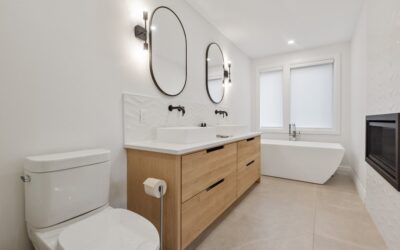
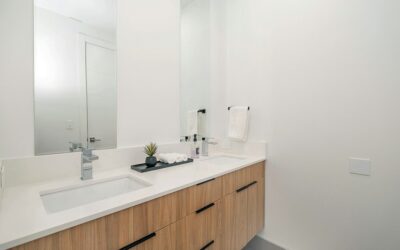
A custom bathroom vanity solves the problem that stock cabinets never quite fix: the awkward alcove, the plumbing that sits three inches off center, or the exact walnut-and-quartz look you saw in a magazine. When you order a piece built to your measurements and finishes, every inch of the cabinet works for your room instead of forcing your room to work around a big-box size. This guide walks through what “custom” really means, realistic price ranges, materials that hold up in a wet room, and how to decide whether to hire a cabinetmaker or tackle a semi-custom build yourself.
Part of our Bathroom Remodeling & Flooring guide — explore the full guide →
- What “Custom” Actually Means
- Realistic Cost Ranges
- Choosing the Right Size and Height
- Cabinet Materials That Survive a Bathroom
- Countertops and Sinks
- Storage That Earns Its Space
- DIY vs. Hiring a Pro
- Common Mistakes to Avoid
- Wood Species and Finish Options
- Hardware and Faucet Coordination
- Timeline and Ordering Lead Times
- Bringing It All Together
What “Custom” Actually Means
There are three tiers most homeowners run into. Stock vanities come in fixed widths (24″, 30″, 36″, 48″, 60″, 72″) and finishes, and cost the least. Semi-custom lets you modify a base design: pick door styles, drawer configurations, and finishes from a menu, and sometimes adjust depth. True custom means a cabinetmaker builds from your drawings with any dimension, wood species, and hardware you choose.
You only need full custom when you have a genuine constraint or a specific vision. A 41-inch-wide nook, a floating wall-mount design over a heated floor, or a furniture-style piece with turned legs and a specific stain are all good reasons. If your space accepts a standard 36″ or 48″ cabinet and you like an available finish, semi-custom will save you hundreds of dollars.
Realistic Cost Ranges
Pricing varies widely by region and materials, but these numbers reflect what US homeowners typically pay in 2026:
- Semi-custom vanity (cabinet only): $600 to $2,000 for a 36″ to 48″ unit
- Full custom from a local cabinetmaker: $2,500 to $6,000+ for a single vanity, more for double sinks
- Countertop (quartz or granite): $40 to $100 per square foot installed
- Undermount sink and faucet: $150 to $600 combined
- Professional installation and plumbing hookup: $300 to $1,200
A completed 48″ custom vanity with quartz top, undermount sink, and a decent faucet commonly lands between $3,500 and $7,500 installed. Double-vanity builds at 60″ to 72″ can push past $10,000 with premium stone.
Choosing the Right Size and Height
Measure the wall width and subtract clearance so doors and drawers open without hitting an adjacent wall, toilet, or door swing. Building code and comfort call for at least 15 inches from the vanity centerline to any side wall, and roughly 21 to 30 inches of clear floor space in front.
Standard vanity height is 32 inches, but “comfort height” (sometimes called counter height) at 36 inches matches kitchen counters and suits taller adults. If small children use the bathroom daily, the lower 32-inch height or a step stool makes more sense. Depth is usually 21 inches, but a shallow 18-inch or even 15-inch cabinet is a lifesaver in a powder room or narrow hallway bath.
Cabinet Materials That Survive a Bathroom
Humidity is the enemy of cabinetry. The best custom bathroom vanity uses materials that resist swelling and warping:
- Plywood boxes: Marine-grade or cabinet-grade plywood resists moisture far better than particleboard and holds screws for wall mounting.
- Solid hardwood face frames and doors: Maple, oak, walnut, and cherry are common; all should be sealed on every surface, including undersides.
- MDF for painted doors: Medium-density fiberboard takes paint beautifully and won’t show grain, but it must be fully sealed because it wicks water badly if exposed.
Avoid raw particleboard in any location that could see standing water, especially the sink base floor. Ask your builder to add a waterproof mat or aluminum drip tray under the plumbing.
Countertops and Sinks
Quartz (engineered stone) is the most popular vanity top for good reason: it is non-porous, never needs sealing, and resists toothpaste, makeup, and mild acids. Expect $50 to $90 per square foot installed. Granite is beautiful and durable but needs periodic sealing. Solid surface (Corian) allows integrated sinks with no seams to trap grime. Cultured marble is budget-friendly but scratches and dulls over time.
Undermount sinks are the standard for custom work because the counter wipes clean straight into the bowl. Vessel sinks look dramatic but raise the effective counter height, so plan the cabinet lower (around 30 to 32 inches) to compensate.
Storage That Earns Its Space
The biggest advantage of building custom is smart storage. Drawers almost always beat doors for daily-use items because you can see everything at once. Ask for:
- U-shaped drawers that notch around the P-trap so you don’t lose the sink-base drawer
- Soft-close undermount slides rated for the drawer weight
- A pull-out for the trash or hamper
- Built-in outlets inside a drawer for charging razors and toothbrushes
- Adjustable shelves behind doors rather than fixed ones
DIY vs. Hiring a Pro
A confident woodworker can build a custom bathroom vanity cabinet for the cost of materials, roughly $300 to $900 in plywood, hardwood, hardware, and finish. The build itself is straightforward joinery, but three tasks trip up beginners: cutting an accurate sink and plumbing opening, achieving a durable moisture-proof finish, and leveling a heavy cabinet against an out-of-square wall.
Countertop templating and stone fabrication should almost always go to a pro; a $70-per-square-foot quartz slab is unforgiving of measuring mistakes. Plumbing hookups are DIY-friendly if you are comfortable with supply lines and a P-trap, but any new drain or valve work in some jurisdictions requires a permit.
Common Mistakes to Avoid
Homeowners repeatedly make the same errors. Do not order the vanity before confirming the rough-in location of the drain and supply lines; a mismatch means opening drywall. Don’t forget door and drawer clearance against a swinging entry door. Skipping a full seal on MDF or unsealed undersides guarantees swelling within a year. And measuring only the width while ignoring the toilet clearance leads to a cabinet that technically fits but makes the room feel cramped and violates the 15-inch side clearance many inspectors check.
Finally, order your countertop and sink before finalizing the cabinet top so the fabricator’s overhang and reveal match the doors. Coordinating these three components early prevents the small gaps and awkward proportions that make a custom job look homemade.
Wood Species and Finish Options
The wood species you choose sets the entire personality of the vanity and affects both cost and durability. Paint-grade maple and poplar take a smooth painted finish and hide grain, ideal for classic white or navy Shaker cabinets. Red oak is inexpensive and stains well but shows a strong open grain. Walnut delivers rich, dark, contemporary luxury at a premium price. White oak, especially rift-and-quarter-sawn, is the darling of modern design for its tight, straight grain and pale tone. Cherry darkens beautifully with age. Whatever species you pick, insist on a durable, moisture-resistant topcoat: conversion varnish and catalyzed lacquer used by professional shops far outperform a brushed-on polyurethane, and every surface, including the back panel, drawer bottoms, and cut edges, must be sealed to survive bathroom humidity.
Hardware and Faucet Coordination
The small details make a custom vanity feel finished. Cabinet pulls and knobs come in finishes, matte black, brushed brass, polished nickel, and chrome, that should coordinate with your faucet, towel bars, and light fixtures for a cohesive look. Decide early whether the faucet is deck-mounted (drilled into the counter) or wall-mounted, because a wall-mounted faucet requires the valve to be roughed into the wall before tiling. Widespread faucets need three holes; single-hole faucets need one. Confirm the faucet’s spout height and reach suit your sink so water lands in the bowl, not on the counter edge. Coordinating these finishes and drillings before fabrication prevents the mismatched, pieced-together look that undermines an otherwise custom job.
Timeline and Ordering Lead Times
A custom vanity is not an off-the-shelf purchase, so plan your timeline. A local cabinetmaker typically needs four to ten weeks from approved drawings to delivery, and stone countertops add one to two weeks for templating and fabrication after the cabinet is set. Order the faucet, sink, and hardware early so they are on hand when the plumber connects everything. If you are remodeling the whole bathroom, sequence the work: rough plumbing and electrical first, then flooring and wall tile, then the vanity, and finally the countertop template taken off the installed cabinet. Rushing this sequence, or ordering the counter before the cabinet is level and set, is how gaps and misalignments creep in.
Bringing It All Together
Start with an accurate drawing that notes plumbing locations, then decide semi-custom versus full custom based on your real constraints. Choose plywood boxes and sealed hardwood or MDF doors, pair them with a non-porous quartz top and an undermount sink, and design drawers around the plumbing. Whether you build it yourself or commission a cabinetmaker, a well-planned custom bathroom vanity turns the most-used room in the house into one that feels tailored, organized, and worth every dollar you spent.