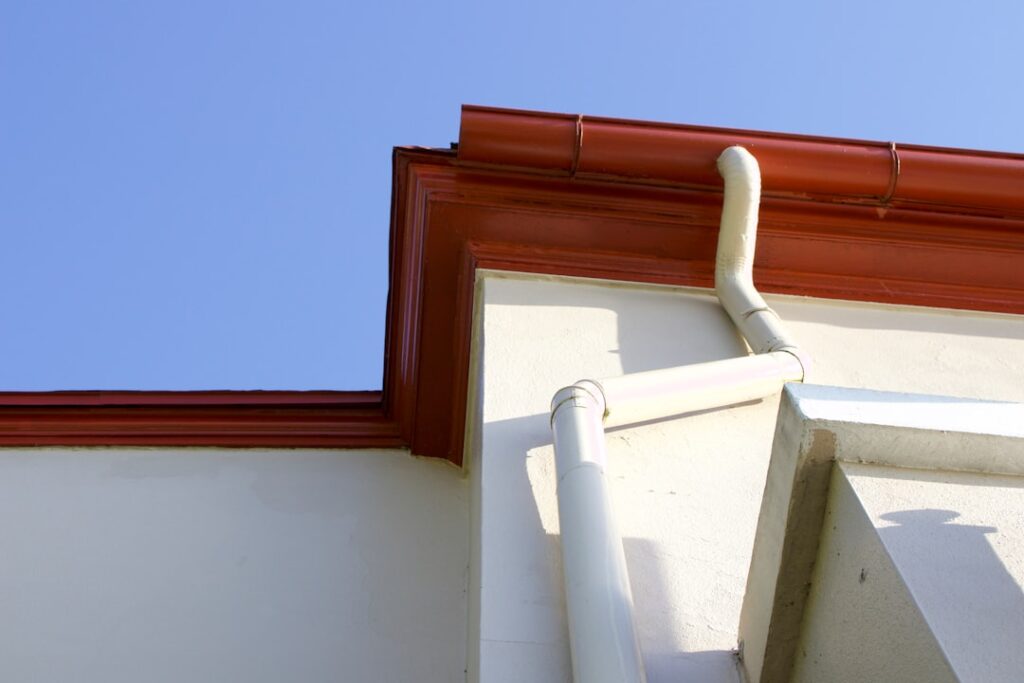
When a contractor rolls a machine off a trailer and feeds a coil of aluminum through it, that is what custom gutter installation actually means: your gutters are formed on-site to the exact length of each roof run, with no factory seams every ten feet. Done right, custom gutters outlast box-store sectional gutters by a decade and shed water without the drips and stains that plague pieced-together runs. Here is how the job works and what it should cost.
Part of our Roofing guide — explore the full guide →
- Seamless vs Sectional: Why It Matters
- On-Site Fabrication: How the Machine Works
- K-Style vs Half-Round: Picking a Profile
- Sizing: Getting the Width Right
- Downspouts and Drainage
- What Custom Gutter Installation Costs
- Material Choices Beyond Aluminum
- Common Mistakes That Cause Callbacks
- Hiring the Job Out vs DIY
Seamless vs Sectional: Why It Matters
Sectional gutters come in 10-foot lengths you snap together with joiners. Every joiner is a future leak, and there are a lot of them on a 40-foot wall. Seamless gutters are extruded in one continuous piece for the entire run, so the only joints are at inside and outside corners and at the downspout outlets.
The practical payoff: fewer leak points, no ugly seam stains streaking down your siding, and a cleaner look. Roughly 90% of professional installs today are seamless because the fabrication machine has made it affordable. Sectional still has a place for the DIYer doing a short garage run, but for a whole house, seamless is the standard and worth the modest premium.
On-Site Fabrication: How the Machine Works
The heart of a custom job is the portable roll-forming machine, usually mounted in the installer’s trailer. A coil of coated aluminum (or steel, or copper) feeds in flat and comes out the other end as a fully formed K-style or half-round profile. The operator measures your roof run, cuts a piece to that exact length plus a couple inches, and carries it up.
Because the material is formed to length on the spot, a 46-foot wall gets a single 46-foot gutter. That is the entire advantage. It also means your color and profile are made fresh, not pulled from a limited shelf stock, so you can match trim and fascia closely.
K-Style vs Half-Round: Picking a Profile
K-style gutters have a flat back and a decorative front edge that mimics crown molding. They hold more water than a half-round of the same width, nest tight against the fascia, and are what you see on most American homes. A 5-inch K-style moves plenty of water for an average roof.
Half-round gutters are literally a half-tube. They are the traditional look for historic homes, Spanish tile roofs, and copper installations. They are easier to keep clean because there is no inside crease for debris to pack into, but they carry less water per inch of width and cost more to install because they need special brackets. Choose K-style for capacity and price, half-round for period-correct looks or a copper showpiece.
Sizing: Getting the Width Right
Undersized gutters overflow in heavy rain no matter how well they are hung. Sizing is driven by roof area, roof pitch, and your region’s peak rainfall intensity. The rules of thumb:
- 5-inch K-style: standard for most homes, handles roughly 5,500 square feet of roof drainage area under typical conditions.
- 6-inch K-style: for large roofs, steep pitches, or heavy-rain regions. Carries about 40% more water and pairs with 3×4-inch downspouts.
- Steeper roofs throw water faster and need more capacity or added downspouts, so a steep 6/12 pitch may push you to 6-inch even on a modest house.
If you live where an inch-per-hour downpour is normal, spend the extra dollar or two per foot on 6-inch. It is far cheaper than repainting water-stained siding or fixing a soaked foundation.
Downspouts and Drainage
Gutters only work if the downspouts can carry water away fast enough. Standard downspouts are 2×3 inches; upgrade to 3×4 inches on 6-inch gutters or any long run, because the larger cross-section clogs far less and drains roughly twice the volume.
Plan one downspout per 30 to 40 feet of gutter run, and add one anywhere a long slope funnels water to a single corner. At the bottom, get water at least 4 to 6 feet from the foundation with an extension, splash block, or buried drain line. A perfect gutter that dumps at the base of your wall just moves the water problem into your basement.
What Custom Gutter Installation Costs
Pricing is quoted per linear foot, installed, and driven mostly by material:
- Seamless aluminum (5-inch): $6 to $13 per foot installed. The default choice.
- Seamless aluminum (6-inch): $9 to $16 per foot installed.
- Steel or galvanized: $9 to $20 per foot, stronger but can rust at cuts.
- Copper: $25 to $45+ per foot, decades of life and a patina finish.
For a 180-foot single-story home in standard aluminum, budget roughly $1,300 to $2,300 all in. Add for two-story access, extra downspouts, fascia or rotted-wood repair, and premium colors. Corners, elbows, and hangers are usually folded into the per-foot number, but confirm that on the estimate.
Material Choices Beyond Aluminum
Aluminum is the default for good reason: it does not rust, it is light, it comes in dozens of baked-on colors, and 0.032-inch stock holds up to ladders and ice. But it is not your only option. Galvanized and galvalume steel are stronger and resist dents better, which matters under heavy snow load or where tree limbs come down, though the cut ends can rust over time if not sealed. Copper is the premium play at $25 to $45 per foot, lasting 50-plus years and weathering to a green patina that suits historic and high-end homes. Zinc splits the difference, self-healing minor scratches and lasting decades, but it is niche and pricey in the US.
For the vast majority of homes, 0.032-inch aluminum in a factory color that matches your fascia is the right answer. Spend up on steel only if impact resistance is a real concern, and on copper only if the look justifies the cost, because functionally the aluminum sheds water just as well.
Common Mistakes That Cause Callbacks
Most gutter failures trace back to installation, not material. The usual culprits: too little pitch so water pools and breeds mosquitoes, hangers spaced too far apart so the gutter sags and pulls loose under snow, downspouts undersized or too few so the system overflows in a real storm, and sloppy sealant at corners that drips within a season. Another quiet killer is mounting gutters too high or too low relative to the roof edge, so water either shoots over the front or backs up behind the gutter and rots the fascia.
A quality custom job addresses all of these on day one. That is really what you are paying a good installer for, not just the seamless material but the details of pitch, hanger spacing, outlet sizing, and clean sealed corners that keep the system working for fifteen or twenty years.
Hiring the Job Out vs DIY
Seamless custom gutter installation is not a true DIY project because you cannot rent the roll-former practically and the runs are long, heavy, and installed off a ladder or scaffold. What you can control is prep and vetting. Confirm the installer uses hidden hangers screwed into the fascia every 24 inches (not old-style spikes), that they set the gutter with proper pitch of about a quarter inch of fall per 10 feet toward the downspout, and that they seal every corner and outlet with a quality gutter sealant.
Get at least three quotes, ask for the aluminum thickness (0.027-inch is standard, 0.032-inch is heavier and better), and make sure the estimate lists downspout count and locations. A good crew does an average house in a single day. When it is done, run a hose on the roof and watch every run drain cleanly to a downspout with no standing water and no drips at the corners. That five-minute hose test is the single best thing you can do to catch a problem, and it is the difference between a job well done and a frustrating callback next spring.