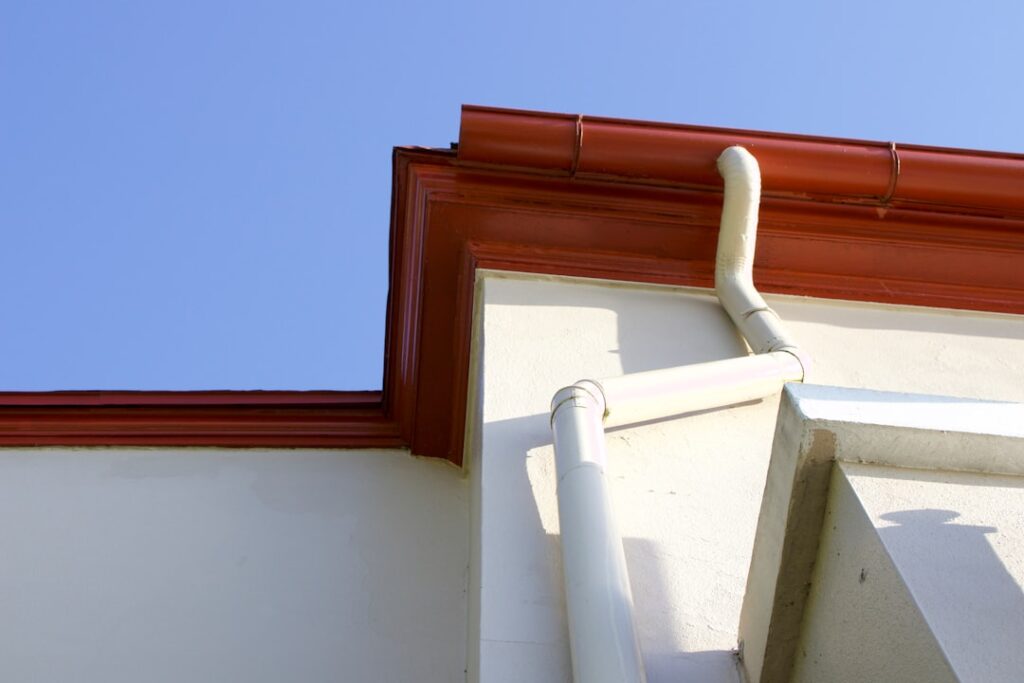
Seamless metal gutters are exactly what they sound like: a single continuous run of metal formed on-site to fit your roofline, with no joints except at inside and outside corners and downspout outlets. That one difference, far fewer seams, is why they’ve become the standard for quality gutter jobs. Fewer seams means fewer leaks, fewer clogs, and a cleaner look.
Part of our Roofing guide — explore the full guide →
Here’s the full rundown on materials, costs, and whether seamless is genuinely worth the extra money over the old sectional systems from the home center.
- How Seamless Gutters Are Made
- Why Seams Matter
- Material Options and Costs
- Choosing a Gauge and Profile
- Seamless vs. Sectional: The Real Comparison
- K-Style vs. Half-Round in Practice
- Installation: What to Expect
- Color and Finish Options
- Downspouts and Water Management
- Maintenance Still Required
- How Long They Last by Material
- Are Seamless Metal Gutters Worth It?
How Seamless Gutters Are Made
The magic is a portable roll-forming machine. An installer feeds a coil of flat aluminum, steel, or copper stock into the machine right in your driveway, and it extrudes a continuous gutter cut to the exact length of each roof run. A 40-foot side of your house becomes one unbroken piece instead of five 10-foot sections joined with connectors and sealant.
Because the machine forms them on-site, seamless gutters are effectively custom-made for your home. That’s also why they’re a professional install, since you can’t buy the continuous runs at a store.
Why Seams Matter
Every joint in a sectional gutter is a weak point. Sealant dries out, joints work loose with thermal expansion, and debris snags on the connectors inside. Within a few years, sectional seams start dripping and clogging. Seamless gutters eliminate those failure points along the straight runs entirely, leaving only the corners and outlets to seal. The result is a system that lasts longer with far less leaking and maintenance.
Material Options and Costs
Seamless gutters come in several metals, each with its own price and lifespan:
- Aluminum: the most popular by far. Rustproof, lightweight, comes in dozens of baked-on colors. Runs $6 to $13 per linear foot installed and lasts 20 to 30 years.
- Galvanized/galvalume steel: stronger than aluminum and better in heavy snow country, but can eventually rust. Roughly $9 to $18 per foot installed, 20 to 25 years.
- Copper: the premium choice, beautiful and extremely durable, developing a patina over time. Expensive at $25 to $40-plus per foot installed, but can last 50 to 100 years.
- Zinc: another long-life premium option, similar pricing to copper, popular on high-end and historic homes.
For a typical home with 150 to 200 feet of gutter, an aluminum seamless system runs $1,200 to $2,600 installed. Copper on the same house can hit $5,000 to $8,000 or more.
Choosing a Gauge and Profile
Thickness matters. Aluminum comes in .025, .027, and .032-inch gauges; the thicker .032 resists dents and holds up better under ladders and ice, and it’s worth the small upcharge. For profile, the two common shapes are:
- K-style: the flat-backed, decorative-front profile that looks like crown molding. It holds more water and is the most common choice.
- Half-round: a semicircular trough, often paired with copper on traditional and historic homes.
Size matters too. Standard residential gutters are 5-inch; step up to 6-inch on steep or large roofs to handle heavier runoff without overflowing.
Seamless vs. Sectional: The Real Comparison
Weighing the two systems side by side:
- Leaks: seamless wins clearly with almost no seams to fail; sectional leaks at every joint over time.
- Cost: sectional aluminum is cheaper up front at $4 to $9 per foot and is DIY-friendly; seamless costs more and must be professionally installed.
- Appearance: seamless looks cleaner with no visible joints.
- Maintenance: seamless clogs less because there are no internal connectors to catch debris.
- Longevity: seamless lasts longer thanks to fewer failure points.
The trade is simple: sectional saves money today, seamless saves headaches for decades. On a home you plan to keep, seamless usually wins.
K-Style vs. Half-Round in Practice
The profile you choose affects more than looks. K-style is the workhorse: its flat back mounts easily to fascia, and its wide, angular trough carries more water than a half-round of the same nominal size, making it the better pick for heavy-rain regions and large roofs. Half-round has a smoother interior that resists debris buildup and corrosion, drains cleanly, and suits traditional, Craftsman, and historic homes, especially in copper. The trade-off is that half-round holds less water and typically costs more to fabricate and hang. For most modern homes, K-style is the practical default; choose half-round when the architecture calls for it or when you want the easiest-to-clean interior.
Installation: What to Expect
A professional crew can do most homes in one day. The process runs like this:
- Remove old gutters and inspect the fascia for rot, repairing as needed.
- Roll-form the continuous runs on-site to measured lengths.
- Attach the runs with hidden hangers screwed into the fascia every 24 to 36 inches, set to the correct slope of about a quarter-inch per 10 feet toward downspouts.
- Seal and rivet the corners and downspout outlets, the only real joints.
- Hang and secure the downspouts, directing water at least 4 to 6 feet from the foundation.
Proper slope and solid hangers matter more than the gutter itself. A perfectly formed seamless gutter that’s hung flat will still pool water and overflow.
Color and Finish Options
One underrated advantage of aluminum seamless gutters is the range of baked-on enamel colors, often 25 to 30 or more, that let you match or complement your trim, fascia, and roof. The factory finish is durable and rarely needs painting for the life of the gutter. Because they’re formed from pre-finished coil stock, the color goes on before installation and won’t chip like field-painted metal. Steel gutters offer fewer colors, and copper is left to develop its natural patina rather than painted. If curb appeal matters, walk the color chart against your house before ordering, since the gutter runs the entire roofline and is more visible than people expect.
Downspouts and Water Management
Gutters are only half the system; the downspouts carry the water away, and seamless gutter jobs should include properly sized downspouts. Standard downspouts are 2-by-3-inch or the larger 3-by-4-inch, which handles more water and clogs less on big or steep roofs. Plan one downspout per 30 to 40 feet of gutter run, and make sure each discharges at least 4 to 6 feet from the foundation using extensions, splash blocks, or buried drain lines. Even flawless seamless gutters will cause wet basements and foundation problems if the water dumps right at the wall, so treat downspout routing as part of the same project.
Maintenance Still Required
Seamless doesn’t mean maintenance-free. You’ll still need to clear leaves and debris from the trough and downspout outlets once or twice a year, especially near trees. Seamless just removes the internal seams where clogs used to start. Pair them with quality micro-mesh guards and you can stretch cleaning to an annual inspection.
How Long They Last by Material
Lifespan is where the material choice really pays off, so it’s worth knowing what you’re buying into:
- Aluminum: 20 to 30 years, rustproof, the practical all-rounder.
- Galvanized/galvalume steel: 20 to 25 years, strong in snow but can rust once the coating wears.
- Copper: 50 to 100 years, essentially a lifetime investment that often outlives the roof.
- Zinc: 50-plus years, self-healing patina, a premium long-life choice.
Spread the cost over those lifespans and the pricier metals look more reasonable. Aluminum at $6 to $13 a foot lasting 25 years is a strong value, while copper’s high upfront price is offset by rarely, if ever, needing replacement.
Are Seamless Metal Gutters Worth It?
For most homeowners, yes. The modest price premium over sectional buys you a system that leaks less, clogs less, lasts longer, and looks better, and aluminum seamless is only a couple dollars more per foot than sectional once you factor in professional installation you’d often want anyway. Copper is a splurge that pays off on the right high-end or historic home, while aluminum is the practical sweet spot for everyone else.
If you’re replacing failing sectional gutters that leak at every joint, seamless metal gutters are the upgrade that actually solves the problem instead of postponing it. Choose thicker .032 aluminum, get the slope right, and you’ll have a gutter system that quietly does its job for 25 years.