Custom plantation shutters are the only window treatment that reads as permanent architecture rather than an accessory, which is why they add resale value where blinds and curtains do not. Built to the exact dimensions of each opening, they mount into the window frame and swing or tilt to control light with a solid, furniture-grade feel no soft covering matches.
This guide covers what makes custom plantation shutters worth their higher price, the louver sizes and materials to choose from, mounting styles, and realistic costs so you know what you are buying before a rep quotes you.
- What plantation shutters are
- Why “custom” matters here
- Louver sizes
- Materials compared
- Tilt options: front bar, hidden, or split
- Mounting and configuration
- What custom plantation shutters cost
- Measuring and ordering
- Frame styles and finishes
- How they compare to blinds and shutters
- Measuring pitfalls to avoid
- Living with them
What plantation shutters are
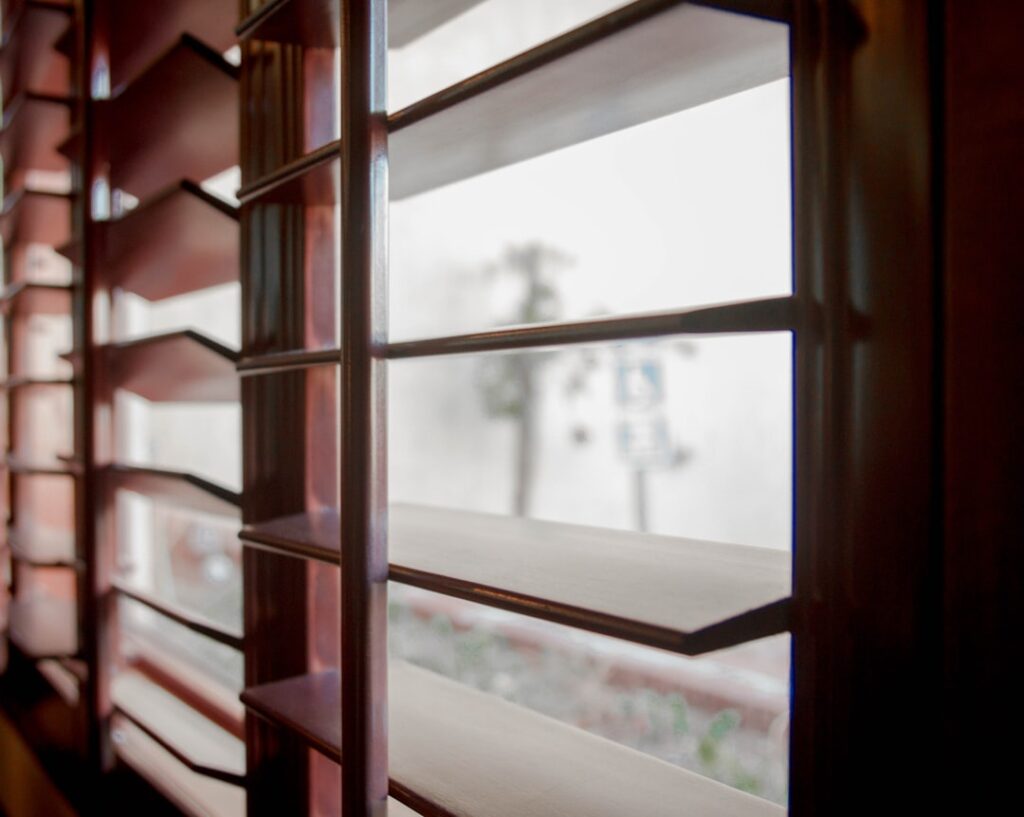
Plantation shutters are interior shutters with wide, adjustable horizontal louvers set in a solid frame that mounts inside or over the window opening. A vertical tilt bar (or a hidden tilt mechanism) rotates all the louvers together to angle light. Because they are hinged panels attached to the frame, they open fully like a cabinet door for an unobstructed view, then close and latch for privacy and a clean, shuttered facade from outside.
Why “custom” matters here
Unlike blinds you can buy off a shelf and trim, shutters must fit the opening precisely to look right and operate smoothly. Custom plantation shutters are measured and built to your window’s exact width, height, and squareness, then fitted with a frame that hides out-of-square walls, common in older homes. A stock shutter almost never fits a real window; the custom build is what delivers the tight, tailored reveal that makes them look like part of the house.
Louver sizes
Louver width sets the whole look:
- 2.5 inch: traditional, tighter spacing, suits small windows and period homes but blocks more of the view when open.
- 3.5 inch: the most popular all-around size, a balance of view and classic proportion.
- 4.5 inch: wide, modern, and airy, maximizes the view and light when open and gives fewer louvers to dust, best on larger windows.
Wider louvers generally look more contemporary and let in more light when open; narrower louvers feel more traditional. Match the size to the window scale, small windows can look busy with 4.5 inch louvers.
Materials compared
- Basswood: the premium choice, lightweight, strong, and stainable to show real grain. Best for dry rooms and larger panels because it stays rigid over wide spans. Most expensive.
- Composite / engineered wood (MDF core with a wrap): heavier and more affordable than basswood, resists warping, and takes a smooth painted finish. Span limits are lower, so very wide panels get a divider rail.
- Poly / faux wood (solid PVC or ABS): fully waterproof and the right choice for bathrooms, kitchens, and high-humidity spaces. Some are foamed around an aluminum insert for extra rigidity on wide panels.
- Vinyl: the budget option, moisture-proof but limited in color and panel size.
Choose basswood for a stained, high-end look in dry rooms; poly or faux wood anywhere there is moisture or where you want a durable painted white finish at lower cost.
Tilt options: front bar, hidden, or split
The traditional center tilt bar is a vertical rod down the front of each panel that moves all louvers together. A hidden (clearview) tilt puts the mechanism inside the panel stiles for an unobstructed view, the current designer preference. A split tilt divides a panel so upper and lower louvers move independently, letting you close the bottom for privacy while keeping the top open for light, ideal for street-facing and ground-floor windows.
Mounting and configuration
Shutters mount as an inside mount, set within the window’s depth for a recessed, built-in look that needs adequate frame depth (usually 2.5 to 3.5 inches), or an outside mount on the wall over the opening when depth is short or the window is out of square. Panel configurations include single or double panels that swing open, bi-fold panels for wide openings, and tier-on-tier where upper and lower panels operate separately. Bay and specialty-shape windows get angled frames built to the exact geometry, one of the strongest arguments for going custom.
What custom plantation shutters cost
Expect roughly $200 to $350 per window for vinyl and basic poly, $250 to $450 for quality composite, and $350 to $600 or more per window for basswood, before installation. Professional installation typically adds $65 to $150 per window. A whole house of 12 to 15 windows commonly runs $4,000 to $9,000 installed depending on material and size. It is a significant investment, but shutters are considered a permanent home improvement and typically stay with the house, recovering much of the cost at resale.
Measuring and ordering
For custom shutters, precise measurement is everything, most homeowners have the dealer measure so the fit is guaranteed. If you DIY, measure width and height at three points each, note the shallowest depth for inside mounts, and check for square by comparing diagonals. Decide louver size, material, tilt style, frame type, and hinge color before ordering, and confirm lead time; custom shutters are built to order and typically take 4 to 8 weeks.
Frame styles and finishes
The frame is what makes shutters look built-in, and there are several to match your trim. An L-frame is the most common for inside mounts, sitting flush with the wall. A Z-frame adds a lip that covers gaps around out-of-square windows, useful in older homes. A deco or decorative frame gives a more substantial, trimmed appearance for outside mounts. Finishes range from smooth painted white, by far the most popular and the most versatile, to custom paint colors matched to your trim, to natural and stained wood grains that show off basswood. A hidden rear tilt rod and a matching frame in the same color are what push shutters from generic to genuinely custom.
How they compare to blinds and shutters
Against blinds, shutters win on durability, insulation, and resale value but cost several times more upfront and cannot be swapped out on a whim. Against curtains, shutters offer better light and privacy control and never need laundering, though they lack fabric’s softness. The louvers also filter light more precisely than most blinds: tilt them slightly and you get privacy plus a soft glow, close them fully for near-darkness, or fold the panels back for a wide-open view. For homeowners planning to stay put and wanting a permanent, low-maintenance treatment that adds to the home’s value, shutters justify the premium; for renters or fast style changes, blinds or curtains make more sense.
Measuring pitfalls to avoid
- Ignoring depth: inside-mount shutters need enough window depth to clear the louvers; measure the shallowest point or plan an outside mount.
- Assuming the window is square: older openings rarely are, compare diagonal measurements, and let a Z-frame or the dealer’s build hide the discrepancy.
- Forgetting obstructions: cranks on casement windows, alarm sensors, and deep sills all affect the fit and panel swing.
- Rushing the order: custom shutters are built to order in 4 to 8 weeks and cannot be returned if mismeasured, so most buyers let the dealer measure for the guarantee.
Living with them
Lead time and installation are worth planning around. Because each panel is built to order, expect 4 to 8 weeks from measurement to delivery, longer for specialty shapes and stained wood. Professional installation takes a couple of hours per window and ensures the panels hang square and latch cleanly; a skilled DIYer can hang a straightforward inside-mount set, but bay windows and out-of-square openings reward a pro. Confirm the installer adjusts the tension so louvers hold any angle you set and do not drift shut on their own.
Shutters are the lowest-maintenance treatment once installed: wipe louvers with a dry cloth or vacuum brush, no laundering or cord replacement. They insulate the window better than blinds thanks to the solid frame and thicker louvers, cutting drafts and blocking summer heat. The main trade-offs are the higher upfront cost and the stacking of the frame that slightly reduces glass area. For homeowners who want a permanent, value-adding, low-fuss treatment, custom plantation shutters are the benchmark other window coverings are measured against.