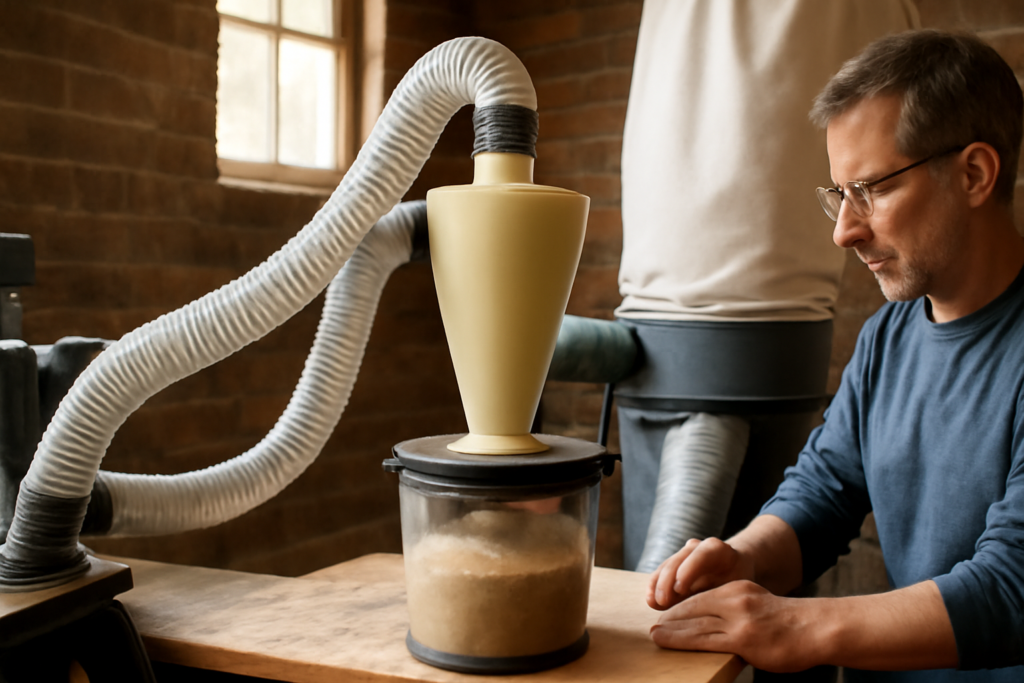
Filters and impellers are the parts that suffer most in a woodshop dust system, and a cyclone dust separator is the cheapest way to protect them. It spins incoming air so chips and most dust fall into a bin before the air ever reaches the collector’s filter or fan. The result is steadier suction, far less filter cleaning and fewer chunks of wood battering the impeller blades.
In short: add a cyclone pre-separator if your collector’s filter clogs quickly or you are tired of emptying bags every few hours. Choose inline or top-mount based on your space and hookup. Expect some loss of static pressure, and consider a full cyclone collector if you run a large shop with long duct runs and several machines.
- How a Cyclone Dust Separator Works
- Pre-Separator Add-Ons vs. Full Cyclone Collectors
- Inline vs. Top-Mount Configurations
- Efficiency vs. Static Pressure Loss
- Sizing the Cone and Bin to Your Tools
- Step-by-Step: Adding a Cyclone Dust Separator
- Troubleshooting
- Costs and When to Upgrade to a Full Cyclone
- Frequently Asked Questions
This guide explains the physics, the styles, efficiency trade-offs, installation, troubleshooting and typical costs.
How a Cyclone Dust Separator Works
Air enters the cone through a side inlet at an angle, so it spirals down along the inside wall. Heavier particles are flung outward by centrifugal force, lose speed against the wall and drop out the bottom into a collection drum. The cleaner air reverses direction in the center of the cone and rises up through an outlet tube, usually called the vortex finder, then continues to the vacuum or collector.
How well it separates depends on air speed and cone design. Tall, narrow cones spin air faster and drop finer particles. Short or poorly shaped cones let more fine dust slip through. Good units remove nearly all chips and a large share of fine dust, which is why a vortex dust collector design has become the default for serious shops.
Separation is not filtration, though. The finest particles, the kind that stay airborne and reach deep into your lungs, still travel on to the filter. A quality filter on the collector remains essential.
Pre-Separator Add-Ons vs. Full Cyclone Collectors
There are two ways to put a cyclone in your shop.
- Add-on pre-separator. A dust collector cyclone separator that bolts between your machines and an existing collector or shop vac. Small cones for shop vacs often sit on a 5-gallon bucket; larger ones for 1 to 2 horsepower collectors sit on a 30 to 55-gallon drum.
- Full cyclone collector. A purpose-built system where the cone, blower and filter are engineered together. The motor sits on top, the cone below, and the bin at the bottom. These cost more but are designed for the airflow they must move.
A plain dust collector separator lid or baffle bin is a third, simpler option. It uses a baffle rather than a true cone and catches heavy chips well, though it drops fewer fine particles.
Inline vs. Top-Mount Configurations
Inline separators sit in the duct between the tool and the collector. The hose from the machine goes to the cyclone inlet, and the outlet goes to the collector inlet. This is the most common way to retrofit a single-stage bag collector, and it can live on a mobile cart beside the collector.
Top-mount designs place the cone directly on the collector or on a drum under the blower, eliminating the extra hose between them. That shorter path reduces airflow losses. Some single-stage collectors can be converted by replacing the separator ring with a cone kit.
Pick inline when you want flexibility or a quick upgrade. Pick top-mount when floor space is tight and you want the best airflow from the same motor.
Efficiency vs. Static Pressure Loss
Every cyclone costs you some suction. Spinning air against a cone wall and turning it back up through the center creates resistance, measured as static pressure loss. A well-designed cone may add a few inches of water column of resistance at its rated airflow; a small or poorly matched one can add more.
For a shop vac, that loss is usually minor because vacs develop very high pressure. For a single-stage collector with modest pressure, adding a cyclone plus flex hose can drop airflow noticeably at the tool. Signs that you have lost too much include chips piling in a planer’s chute or a table saw leaving dust behind the blade.
Ways to limit the loss:
- Match the cone inlet size to your hose or duct. A 4-inch collector should feed a 4-inch or larger inlet, not a reducer to 2 1/2 inches.
- Keep the cyclone-to-collector connection short and smooth, using rigid duct or a brief length of flex.
- Use long-radius elbows and wye fittings instead of tight 90-degree bends.
- Keep filters clean; a clean filter makes up for much of the cyclone’s resistance.
In most cases, the trade is worth it. A clogged filter costs far more airflow than a cyclone does, and the cyclone keeps that filter clean far longer.
Sizing the Cone and Bin to Your Tools
Match the separator to the machine feeding it. A shop vac cone with a 2 1/2-inch inlet suits sanders, routers, track saws and miter saw ports. A 4-inch cone fits a 1 to 1 1/2 horsepower collector serving one tool at a time, while 5- and 6-inch inlets belong on 2 horsepower and larger systems pulling through fixed duct. Undersizing the cone chokes airflow; oversizing it slows the air so much that fine dust never spins out.
Bin capacity matters too. Planers and jointers fill a 5-gallon bucket in minutes, so plan on a 30- to 55-gallon drum for thicknessing lumber. Sanding and routing produce fine powder in small volumes, and a bucket is usually plenty. If you work mostly with sheet goods such as plywood and MDF, prioritize a taller cone and a good downstream filter, because that material produces a high share of very fine particles.
Step-by-Step: Adding a Cyclone Dust Separator
Tools and materials: the cyclone kit, a drum or bucket with a sealing lid, flex hose, hose clamps, foil tape or silicone, a drill/driver and a caster dolly if the setup will move. Turn off and unplug the collector before connecting anything.
- Choose the location. Put the cyclone between the tools and the collector, ideally close to the collector.
- Mount the cone on the drum. Seal the lid gasket carefully. Any air leak at the bin destroys separation and pulls dust back up the cone.
- Stiffen the drum. Thin plastic or fiber drums can collapse under strong suction. Use a metal drum or add internal bracing when running a collector.
- Connect the inlet. Run the hose from the machine or main duct to the side inlet and clamp it.
- Connect the outlet. Run a short hose from the top outlet to the collector’s inlet.
- Seal and ground. Tape every seam, and bond metal fittings with a bare copper wire to reduce static buildup.
- Test. Run a few boards through a planer and check the collector bag. It should stay nearly empty while the drum fills.
Empty the drum before it reaches about three-quarters full. Chips that pile into the cone throat get re-entrained and pass straight to the filter. A clear window or level sensor on the drum helps.
Troubleshooting
Dust reaching the filter. Look for leaks at the lid, a drum that is too full, or airflow too low to spin the cone properly.
Drum collapses. Suction is too strong for the container. Switch to a steel drum or a reinforced bin.
Clogs at the inlet. Long shavings from a jointer or planer can bridge a small inlet. Use the largest inlet the kit offers and avoid tight elbows before the cone.
Static shocks. Bond fittings, use anti-static hose and keep the shop from getting bone dry in winter.
Weak suction at the tool. Clean the collector filter, shorten flex runs and verify the cone suits your collector’s airflow.
Costs and When to Upgrade to a Full Cyclone
Small shop vac cyclone lids and buckets are low-cost upgrades, often under a hundred dollars. Larger add-on cones for 1 to 2 horsepower collectors typically run from roughly one hundred to a few hundred dollars. Full cyclone collectors generally start in the high hundreds and can reach a few thousand dollars.
Consider a full cyclone dust collector when you run several stationary machines through fixed ducts, when runs exceed 25 feet, or when your single-stage unit cannot keep up even with a pre-separator. If you add a large 240-volt collector, have a licensed electrician install the circuit. Keep collectors away from sparks and grinders; wood dust is combustible, and metal particles in a wood dust bin can start a smoldering fire.
Frequently Asked Questions
Does a cyclone dust separator reduce suction?
Yes, a little. The cone adds some static pressure loss, but it keeps the filter much cleaner, so overall suction is usually steadier than without one.
Can I use a cyclone separator with a shop vac?
Yes. Small cones on 5-gallon buckets are designed for shop vacs and dramatically reduce filter clogging and bag replacement.
What is the difference between a cyclone and a baffle separator?
A cyclone uses a cone to spin air and drop fine particles. A baffle separator uses a plate to slow air and drop heavy chips, so it catches less fine dust.
How full should I let the cyclone drum get?
Empty it before about three-quarters full. An overfilled drum lets chips get pulled back up and sent to your filter.
Is a full cyclone collector worth it for a small shop?
For one or two machines, an add-on pre-separator on a good single-stage collector is usually enough. A full cyclone pays off with multiple machines and long duct runs.