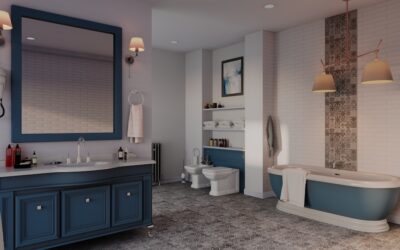
Most homeowners who attempt a moody bathroom remodel pick the wrong gray and end up with a space that feels like a parking garage. A well-executed dark gray bathroom hits a balance between drama and warmth, using charcoal walls or slate tile alongside enough natural light, brass or matte black hardware, and softer accent textures. Done right, it reads spa-like. Done wrong, it reads dungeon. The good news is the difference comes down to four or five decisions, and none of them require an interior designer on retainer.
Part of our Bathroom Remodeling & Flooring guide — explore the full guide →
Choose the Right Shade of Gray
Not every dark gray works in a small, low-light room. Cool-leaning grays like Benjamin Moore Wrought Iron or Sherwin-Williams Iron Ore have blue or green undertones that can flatten under cool LED lighting. Warmer charcoals such as Farrow & Ball Down Pipe or Benjamin Moore Kendall Charcoal hold up better in bathrooms with minimal windows because they carry a hint of brown undertone.
Test the color in 12×12-inch samples on at least two walls. Look at the swatch at 7 a.m., noon, and 9 p.m. Bathroom lighting changes more dramatically than any other room because of the mirror, the vanity light, and (often) a single overhead fixture all bouncing differently off tile.
Tile Pairings That Avoid the Cave Effect
Pair charcoal walls with one lighter element to keep the room from collapsing in on itself. Most successful designs combine dark gray with one of three contrasts:
- White subway tile on the shower wall — keeps the wet zone bright, especially when paired with light gray grout
- Honed marble countertops in Carrara or Calacatta — the veining catches light and breaks up the mass of color
- Wood-look porcelain plank floors in a mid-tone oak — adds warmth without competing for attention
Avoid dark floor + dark wall + dark vanity. That trio works in a 200 sq ft primary suite with a big window. In a 5×8 hall bath, it will feel claustrophobic by week two.
Lighting Is Non-Negotiable
Dark walls absorb roughly 15-20% more light than white walls, which means a 60-watt bulb effectively performs like a 45-watt in the same fixture. Compensate by layering three sources: an overhead canister or flush mount, sconces flanking the mirror at face height (around 66 inches from the floor), and either a recessed shower light or LED toe-kick under the vanity.
Stick to bulbs rated 2700K to 3000K. Anything cooler than 3500K will turn warm grays gray-blue and make skin tones look ashy in the mirror — a small detail that ruins the room when you’re trying to get ready for work at 6 a.m.
Hardware and Fixture Finishes
Three finishes work consistently well against charcoal: unlacquered brass, matte black, and brushed nickel. Polished chrome can read cold and cheap in this palette and is best avoided unless you’re working with a strong vintage theme.
Brass is the safest crowd-pleaser. A brushed brass faucet from Delta’s Trinsic line (around $260) or a Kohler Purist (around $580) on a floating walnut vanity will sell the look immediately. Matte black faucets cost less but show water spots and toothpaste splatter more obviously — fine for adults, frustrating for kids’ bathrooms.
Vanity and Storage Choices
A floating vanity in walnut or rift-cut white oak is the single most photographed element of any high-end dark gray bathroom. Floor space underneath makes the room look 6-8 inches larger than it is. If a floating unit isn’t structurally possible (older homes with plaster walls often can’t support the load without blocking), a leggy console vanity from West Elm or Pottery Barn achieves a similar effect for under $1,400.
Skip painting the vanity the same gray as the walls. The room loses depth instantly. Even one shade lighter — or, ideally, a contrasting wood — creates the visual layering that gives the space dimension.
Textiles, Plants, and Soft Touches
The fastest way to warm up a dark gray bathroom is with texture. Add a thick cotton bath mat in cream or oatmeal, oversized waffle-weave towels in white or terracotta, and a single trailing plant — pothos and English ivy both tolerate low-light bathrooms with humidity. A small woven basket beside the vanity for toilet paper or magazines breaks up the hard surfaces.
Skip anything fussy. Heavy patterns, multiple accent colors, or too many decorative bottles will fight the calm the dark color is supposed to deliver.
Common Mistakes That Sink the Look
Three errors show up over and over in DIY dark gray bathroom remodels. First, choosing a high-sheen paint — eggshell or matte is correct for walls; semi-gloss bounces too much light and highlights every roller mark. Second, using stark white grout with dark tile in a wet area; it will discolor in 18 months. Use a gray grout that’s two shades lighter than the tile. Third, forgetting to seal grout and natural stone within 30 days of install — once mineral deposits set in, you’ve lost the clean look that justified the upgrade in the first place.
Budget Expectations
A full bathroom paint-and-hardware refresh in this style runs $400-$900 in materials (paint, faucet, mirror, lighting, accessories). A full remodel with new tile, vanity, and fixtures runs $9,000-$22,000 depending on whether you DIY any of it. The single biggest cost driver is wall tile in the shower — porcelain runs $4-$9 per sq ft installed, while a hand-glazed zellige tile can hit $25-$40 per sq ft installed.
If you’re working with a $3,000 budget, prioritize paint, lighting, and the vanity. Keep existing tile if it’s neutral, and add black or brass hardware as the unifying detail.