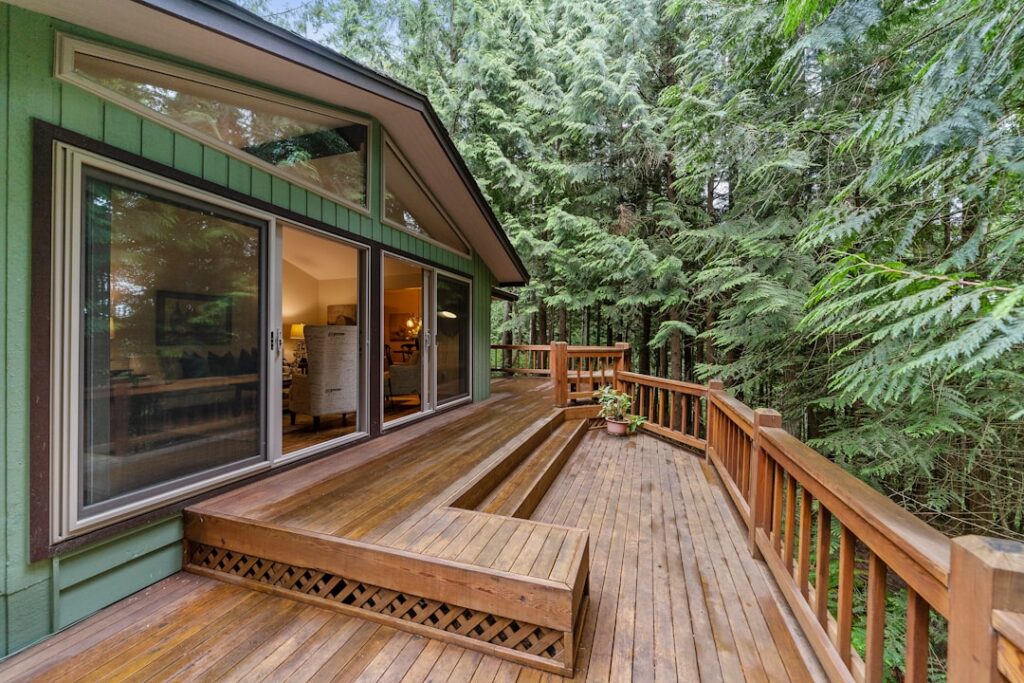
A reliable deck staining cost calculator starts with two numbers: your deck’s square footage and the price per square foot for the job. Do the DIY route and you are looking at roughly $0.50 to $1.25 per square foot in materials, while hiring a professional runs $2 to $5 per square foot including labor. For a standard 300-square-foot deck, that means somewhere around $150 to $375 in materials if you do it yourself, or $600 to $1,500 to have a contractor handle everything from prep to final coat.
Part of our Decks & Outdoor guide — explore the full guide →
Those ranges are wide because the details matter: the condition of your wood, how much railing and stair surface you have, the type of stain you choose, and whether the old finish needs stripping all move the final number. This guide walks through how to measure your deck accurately, figure coverage, budget for prep, and run the actual math on a real-world example so you can build a number you trust before spending a dollar.
Cost Per Square Foot: DIY vs. Professional
The single biggest cost driver is whether you supply the labor. Staining is labor-intensive rather than technically difficult, so doing it yourself eliminates the largest line item. DIY materials, meaning stain plus cleaner and applicators, typically land between $0.50 and $1.25 per square foot. A gallon of quality deck stain costs $30 to $60, and most decks need two coats, so material cost scales with size and how thirsty the wood is.
Professional staining costs $2 to $5 per square foot, and occasionally more for intricate railings, multi-level decks, or premium stains. That price bundles labor, materials, prep, and cleanup, and labor alone usually accounts for 50 to 70 percent of the total. A pro brings sprayers, back-brushing experience, and speed, finishing in a day or two what might take a homeowner a full weekend. The decision often comes down to your time: if your weekend is worth more than the $450 to $1,100 in labor you would save on a 300-square-foot deck, hiring out makes sense. If not, DIY captures real savings.
How to Measure Your Deck’s Square Footage
Accurate square footage is the foundation of any estimate, and most people underestimate because they forget the vertical surfaces. Start with the deck floor: multiply length by width. A 15-foot by 20-foot deck floor is 300 square feet. That is your base number, but it is rarely the whole story.
Railings add substantial surface area and eat stain quickly because of all the spindles. As a rule of thumb, add roughly 20 to 30 percent to your floor square footage to account for railings, or measure them directly by calculating the linear feet of railing and multiplying by the height, then doubling for both sides. Stairs are another commonly missed area; each step has a tread and a riser, so estimate about 2 square feet of surface per linear foot of stair width, per step. Built-in benches, planters, and skirting all add more. When in doubt, round up, because running out of stain mid-project and getting a slightly different tint from a new batch is a real and avoidable headache.
Understanding Stain Coverage Rates
Stain coverage is where many budgets go wrong, because the number on the can is a best-case figure for smooth, sealed wood. Most deck stains list coverage of 200 to 300 square feet per gallon for the first coat. Real-world coverage on weathered, thirsty, or rough-sawn lumber often drops to 150 to 200 square feet per gallon, because dry wood drinks the first coat.
The type of stain also changes coverage. Transparent and semi-transparent stains soak in and cover less area per gallon but show the wood grain, while solid and semi-solid stains sit more on the surface and cover slightly more. Second coats always go further than first coats, sometimes 300 to 400 square feet per gallon, because the wood is already partially sealed. To estimate gallons, divide your total square footage by the low end of the coverage range, then add a coat. For a 360-square-foot total surface needing two coats, plan on about 3 to 4 gallons rather than the 2 gallons the optimistic label math suggests.
Prep Costs You Cannot Skip
Prep is the unglamorous half of the job, and skimping on it is the top reason stain fails early. At minimum you need a deck cleaner to strip dirt, mildew, and gray oxidized fibers; a gallon of concentrate runs $15 to $25 and covers a few hundred square feet. For decks with mildew or a tired existing finish, a wood brightener, which neutralizes cleaner and reopens the wood pores, costs another $15 to $25 and noticeably improves how evenly the new stain absorbs.
If the old finish is a peeling solid stain or a film-forming sealer, you may need a chemical stripper at $25 to $40 per gallon plus more elbow grease, and possibly a sander. Renting an orbital or belt sander runs $40 to $70 per day, and you will need sandpaper on top of that. Add basic supplies most projects require: brushes and a roller ($20 to $40), a paint pad or stain applicator on a pole ($15 to $25), painter’s tape and drop cloths ($15), and gloves. Altogether, prep and supplies commonly add $60 to $150 to a DIY project before you buy a single gallon of stain, which is exactly why the honest DIY floor is closer to $0.75 per square foot than the rock-bottom $0.50 figure.
A Worked Example: 300 Square Foot Deck
Consider a common backyard deck: a 15-by-20-foot floor, so 300 square feet, with perimeter railings on three sides and a short flight of four stairs. First, adjust for the true surface area. Railings add roughly 25 percent, bringing us to about 375 square feet, and the stairs add another 15 or so, for a working total near 390 square feet of surface to coat.
Now the DIY math. At real-world coverage of about 175 square feet per gallon for two coats, that 390-square-foot surface needs roughly 4 gallons of stain. At $45 a gallon, stain is $180. Add a gallon of cleaner ($20), a gallon of brightener ($20), and applicators, brushes, and tape ($50), and materials total around $270, which pencils out to about $0.90 per square foot on the original 300-square-foot footprint. That is a realistic DIY number, not the optimistic floor. By contrast, a professional charging $3.50 per square foot on the same deck, priced on the finished surface area, would quote roughly $1,300 to $1,400 all-in, with the difference being labor and their built-in efficiency.
What Makes the Price Go Up or Down
Several factors swing your final cost meaningfully. Wood condition is first; a new or well-maintained deck needs only a wash before staining, while a deck with peeling old finish needs stripping and sanding that can double prep labor and cost. Stain type matters too, as premium oil-based and hybrid stains cost $50 to $70 per gallon versus $30 to $40 for economy products, and the pricier ones often last longer and go on more evenly, so the higher upfront cost can be the better value over a 3-to-5-year cycle.
Deck complexity is the other big lever. A simple ground-level rectangle stains fast, but multi-level decks, intricate railing designs, pergolas, and built-in seating multiply the surface area and the fiddly cutting-in time, which pros price accordingly and DIYers pay for in hours. Regional labor rates also matter; the same job costs noticeably more in high-cost metro areas than in rural markets. Finally, timing counts. Staining in mild, dry weather between 50 and 90 degrees Fahrenheit with no rain for 24 to 48 hours afterward gives the best results, and rushing a job in poor conditions often means redoing it, which is the most expensive outcome of all.
Using the Numbers to Build Your Budget
Pulling it together, a practical deck staining cost calculator is just a short sequence: measure the floor, add 20 to 30 percent for railings and a bit more for stairs, divide the total by a realistic 175 square feet per gallon and multiply by your number of coats, then price the stain and add $60 to $150 for prep and supplies. That gives you a defensible DIY materials budget. To evaluate hiring out, multiply your finished surface area by $2 to $5 and compare.
For most homeowners with a straightforward 200-to-400-square-foot deck in decent shape, budget $150 to $400 to stain it yourself over a weekend, or $600 to $2,000 to hire a professional. Set aside a 10 to 15 percent contingency for the extra gallon or the surprise soft board you did not plan on. Whichever route you choose, the money spent on proper cleaning and brightening is the best investment in the whole project, because a well-prepped deck holds its finish two to three years longer and spreads that cost across far more seasons of use.