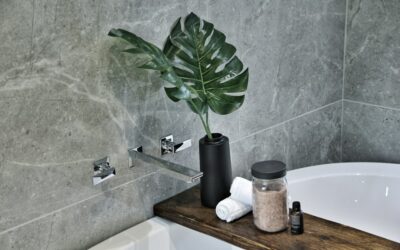
Bathrooms are the smallest rooms in most homes and the hardest to decorate well. Humidity destroys materials that work everywhere else, scale and color have to be precise because there’s no room to hide mistakes, and the room still needs to function for the actual showering, shaving, and tooth-brushing people are doing in there. Decorating a bathroom well means choosing pieces that survive 70% humidity, look good in artificial light, and don’t make a 5×8 space feel like a closet. Here’s the playbook that consistently works.
Part of our Bathroom Remodeling & Flooring guide — explore the full guide →
- Start With Your Color Story
- Lighting Is the Decorating Foundation
- Wall Decor That Survives Humidity
- Textiles That Pull the Room Together
- Storage That Looks Intentional
- Plants That Survive Real Bathroom Conditions
- Mirrors Beyond the Builder Grade
- Hardware as Jewelry
- Accessories With Restraint
- Putting It All Together on a $500 Budget
Start With Your Color Story
Two-color schemes work best in small bathrooms. Pick one neutral (white, warm gray, or soft greige) and one accent (deep green, navy, terracotta, or muted blue). Three or more colors crowd the space visually unless the bathroom is over 80 square feet.
Specific palettes that age well include warm white with brushed brass accents, charcoal gray with matte black fixtures, soft white with sage green, and warm white with navy. Avoid pure stark whites — they read clinical under most bathroom lighting and show every speck of grime.
Lighting Is the Decorating Foundation
You can have perfect tile and beautiful art, but bad lighting kills the whole effect. Three light layers should work together: ambient (overhead), task (at the mirror), and accent (a small lamp or sconce that softens the room when you’re winding down at night).
Bulb temperature matters more than fixture style. Stick to 2700K-3000K bulbs (warm white) with CRI 90+ for accurate skin tones. The same fixture with a 4000K daylight bulb instead of warm white reads completely different — colder, harsher, and unflattering. Brands like Cree Pro Series and Philips Ultra Definition hit the right specs at $4-$8 per bulb.
Wall Decor That Survives Humidity
Standard paper art in cardboard frames does not survive a daily-use bathroom. Within a year, the matting buckles and the paper develops faint waves. Three approaches actually work:
- Framed prints with acrylic glazing: Better moisture resistance than glass, lighter weight
- Canvas prints with sealed surfaces: Liquitex matte varnish protects against daily humidity
- Wood signs or panels: Sealed wood handles humidity well, adds warmth
- Ceramic or metal wall pieces: Essentially humidity-proof, last decades
Hang art at least 18 inches above the highest splash zone. Above-toilet placement should sit 6-8 inches above the tank. Above-vanity art should clear the highest faucet handle by at least a foot.
Textiles That Pull the Room Together
The fastest visual upgrade in any bathroom is replacing the towels, bath mat, and shower curtain as a coordinated set. Stick to one color family across all three. Hotel-quality cotton towels (Brooklinen Super-Plush, Parachute Classic) cost $25-$40 each and replace tired Target sets that have been there since you moved in.
For the bath mat, pick something that drains. Wood mats (teak or bamboo) at $40-$80 last 5-10 years and look upscale. Cotton bath rugs need to come up after each shower to dry — leaving them flat traps moisture and breeds mildew within a season.
Storage That Looks Intentional
The decorating mistake most homeowners make is treating storage and decor as separate categories. They’re not. Open shelving with curated baskets, glass jars, and folded towels reads as decor, not utility. Closed cabinets full of products read as clutter just because the door’s transparent or open.
Three-tier rolling carts from IKEA (Råskog at $40) tuck into 18-inch gaps and hold hair tools, supplies, and overflow. Wicker baskets in matching sizes corral toilet paper rolls and extra towels. Pottery Barn ceramic jars hold cotton balls and Q-tips on the counter, signaling intention rather than chaos.
Plants That Survive Real Bathroom Conditions
Most bathrooms are low-light, high-humidity environments. Roughly five plants thrive there with minimal effort.
Pothos handles almost any light level and tolerates being forgotten about. Snake plants survive in low-light bathrooms for years on near-zero water. ZZ plants are practically indestructible. Boston ferns love the humidity but need a north or east-facing window. Air plants don’t need soil at all — they sit in a glass globe and get misted weekly.
Skip orchids in bathrooms unless you have a south-facing window. They look magazine-perfect for two weeks, then drop flowers and judge you.
Mirrors Beyond the Builder Grade
The single biggest visual upgrade for under $300 is replacing a builder-grade plate glass mirror with something framed and architectural. Round, arched, or thin-frame rectangular mirrors all read more current than the standard slab.
Mirror size matters. Above a 36-inch vanity, the mirror should span 24-32 inches wide. Above a 24-inch vanity, 18-24 inches works. Going too small leaves visual gaps that make the wall look unfinished.
Hardware as Jewelry
Think of fixtures, knobs, and pulls as the jewelry of the room. Pick one finish and stick with it across the faucet, shower trim, towel bars, drawer pulls, light fixtures, and even the toilet flush handle. Mixed finishes work in larger bathrooms but rarely in small ones — the eye picks up the inconsistency and reads “unfinished.”
Brushed nickel and chrome are dated for new design in 2024. Matte black is past its peak. Brushed brass and aged bronze are the finishes designers are specifying most this year, with polished nickel making a quiet comeback in high-end traditional bathrooms.
Accessories With Restraint
The temptation in a small bathroom is to fill every surface with decor. Resist it. Three to five styled objects on the counter (soap dispenser, hand lotion, single candle, one decorative tray) is the maximum before the room starts to look cluttered.
A single live element — fresh eucalyptus stems in a vase, a small olive tree in the corner, or a hanging air plant — adds more visual interest than ten ceramic trinkets. Fresh eucalyptus lasts 3-4 weeks in a vase and releases a mild scent during showers from the humidity.
Putting It All Together on a $500 Budget
A complete bathroom refresh under $500 looks like this: $80 framed art set, $90 coordinated towel set, $60 wood bath mat, $50 plant and ceramic pot, $80 mirror, $40 hardware upgrade on the vanity, $50 ceramic accessories tray and dispensers, $50 lighting bulbs and small accent lamp. That’s a complete visual reset without paint, fixtures, or contractor labor.