More Roman tub orders go wrong over one hidden part than over every visible part combined: the rough-in valve buried under the deck, which Delta sells separately from every trim kit in the catalog. A Delta Roman tub faucet is a two-piece purchase — the R2707 or R2907 rough valve that plumbs in below, and a series-matched trim (Trinsic, Lahara, Cassidy, and a dozen others) that shows above — and understanding which valve pairs with which trim is 90 percent of getting the job right. This guide covers exactly that pairing logic, plus deck layout dimensions, handshower add-ons, the install sequence, and what the whole package costs. For Delta’s brand history, lavatory lines, cartridge families, and warranty details, see our dedicated Delta articles; this one stays on the tub deck.
What Makes a Faucet “Roman Tub”
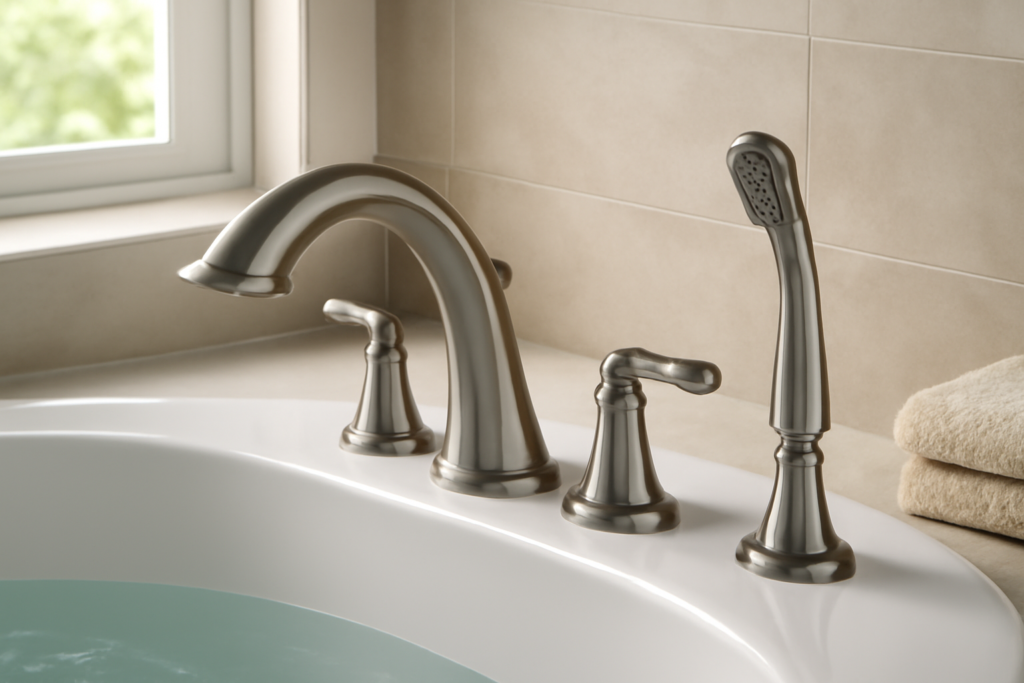
A Roman tub faucet is a deck-mounted tub filler: it mounts through holes in the horizontal surface surrounding a drop-in or undermount soaking tub — the tile or stone deck, or the tub’s own rim flange — rather than on the wall or a freestanding leg. The defining traits: a tall, high-arc spout that clears the deck and pours into a wide basin, two separate handles flanking it (almost always on 8-inch or wider centers), and high flow. Delta’s Roman tub valves deliver up to roughly 18 to 20 gallons per minute at typical pressures — triple a shower valve’s flow — because filling an 80-gallon soaker at shower rates takes half an hour. If your tub sits in a tiled deck alcove with three holes across the corner, a Roman tub set is what fits there.
The Two Rough Valves: R2707 and R2907
Every current Delta Roman tub trim mounts on one of two rough-in bodies, and the difference is the handshower:
- Delta R2707 — the standard 2-handle Roman tub rough. Two valve bodies and a spout tee, connecting 1/2-inch or 3/4-inch supplies, for trims without a hand-held sprayer. Street price about $70 to $110.
- Delta R2907 — the same architecture plus a fourth port and integral diverter passage feeding a deck-mounted handshower. Required for any “with handshower” trim (model numbers like T4759-BL versus T2759-BL without). About $90 to $140.
Three rules save the common mistakes. First, the valves are not interchangeable at trim time: a handshower trim cannot run on an R2707, and while a non-handshower trim can technically cap an R2907, you lose the fourth hole’s purpose — decide on the sprayer before the deck is built. Second, both roughs are adjustable for deck thickness within a range (roughly 1/2 inch to 2-1/2 inches of deck material; extension kits like the R2707-XT exist for thick stone decks — measure your finished deck stack before ordering). Third, buy the rough early: it installs during framing and tile, weeks before trim, and having the actual valve on site lets the tile installer drill holes exactly where the bodies land.
Trim Series Compatibility
Delta’s genius (shared with its shower ecosystem) is that one rough serves every style, so the trim decision is purely aesthetic and budget-driven. Current Roman tub trims that mount the R2707/R2907 include:
- Trinsic (T2759 / T4759) — slim modern cylinders; the matte black version is Delta’s contemporary best-seller. Trim runs $400 to $650.
- Lahara (T2738) — soft transitional curves, the mid-market volume pick at $300 to $450.
- Cassidy (T2797 / T4797) — traditional with cross or French-curve lever options, $450 to $700.
- Ashlyn, Windemere, Linden, Stryke, Tetra — spanning builder-grade ($250) to designer ($800) tiers.
Finishes follow Delta’s standard palette — Chrome, Brushed Nickel/Stainless, Champagne Bronze, Matte Black, Venetian Bronze — with SpotShield versions on some lines. Handles ship with the trim, and most series offer optional metal or porcelain lever variants. Total package math: rough plus trim lands between $350 (Windemere on R2707) and $950 (Cassidy with handshower on R2907), before labor.
Deck Layout: The 3-Hole (and 4-Hole) Template
Standard Delta Roman tub geometry uses three holes for the basic set: spout center, with hot and cold handles flanking it at 8-inch minimum centers — Delta’s roughs allow adjustable spreads, typically 8 to 16 inches, since the three bodies connect by tubing rather than a rigid manifold. Handshower models add a fourth hole, usually beyond the cold handle or on the tub’s far corner within hose reach. Layout rules that come from field experience: keep hole centers at least 3-1/4 inches from the tub’s inner rim so escutcheons seat on flat deck; confirm the spout’s reach (Trinsic’s is about 6-1/2 inches) lands water inside the basin from your chosen hole position; drill deck holes at 1-3/8 to 1-1/2 inches unless the spec sheet says otherwise; and dry-set the trim on the tile before final glue-down of anything. Below deck, leave a genuine access panel — 12 by 12 inches minimum through the tub skirt or an adjacent closet — because the valves, connections, and future cartridge service all live down there, and a sealed deck turns a $6 O-ring into a demolition job.
Handshower Add-Ons: Worth the Fourth Hole?
The R2907-based sets cradle a hand sprayer on the deck, fed through a pull-up diverter on the spout. In daily use it earns its cost: rinsing hair without dunking, washing children and dogs, and — the reason cleaners endorse it — rinsing the tub and deck down after use. The tradeoffs are a longer hose loop under the deck that must be free to retract, roughly $100 to $200 added across rough and trim, and code’s requirement for backflow protection, which Delta builds into the diverter assembly on listed models. If the tub will ever be used for anything besides adult soaking, take the handshower; retrofitting one after the deck is tiled means finding a matching trim, drilling stone, and swapping the rough — in practice, nobody does it.
Installation Sequence
The rough stage belongs to the plumber or a confident DIYer at rough plumbing time: mount the R2707/R2907 bodies to blocking beneath the deck at the layout dimensions, sweat or thread the supply connections (3/4-inch feeds reward the high-flow spout if available), pressure-test, and cap for construction. Trim day, after tile:
- Flush both valves into a bucket before any trim goes on — construction debris kills new cartridges in seconds.
- Thread the spout adapter and set the spout, aligning its set screw or mounting nut per the series sheet.
- Install cartridges (Delta Roman tub trims use the RP1740-family stem cartridges on most 2-handle sets — quarter-turn ceramic on current production), then handles, checking hot-left before tightening.
- Seat escutcheons on their gaskets; run a thin silicone bead where the deck sees standing water, leaving weep gaps.
- Connect the handshower hose and confirm the diverter returns flow to the spout when released.
- Fill test: run both temperatures wide open, watch every connection from the access panel for ten minutes.
Labor pricing: trimming an existing rough runs $150 to $350; a full new install with supplies, blocking, and rough valve typically lands at $500 to $1,000 of plumber time within a tub-deck build.
Buying Checklist
Before checkout, confirm five things: the trim model number matches your sprayer decision (T-prefix 2-series without, 4-series with handshower); the correct rough (R2707 vs R2907) is in the cart, since almost no trim includes it; deck thickness falls inside the valve’s adjustment range or you have added the extension kit; the finish is in stock across every piece, including the handshower cradle; and there is an access panel in the plan. Delta’s lifetime residential warranty on parts and finish covers the set — register it, photograph the rough installation before the deck closes, and file the spec sheets in the access panel itself. Done that way, a Delta Roman tub set is about as future-proof as deck plumbing gets: the style above can change with a $400 trim swap in an afternoon, while the valve below keeps working through all of it.