Walk into any garage with a peeling, oil-stained slab and you’re looking at the exact problem armor epoxy was built to solve. The Armor brand has carved out a serious following among DIY garage refinishers because their high-solids formula resists hot tire pickup, road salt, and dropped tools far better than the 50 percent solids kits sold at big box stores. If you’re researching whether to use it, here’s what you need to know before you buy a kit.
Part of our Epoxy, Concrete & Garage Floors guide — explore the full guide →
- What Makes Armor Epoxy Different
- Product Lines Compared
- Surface Prep Is 80 Percent of the Job
- Moisture Testing You Cannot Skip
- Mixing and Application Walkthrough
- Realistic Cost Breakdown
- Common Mistakes That Ruin the Finish
- Maintenance for the Long Haul
- Decorative Chip Patterns
- Comparing Armor to Other Brands
What Makes Armor Epoxy Different
The headline number is solids content. Armor’s flagship product, AG (Armor Granite), is a 100 percent solids epoxy, meaning the entire volume in the can ends up as cured film on your floor. Big box kits typically run 40 to 60 percent solids — the rest is solvent and water that evaporates, leaving a thin coating that wears through in two or three years.
A 100 percent solids product builds 10 to 15 mils per coat. That’s roughly four times thicker than a typical hardware-store epoxy. Thicker film equals better impact resistance, better stain protection, and a coating that won’t lift when you park a hot vehicle on it after a summer drive.
Product Lines Compared
Armor sells several formulas tailored to different jobs:
- AG (Armor Granite) — premium 100% solids, designed for garages, includes decorative chips. Around $250 to $400 for a two-car kit.
- AU (Armor U) — 100% solids polyurethane topcoat, used over AG for UV stability and chemical resistance.
- AR350 / AR500 — penetrating concrete sealers for outdoor patios, driveways, and pavers. Not a coating; densifies the surface.
- SX5000 — silane-siloxane water repellent for vertical or horizontal concrete. Good for stamped concrete.
Most homeowners installing a garage floor want the AG kit, and many add the AU clear coat on top for showroom gloss and UV protection.
Surface Prep Is 80 Percent of the Job
No epoxy bonds to dirty, sealed, or smooth concrete. Skip prep and you’ll be scraping the floor in 18 months. Start by degreasing oil spots with a citrus-based cleaner like Pour-N-Restore, then etch the entire slab with the muriatic acid or citric acid wash included in the Armor kit. The concrete should feel like 120-grit sandpaper when you run a dry hand across it after rinsing.
For a slab that has previously been sealed, etching alone won’t open the surface. Rent a walk-behind diamond grinder for $80 to $120 a day from a tool rental yard and grind the entire floor with a 30/40 grit metal-bond cup wheel. Vacuum thoroughly with a HEPA shop vac afterward.
Moisture Testing You Cannot Skip
Concrete that vapors moisture will lift any epoxy off the slab within months. Tape a 2-by-2-foot square of clear plastic sheeting to the floor in three different spots overnight. If you see condensation on the underside in the morning, the slab has unmanaged moisture vapor and you need a moisture-mitigating primer like Armor’s WB before installing AG. New slabs need 30 days minimum cure before any coating.
Mixing and Application Walkthrough
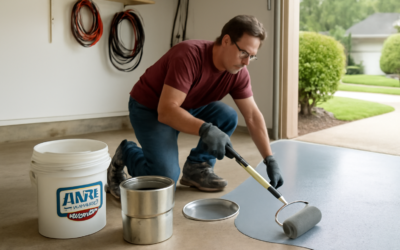
Two-component epoxy has zero forgiveness on mix ratios. Pour Part B into Part A in the exact ratio printed on the can — usually 2:1 by volume — and mix with a paddle on a low-speed drill for three full minutes, scraping the sides and bottom. Pot life on AG is about 40 minutes at 70°F, less if it’s warmer.
Apply with a 3/8-inch nap roller in three-foot sections, back-rolling each pass to even out the coating. Broadcast decorative chips immediately while the epoxy is wet — once it skins over, chips won’t stick. Let cure 16 to 24 hours before walking on it, 72 hours before parking a vehicle.
Realistic Cost Breakdown
For a standard 500-square-foot two-car garage, expect this rough budget:
- AG kit with chips: $300
- AU clear coat: $200
- Diamond grinder rental: $100
- Rollers, pans, mixing paddle, painter’s tape: $60
- Tyvek suit, respirator, nitrile gloves: $40
Total: roughly $700 in materials for a finish that should hold up 10 to 15 years. A pro coating contractor will charge $4 to $8 per square foot for the same job — anywhere from $2,000 to $4,000 for the same garage.
Common Mistakes That Ruin the Finish
Three errors account for most failed installs. First, applying in cold weather: cure rates plummet below 60°F and fish-eyes appear. Schedule the project for a stretch when garage temps will hold 65 to 85°F for 72 hours. Second, skipping the second mix: epoxy that isn’t fully blended will have soft spots that never fully cure. Third, walking on the cured floor in dirty shoes before the topcoat cures — embedded grit becomes a permanent feature.
Maintenance for the Long Haul
A finished floor cleans up with a soft-bristle push broom and a wet mop. Avoid acidic cleaners and degreasers labeled for raw concrete — they’re unnecessary on a sealed floor and can dull the gloss. Spot-treat tire marks with mineral spirits and a soft rag. Plan to apply a fresh coat of AU clear every five to seven years if the garage sees heavy use.
Decorative Chip Patterns
The chips broadcast into wet epoxy aren’t just decorative — they hide dirt and add traction. Most kits include a quarter-pound of chips per 50 square feet, which gives a moderate sprinkle. Doubling that amount to a half pound per 50 square feet creates a near-full coverage look that hides every flaw in the underlying concrete. Standard chip blends include greys, tans, blue-grey, and black-and-white. For a custom shop floor, order extra chips and broadcast in a tight pattern around tool boxes and lifts where contrast helps you see dropped fasteners.
Comparing Armor to Other Brands
Armor’s main competitors at the high end are Rust-Oleum’s Rock Solid Polycuramine and Behr Premium 1-Part Epoxy. Both fall short of true 100 percent solids epoxy in pure abrasion resistance, but Rock Solid offers faster cure times — usable in 24 hours rather than 72. For a homeowner who needs the garage back in service quickly and isn’t running a body shop, Rock Solid is a reasonable alternative at slightly lower cost. For maximum durability, the Armor product line still leads the consumer market by a clear margin.