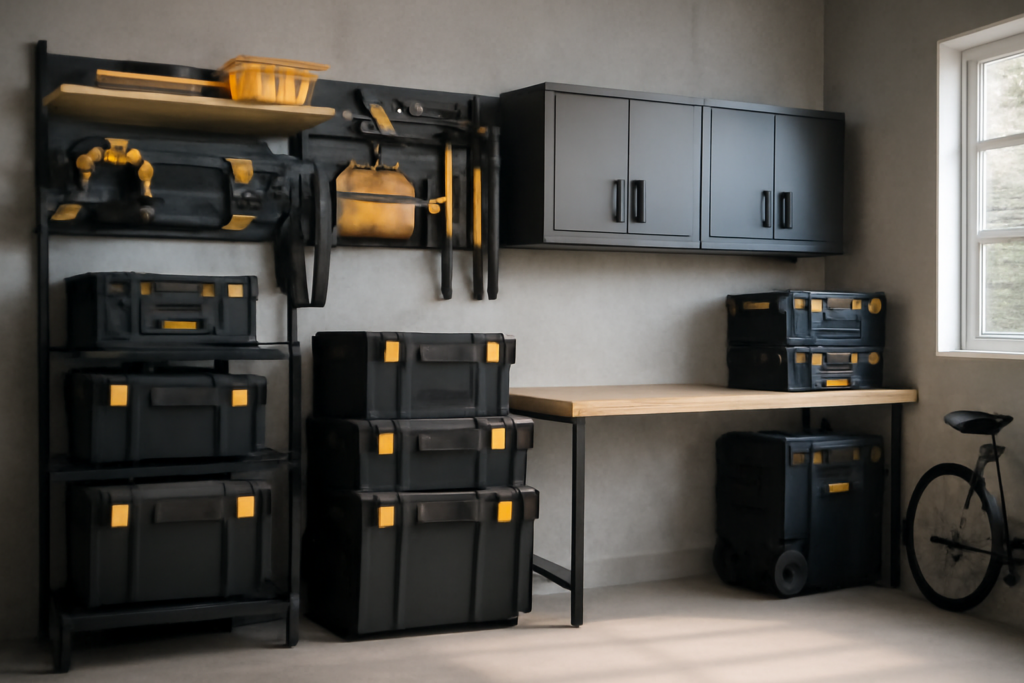
Most garage storage fails not because the shelves are weak but because homeowners buy a random mix of products that never work together. DeWalt garage storage takes the opposite approach, offering coordinated systems, wall-mounted rails, modular cabinets, workbenches, and heavy-duty racks, engineered to combine into one cohesive setup built for a serious workspace. Known for professional-grade tools, DeWalt brings the same rugged, jobsite-tough sensibility to organizing a garage. This guide walks through the main components, how to mount them securely, their weight capacities, and how to plan a layout that actually gets and stays organized.
The DeWalt Storage Philosophy
DeWalt’s garage storage is built around modularity and toughness. Rather than a single product, it is a family of components, wall tracks and accessories, cabinets, workbenches, and shelving, that share a design language and connect into a unified system. The steel construction and industrial finishes are aimed at people who actually use their garage as a workshop, not just a place to park bins.
That system approach is the real advantage. You can start with a wall track and a few hooks, then add cabinets and a workbench over time, knowing the pieces coordinate in appearance and function. This lets you build a garage in stages within a budget while ending up with a setup that looks and works like it was planned as a whole.
Wall Track and Hook Systems
The foundation of most DeWalt setups is a wall-mounted rail or track system that accepts a range of hooks, baskets, and shelf brackets. This gets tools, hoses, ladders, and gear up off the floor and onto the wall, which is the single biggest win in any garage, reclaiming floor space and making everything visible and reachable.
- Rails: mount horizontally across studs and provide the anchor for accessories
- Hooks: various sizes for hand tools, power tools, extension cords, and yard equipment
- Baskets and shelves: hold smaller items, sprays, and gear that will not hang on a hook
The beauty of a track system is flexibility, accessories move and rearrange as your needs change, without leaving a wall full of holes. Start by hanging your most-used items at eye and shoulder height, and put seasonal or bulky gear higher or lower.
Cabinets and Workbenches
For enclosed storage and a work surface, DeWalt offers steel cabinets, both wall-mounted and floor-standing rolling units, and workbenches with sturdy tops. Cabinets hide clutter, protect tools from dust, and can lock to secure valuable equipment. Rolling cabinets and tool chests let you move a work station to wherever the job is.
A solid workbench is the heart of a working garage. DeWalt benches typically feature heavy tops, often hardwood or steel, rated to handle real work, clamping, assembly, repairs, without racking or wobbling. Pairing a workbench with overhead cabinets and a pegboard or track panel behind it creates a complete work zone where tools are within arm’s reach of the surface you use them on.
Mounting Securely to Your Walls
Any wall-mounted storage is only as strong as its attachment, and this is where installations succeed or fail. Wall tracks and cabinets must be anchored into the wall studs, not just the drywall. Use a stud finder to locate and mark every stud, then drive the mounting screws or lag bolts into solid framing. Drywall anchors alone cannot support loaded storage and will pull out, dropping your tools.
Check that the track or cabinet is level before final tightening, an out-of-level rail looks sloppy and can let items slide. For heavy cabinets and shelving, use the manufacturer’s specified fasteners and hit as many studs as the unit spans. If your garage has masonry or block walls, you will need appropriate concrete anchors instead of wood screws. Taking the time to mount into structure is the difference between a system that holds for years and one that fails the first time you load it.
Understanding Weight Capacities
Every component has a rated capacity, and respecting it keeps your gear off the floor and your setup safe. Wall hooks and rails carry specific per-hook and per-rail limits, cabinets have shelf ratings, and workbenches have top-load ratings. Distribute weight sensibly, hang heavy items like ladders and power tools on the sturdiest, best-anchored points, and keep loads within the published ratings.
A common mistake is overloading a single hook or piling a cabinet shelf beyond its rating. Spread the load across multiple anchor points and multiple studs. When mounting anything heavy, remember that the wall attachment, not just the product, sets the real limit, a strong rail bolted into drywall is only as strong as the drywall. Stay within ratings and anchor properly, and the system does its job.
Planning Your Garage Layout
Before buying components, plan the space. Walk your garage and think in zones, a work zone with the bench and most-used tools, a long-term storage zone for seasonal and bulky items, a yard-and-garden zone near the door, and so on. Grouping like items keeps things findable and puts frequently used gear where you actually work.
Measure your wall space, note where the garage door track, windows, outlets, and the panel are, and sketch your layout. Keep the floor as clear as possible by moving everything you can onto walls and, if you add them, overhead racks. Leave clearance for car doors and for the garage door’s travel. A little planning up front means you buy the right components once instead of reorganizing three times.
Maximizing Vertical and Overhead Space
The floor is the most valuable and most wasted surface in a garage, so the goal of any good storage plan is to get as much off it as possible. Wall tracks handle the mid-height zone beautifully, but do not neglect the space above the reach line and up near the ceiling. Tall shelving units and upper cabinets store the items you rarely need, holiday bins, camping gear, out-of-season equipment, freeing the accessible walls for daily tools.
Overhead is the final frontier. The ceiling area above a parked car or along the back wall can hold a substantial amount of long-term storage on ceiling-mounted racks, keeping bulky, infrequently used items completely out of the way. Combining a DeWalt wall system for active tools with overhead racks for deep storage creates a layered approach where everything has a place based on how often you use it, most-used at arm’s reach, seasonal up high, and the floor left clear for the car and for actually working. Whatever you mount overhead must, like everything else, anchor into solid ceiling framing and stay within its rated capacity.
Maintaining an Organized Garage
Building a storage system is only half the battle, keeping it organized is the ongoing work, and a good system makes that easy. The principle that keeps a garage from sliding back into chaos is that every item has a designated home, and it returns there after use. Wall tracks help enforce this because a hook left empty is a visible reminder that a tool is out of place, unlike a pile on a bench where nothing has a fixed spot.
Label cabinet drawers and bins so anyone in the household can find and return things. Do a seasonal pass to purge what you no longer use, since garages accumulate clutter faster than any other space in a home. Keep frequently used tools in the prime, easy-reach zone and resist the temptation to let the workbench become a permanent dumping ground, clear it at the end of each project. A well-designed DeWalt garage storage system supports these habits, but the discipline of putting things back is what keeps the garage functional month after month, not just the week you install it.
Building the System Over Time
One of the strengths of a coordinated system is that you do not have to buy it all at once. Start with the highest-impact pieces, usually a wall track with hooks to clear the floor, and a workbench if you do projects. Add cabinets for enclosed and lockable storage as your budget allows, then expand hooks, shelves, and accessories to fine-tune.
DeWalt garage storage rewards this staged approach because the pieces are designed to work together, so a garage you build over a year still looks and functions like a single planned system. Mount everything into studs, respect the weight ratings, organize by zones, and you turn a cluttered garage into an efficient, professional-feeling workspace, one where every tool has a home and the floor is clear enough to actually park the car.