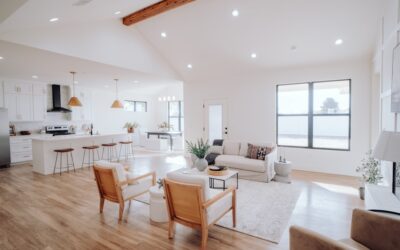
The category took off when designers realized strand-woven bamboo could be hand-scraped to mimic centuries-old oak at a fraction of the price. Distressed bamboo flooring uses wire brushing, hand-scraping, or sand-blasting to expose the dense bamboo fiber texture, then sealed with aluminum-oxide urethane for daily wear. The look reads as rustic and warm, hiding scratches and dents that would show plainly on smooth bamboo. Pricing runs $2.99 to $5.99 per square foot, undercutting most distressed hardwoods by 30%.
How Distressing Is Done
Three manufacturing methods produce the distressed surface. Wire brushing pulls a steel-bristle drum across each plank to scrape soft fibers below the harder grain — the result is a tactile texture with shallow valleys. Hand-scraping uses a CNC-controlled blade to gouge irregular grooves, mimicking 1800s plane marks. Sand-blasting fires pressurized media at the surface to create a uniform pebbled texture.
Each method changes how the floor reads visually and underfoot. Wire-brushed planks feel grippy and look refined. Hand-scraped planks show dramatic gouges and read more rustic. Sand-blasted planks have the most uniform texture and the lowest visual variation between boards. Most US retailers carry the wire-brushed option as their default.
Strand-Woven Construction Basics
Distressed bamboo is almost always strand-woven, where shredded bamboo fibers are mixed with low-VOC adhesive, compressed under 2,000 psi, and cured into dense billets. The result is a board with a Janka hardness of 3,000 to 5,000 — roughly double American red oak and harder than Brazilian cherry. Carbonized bamboo runs softer at 1,800 Janka but still beats most domestic hardwoods.
Plank thickness ranges from 9mm engineered with a click-lock joint to 14mm solid tongue-and-groove. The 14mm solid product can refinish two or three times. Click-lock engineered planks at 9mm carry a 2 to 3mm wear layer and refinish once at most. Confirm the wear layer before you compare prices — the cheaper SKUs almost always have thinner wear layers.
Pros That Win Buyers
- Hides daily wear — texture camouflages scratches from pet nails and furniture
- High Janka hardness at 3,000+, harder than most North American hardwoods
- Rapid-renewable source — bamboo regrows in 5-7 years vs 80+ for oak
- Stable engineered cores work over concrete and radiant heat
- Price-competitive against distressed oak at 30-40% lower cost
Drawbacks Buyers Should Weigh
Indoor humidity sensitivity is the biggest catch. Bamboo cups and gaps faster than oak when humidity swings outside the 35-55% band. In Phoenix at 15% winter humidity, gaps between planks can reach 1/8 inch within a single dry season. Humidification is mandatory, not optional, for this floor in arid climates.
Color consistency between cartons can also vary. Bamboo absorbs stain unevenly because the fiber density shifts across each strand. Always inspect three or four boxes during delivery, mix planks from multiple cartons during install, and order 12-15% over your calculated square footage. Reordering a single box later almost guarantees a visible patch.
Cost Breakdown Per Square Foot
- Materials: $2.99 to $5.99 for strand-woven distressed bamboo
- Underlayment: $0.30 to $0.65 for foam or cork, required on most subfloors
- Installation: $2.75 to $4.50 floating, $3.50 to $5.25 nail-down or glue-down
- Subfloor leveling: $0.50 to $1.50 for self-leveling compound where needed
- Transitions and trim: $40 to $85 per opening
A typical 500 sq ft living room install lands between $3,200 and $6,800 turnkey. DIY click-lock saves roughly 40% on labor, and the dense strand-woven core forgives small alignment errors better than thinner engineered hardwoods.
How to Inspect Before Install
Open at least four boxes and stack 8 to 10 planks per stack. Look for boards with twisted or bowed shape — anything over 1/8 inch bow across an 84 inch plank should go back. Confirm the moisture content with a Wagner Orion meter at 6-9% before install. Bamboo arriving at 11% or higher will shrink and gap noticeably after acclimation.
Acclimate the planks in the install room for 5 to 7 days, cross-stacked with spacers so air flows around each board. The mill ships from a controlled environment that rarely matches your home humidity. Skip the acclimation and the floor will move in the first 30 days, creating gaps or edge crowning that may void the warranty.
Installation Methods That Work
Engineered 9mm distressed bamboo floats with click-lock joints over a foam or cork underlayment. Use a tapping block sized to the joint profile and a pull bar for the final row. Leave a 3/8 inch expansion gap at every wall, cabinet base, and pipe penetration. Skip the expansion gap and you will see edge peaking and end-gaps within one humidity cycle.
Solid 14mm bamboo nails down with 18-gauge cleats every 8 inches into a plywood or OSB subfloor. Glue-down with Bostik Best or Mapei Ultrabond Echo is the alternative for slabs. Use the manufacturer-specified adhesive — generic construction adhesive can off-gas through the bamboo and discolor the finish over time.
Cleaning and Long-Term Care
Vacuum or dust-mop daily in homes with pets, weekly otherwise. Wet-clean with a pH-neutral hardwood cleaner like Bona Pro or Loba Cleaner. Never use vinegar, ammonia, or steam mops — these damage the urethane and void most manufacturer warranties. Microfiber mops wrung nearly dry are the safest weekly tool.
Furniture pads with at least 1 inch of contact surface go under every chair, table, and sofa leg. Trim pet nails monthly to reduce point-load damage. Refresh the finish in high-traffic areas with Bona Refresher every 90 days to maintain the urethane wear coat. Whole-home humidification set to 40% extends the floor life across all US climates. With proper care, distressed bamboo flooring delivers 25 to 30 years of service while hiding the wear marks that would have made a smooth-finish floor look tired in half the time.
Prefer to explore on your own?
See how new flooring looks in your actual room in seconds — free, no signup.
Try the free Floor Studio →