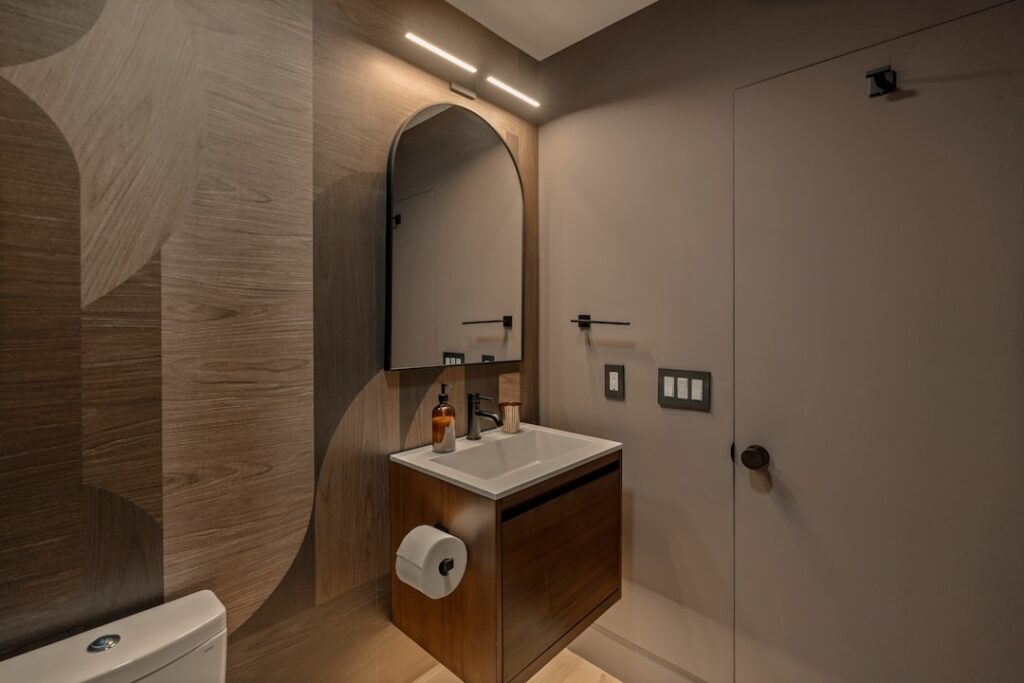
A stock 36-inch vanity from a home center runs $400 to $700, looks like ten million others, and uses particleboard that swells the first time water pools on the toe kick. Better DIY vanity ideas deliver real wood, custom dimensions, and one-of-a-kind storage for the same money or less, often in a single weekend. The trick is matching the build style to your tools and your patience, not to whatever Pinterest dropped in your feed this week.
Part of our Bathroom Remodeling & Flooring guide — explore the full guide →
Repurposed Dresser Conversion
A solid wood dresser from an estate sale or Facebook Marketplace, picked up for $40 to $150, makes the easiest custom vanity build there is. Look for dressers between 32 and 48 inches wide with sturdy joinery. Mahogany, oak, and maple are the targets. Avoid pressboard and 1990s-era veneered MDF.
The conversion is straightforward. Cut the back of the top drawer to clear plumbing, notch the drawer fronts if needed for a U-trap, drop in an under-mount sink template from your sink manufacturer, and seal the inside of the cabinet with two coats of marine spar urethane. Total cost with a $90 vessel sink and $60 widespread faucet lands around $300.
Floating Live-Edge Slab
Floating vanities visually expand small bathrooms by exposing floor underneath. A live-edge walnut or maple slab, 1.75 inches thick by 24 inches deep by 36 to 60 inches long, runs $200 to $450 from a local sawyer. Mount it to studs with heavy-duty steel brackets rated for 150 lb each, hidden behind the slab.
- Slab thickness: 1.5 to 2 inches minimum
- Mounting height: 32 to 34 inches to top of slab
- Bracket spacing: every 16 inches into studs
- Finish: 4 coats of waterborne polyurethane
- Sink type: vessel only, no undermounts in slabs
Drill the drain hole oversize to allow seasonal wood movement. Use a flexible rubber gasket rather than caulk to seal the drain.
Concrete Top on Reclaimed Cabinet
Concrete countertops cost $8 to $15 per sq ft in materials and look incredible on a simple shaker base cabinet. Use Quikrete 5000 or a dedicated countertop mix like Cheng Pro-Formula. Cast in a melamine-lined plywood mold, vibrate out air bubbles with a palm sander pressed against the form, and let cure 7 days under plastic.
Pair it with an unfinished oak or birch cabinet, painted in a saturated color like Sherwin-Williams Naval or Benjamin Moore Hale Navy. The contrast between matte concrete and lacquered wood is striking, and the whole project lands under $400 for a 36-inch unit.
Industrial Pipe and Plank
Black iron pipe legs with a stained 2×10 plank top deliver an industrial look that has held up well over a decade of trends. Build the frame from half-inch black iron pipe and floor flanges from any plumbing aisle. The top is two or three 2×10 boards glued and clamped, then planed flat or sanded with progressively finer grits to 220.
Stain with Minwax Special Walnut or Provincial, then seal with three coats of General Finishes Arm-R-Seal in satin. The finish needs to cure 7 days minimum before water exposure. Plan around $180 in materials for a 48-inch double sink configuration.
Antique Sewing Machine Base
Old Singer sewing machine bases from the early 1900s are dirt cheap on Craigslist because nobody wants the actual sewing machine anymore. The cast iron treadle base, often with the original ornamental ironwork, makes a striking small powder room vanity. Cap it with a butcher block top or a piece of marble remnant, set a copper or hammered nickel vessel sink on top, and you have a conversation piece for under $200.
Built-In Wall-to-Wall
For master baths with awkward dimensions, a built-in wall-to-wall vanity uses every inch. Frame with 3/4-inch birch plywood and pocket-screw construction. Add a face frame of solid maple for paint adhesion and trim detail. This build takes a weekend if you have a Kreg jig, a circular saw with a track guide, and a finish nailer.
- Measure twice and account for out-of-square walls
- Build cabinet boxes from 3/4-inch plywood
- Install with French cleats or screw to studs
- Add face frame with pocket screws and glue
- Top with quartz remnant or thick butcher block
Quartz remnants from local fabricators cost $15 to $30 per sq ft installed if you find a piece large enough. Call three shops on Monday mornings when they’re cutting up odd pieces.
Rustic Barn Wood Console
Reclaimed barn wood vanities suit farmhouse-style baths. Source from Architectural Antiques, local salvage yards, or online from Ohio Wood Reclaimed. Build a simple console table form, leave the joinery exposed, and seal heavily with marine-grade epoxy on the top to handle splash. Pair with a farmhouse-style apron-front sink for cohesion.
Modern Plywood with Edge Banding
Baltic birch plywood, with its many laminated layers, makes beautiful modern vanity bodies when the edges are exposed. Use 18mm or 12mm sheets, cut precisely on a track saw, and apply iron-on birch edge banding only where you do not want the layers visible. The cost runs about $150 for materials on a 30-inch single sink. Finish with hardwax oil like Rubio Monocoat for a low-sheen, water-resistant surface.
Pulling It All Together
Whatever style you pick, three details separate amateur builds from pro-quality results. Use proper plumbing access in the back panel, oversized for repairs. Seal every cut edge inside the cabinet, especially around the drain. And spend the extra $40 on real soft-close drawer slides instead of bargain-bin hardware that fails in two years. Build it once, build it right, and your DIY vanity will outlast anything from a big box.