Nothing changes the personality of a room faster than wallpaper, and thanks to peel-and-stick technology, you no longer need a paste bucket or a pro to do it. These diy wallpaper ideas range from a single bold accent wall to subtle textured backdrops you can install in an afternoon. Best of all, many of today’s options are completely removable, which makes them perfect for renters, first-timers, and anyone who likes to redecorate on a whim.
Part of our Paint & Walls guide — explore the full guide →
- Start With a Single Accent Wall
- Go Renter-Friendly With Peel-and-Stick
- Try Textured and Faux-Material Looks
- Wallpaper Unexpected Surfaces
- Create a Ceiling "Fifth Wall"
- Mix Patterns Without the Mess
- Prep and Application Tips for a Flawless Finish
- Choosing Patterns for Different Room Sizes
- Removable vs. Traditional Wallpaper
- Pick the Idea That Fits Your Space
Start With a Single Accent Wall
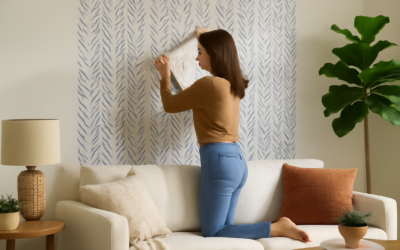
If wallpapering an entire room feels intimidating, an accent wall is the smartest place to begin. Choosing one wall, usually the one behind a bed, sofa, or fireplace, gives you a dramatic focal point with a fraction of the material and effort. A large-scale floral, a geometric pattern, or a moody dark print reads as intentional design rather than overwhelming the space. You’ll use roughly a quarter of the wallpaper a full room requires, which keeps both cost and commitment low.
Go Renter-Friendly With Peel-and-Stick
Peel-and-stick wallpaper is the single biggest reason DIY wallpaper has exploded in popularity. It works like a giant sticker: you peel off the backing and press it to a clean, smooth wall, repositioning as needed until it’s straight. When you move out or get bored, it lifts off without damaging the paint underneath, leaving no residue when applied to a properly prepped surface. For rentals, this is the safest way to add real personality without losing your deposit.
For the cleanest result, wipe the wall down first, let it dry, and apply panels from the top down, smoothing out air bubbles with a plastic squeegee or a credit card as you go.
Try Textured and Faux-Material Looks
Not all wallpaper is about bold color. Some of the most sophisticated DIY looks come from texture and faux materials that fool the eye:
- Faux shiplap or beadboard — instant farmhouse character without cutting a single board.
- Grasscloth-look prints — warm, natural texture for a calm, organic feel.
- Faux brick or stone — industrial edge for a home office, basement, or entryway.
- Subtle linen or plaster textures — quiet depth that elevates a neutral room.
These work especially well in spaces where you want interest without competing with busy furniture or art.
Wallpaper Unexpected Surfaces
The wall isn’t your only canvas. Some of the most charming DIY wallpaper ideas use small, unexpected surfaces that make a big impression for very little material. Line the backs of open bookshelves or a glass-front cabinet to make the contents pop. Cover stair risers with a patterned strip for a custom staircase. Refresh tired furniture by applying wallpaper to drawer fronts or a desktop, then sealing it. Even the inside of a closet door becomes a fun surprise with a leftover panel.
Create a Ceiling “Fifth Wall”
Designers love calling the ceiling the fifth wall, and wallpapering it is a bold move that pays off in bedrooms, powder rooms, and nurseries. A soft sky print, a delicate star pattern, or a rich color overhead draws the eye up and makes the whole room feel more finished. This one is more physically demanding, since you’re working overhead, so recruit a helper and use peel-and-stick to make repositioning easier.
Mix Patterns Without the Mess
Confident decorators can layer patterns, but there’s a simple formula that keeps it from looking chaotic. Pair one large-scale print with one small-scale print and tie them together with a shared color. For example, a big botanical on the accent wall and a tiny coordinating dot inside a nearby alcove. Sticking to a consistent palette is what makes mixed patterns feel curated rather than random.
Prep and Application Tips for a Flawless Finish
The difference between a professional-looking result and a bubbly mess almost always comes down to prep. Keep these steps in mind:
- Clean the wall and let it dry fully; dust and grease keep adhesive from sticking.
- Measure your wall height and add a few extra inches per panel for trimming.
- Use a level or laser line to keep your first panel perfectly vertical, since every panel after it follows that line.
- Overlap or butt the seams according to the product instructions, matching the pattern carefully.
- Smooth from the center outward and trim excess at the baseboard and ceiling with a sharp blade.
Take your time with that first strip. Get it straight, and the rest of the room practically installs itself.
Choosing Patterns for Different Room Sizes
Scale can make or break a wallpaper project, and the size of your room should guide your choice. In a small space like a powder room or entryway, a large, bold print can actually work in your favor, wrapping the room in personality and making it feel intentional rather than cramped. In a bigger room, a large-scale pattern reads as dramatic, while a small, repeating motif can get lost or feel busy across a wide wall. Light colors and vertical patterns help low-ceilinged rooms feel taller, while horizontal motifs visually widen a narrow space. Match the pattern to the room’s proportions and the result feels custom rather than accidental.
Removable vs. Traditional Wallpaper
Knowing the difference between your options keeps expectations realistic. Peel-and-stick removable wallpaper is ideal for renters and quick changes; it goes up without paste and comes down cleanly, though it adheres best to smooth, well-painted walls and may not stick to textured surfaces. Traditional paste-applied wallpaper is more durable and often offers a wider range of premium designs and finishes, but it’s more permanent and harder to remove. There’s also pre-pasted paper, which you activate with water as a middle-ground option. For most DIYers tackling their first project, removable peel-and-stick is the forgiving choice that lets you learn without long-term commitment.
Pick the Idea That Fits Your Space
Whether you’re after a knockout accent wall, a renter-safe refresh, or a quiet textured backdrop, there’s a DIY wallpaper idea that fits your skill level and budget. Start small with an accent wall or a bookshelf back, build your confidence, and you’ll be eyeing the ceiling before long. With removable products doing the heavy lifting, experimenting has never been lower-risk.