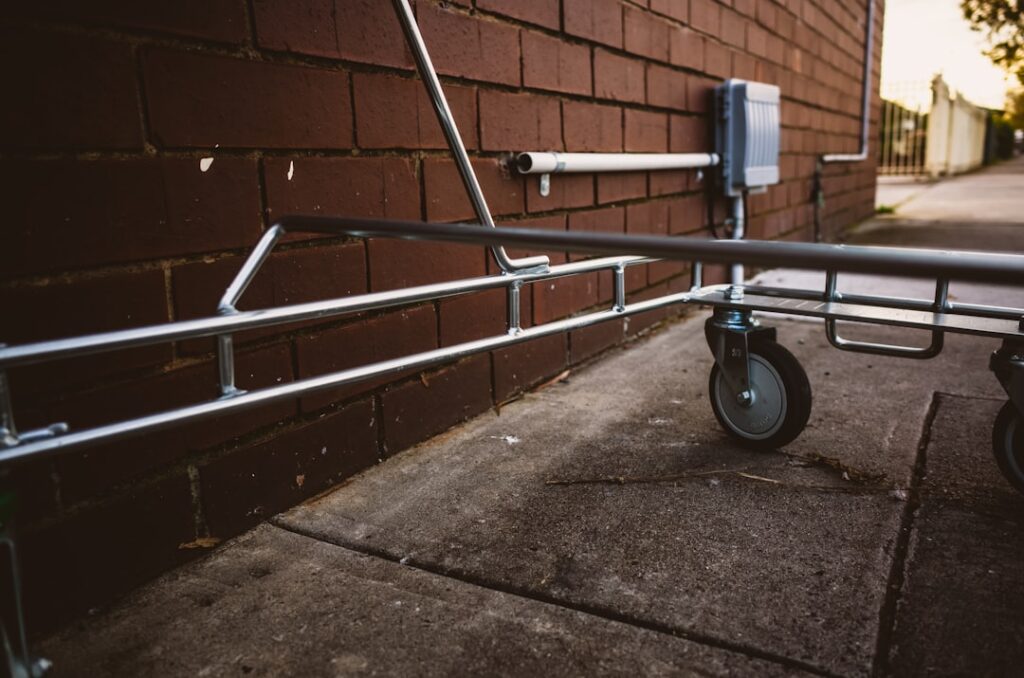
A single sheet of ½-inch drywall weighs about 51 pounds at 4 × 8 feet — and 4 × 12 sheets of ⅝-inch Type X run near 105. Now multiply by the 40-80 sheets in a typical basement or whole-house job, and the case for a drywall cart makes itself: one person rolls a half-ton stack across the job in minutes, with no strained backs, no gouged corners, and no sheets snapped over a doorknob. This guide covers cart types and real capacities, the doorway-clearance math that decides whether a cart works in your house, rental versus purchase, and the lighter alternatives when a cart is overkill.
- What a Drywall Cart Is
- The Doorway Math (Do This Before Renting)
- Rental vs Buying
- Loading and Moving Safely
- Alternatives When a Cart Doesn't Fit the Job
- Mistakes to Avoid
- FAQ
- How many sheets of drywall fit on a cart?
- Will a drywall cart fit through a standard door?
- Can I use a furniture dolly instead?
- What else is a drywall cart good for?
- Bottom Line
What a Drywall Cart Is
The standard drywall cart (also called a panel cart, sheetrock dolly, or board trolley) is a welded steel A-frame on four casters: a narrow deck 9-12 inches wide holds sheets on edge, leaning slightly against an angled back support. Sheets ride vertically-on-edge — the strong orientation that resists snapping — and the tall load stays balanced over the wheels. Key specs:
- Capacity: economy carts are rated 800-1,000 lb; standard pro carts 2,000-3,000 lb; heavy commercial models to 3,600 lb. Ratings are rarely the limit — footprint and tipping are.
- Sheet count: a 10-12 inch deck holds roughly 15-25 sheets of ½-inch (about ½ inch each with gaps). Weight-wise that’s 750-1,250 lb of standard board — inside even mid-tier ratings.
- Deck length: most are ~45-48 inches, supporting 8-12 ft sheets with overhang; sheets longer than 12 ft want two carts or a second set of hands at the ends in turns.
- Casters: the spec that separates junk from tools. Look for 8-inch (minimum 5-inch) non-marring polyurethane or full-poly casters, two rigid + two swivel or four swivel with brakes. Small hard casters stall on cords, gravel, and door thresholds with a heavy load — the classic cheap-cart failure.
The Doorway Math (Do This Before Renting)
A loaded cart is wide, long, and doesn’t bend. Measure before you commit:
- Width: cart frame 25-32 inches wide + load lean = plan on 30-34 inches of clear opening. A standard 32-inch door (30.5-inch clear) is marginal; a 36-inch door is comfortable; a 28-inch bathroom door is a hard no.
- Turning: an 8-ft sheet on a 4-ft cart needs roughly a 9-10 ft swing to turn a corner. Hallway-to-door turns are where carts get stuck — walk the route with a tape measure, checking hall width at the turn, not just the door.
- Height: sheets on edge stand 48 inches plus 4-8 inches of deck height — fine under any ceiling, but watch stair soffits and garage door tracks.
- Floors and thresholds: carts need reasonably smooth, level floor. A ¾-inch threshold under 1,000 lb needs a ramp (a scrap of plywood works). Never take a loaded cart on stairs — that’s what carry alternatives are for.
If the route fails any test, don’t force it: stage the cart to the nearest large opening and hand-carry the last stretch, or skip the cart entirely (see alternatives).
Rental vs Buying
| Option | Cost | Makes sense when |
|---|---|---|
| Rent | $15-$30/day, $50-$90/week at rental yards and some big-box tool counters | One-time room or basement job; delivery day + hang weekend |
| Buy economy | $120-$220 (1,000-2,000 lb import carts) | Remodelers doing a few rooms a year; garage/shop double duty |
| Buy pro | $300-$700 (3,000 lb+, 8-inch poly casters, welded US/commercial brands) | Contractors; daily use; plywood and door slabs too |
Two buying notes: first, a drywall cart is secretly a general material cart — plywood, OSB, doors, countertops, foam board — so ownership pays back beyond drywall. Second, if you’re paying for boom-truck delivery, ask the supplier to stock sheets exactly where you’ll work; the best cart is the one you don’t need because 60 sheets landed in the garage stack-side-up next to the door.
Loading and Moving Safely
- Load against the lean. Sheets go finished-face-in, resting on the angled support; alternate lean direction on double-sided carts to balance.
- Keep the stack centered on the deck lengthwise — a 2-ft overhang on one end steers the cart into walls.
- Push from the end, steer from the middle. Two hands on the sheet tops at one end gives the most control; around corners, one person at each end.
- Slow through doorways. Sheet corners travel faster than you think; a drywall corner meeting a door jamb takes paint off both.
- Brake or chock when parked — especially on any slope. A rolling half-ton cart is a genuine hazard to shins and vehicles.
- Mind the floor: on finished floors, run poly-caster carts only, sweep grit first, and lay hardboard runners over anything precious.
Alternatives When a Cart Doesn’t Fit the Job
- Panel carry handle ($10-$25): a plastic or steel hook that grips the sheet’s bottom edge so one person carries a sheet at their side with a straight back. The single best $15 in drywall — buy two and a pair of movers walks sheets upstairs safely.
- Shoulder/forearm lifting straps ($20-$40): two-person strap sets that put the load on shoulders and keep hands free for balance — best for stairs and long carries.
- Panel sled/mini dolly ($30-$60): a small two-wheel cradle that rolls one or two sheets — the tight-house compromise where a full cart can’t turn.
- Drywall lift ($40/day rental, $150-$300 to buy): not a mover but the ceiling-hanging partner to all of the above; if you’re moving sheets alone you’ll want the lift for the lid anyway.
- Two strong friends: the traditional method — real, but the injury statistics on 12-ft ⅝ sheets argue for hardware. Anyone doing more than 10 sheets should mechanize something.
Mistakes to Avoid
- Overloading past the footprint, not the rating. 25 sheets may be under the weight limit while making the cart top-heavy on a doorway threshold bump. Load what stays stable, not what fits.
- Storing sheets on the cart long-term leaning hard to one side — board takes a set and edges crush. For storage, flat stacks on a dry floor; our drywall guide covers handling and storage basics.
- Rolling loaded carts over cords and hose. Small casters stop dead; sheets keep going.
- Using the cart as a work platform. It’s on wheels. Every year someone re-learns this.
- Ignoring sheet edges. Carts protect faces, not edges — a crushed tapered edge means extra coats of drywall compound at every joint that edge touches. Load gently, pad the deck with a strip of carpet or foam.
FAQ
How many sheets of drywall fit on a cart?
Practically 15-25 sheets of ½-inch board on a standard 10-12 inch deck — 750-1,250 lb. Heavier ⅝-inch Type X: keep to 12-18 sheets for stability even though ratings allow more.
Will a drywall cart fit through a standard door?
Through a 36-inch door, yes with care. Through a 32-inch door, marginally — measure your specific cart’s width plus load lean. Through 30-inch and smaller, no; use carry handles or a panel sled.
Can I use a furniture dolly instead?
Flat four-wheel dollies carry drywall lying flat, which risks corner snaps, takes two people to load each sheet, and steers badly. It works for a few sheets on smooth floor; a panel cart or carry handle beats it everywhere else.
What else is a drywall cart good for?
Plywood, MDF, rigid foam, interior doors, solid-surface counters, long trim bundles — any sheet or slab good. It’s the shop cart that gets borrowed most, alongside the rest of the hanging and finishing kit in our drywall tools guide.
Bottom Line
If your job is more than a dozen sheets on one level, a drywall cart turns the worst part of drywalling into a five-minute roll: rent one for $20 on delivery weekend, or buy a 2,000-lb cart with 8-inch poly casters if sheet goods pass through your life regularly. Measure the doorways first, load it balanced, and save your spine for the ceiling — and for the cutting that comes next with a proper drywall cutting tool lineup.