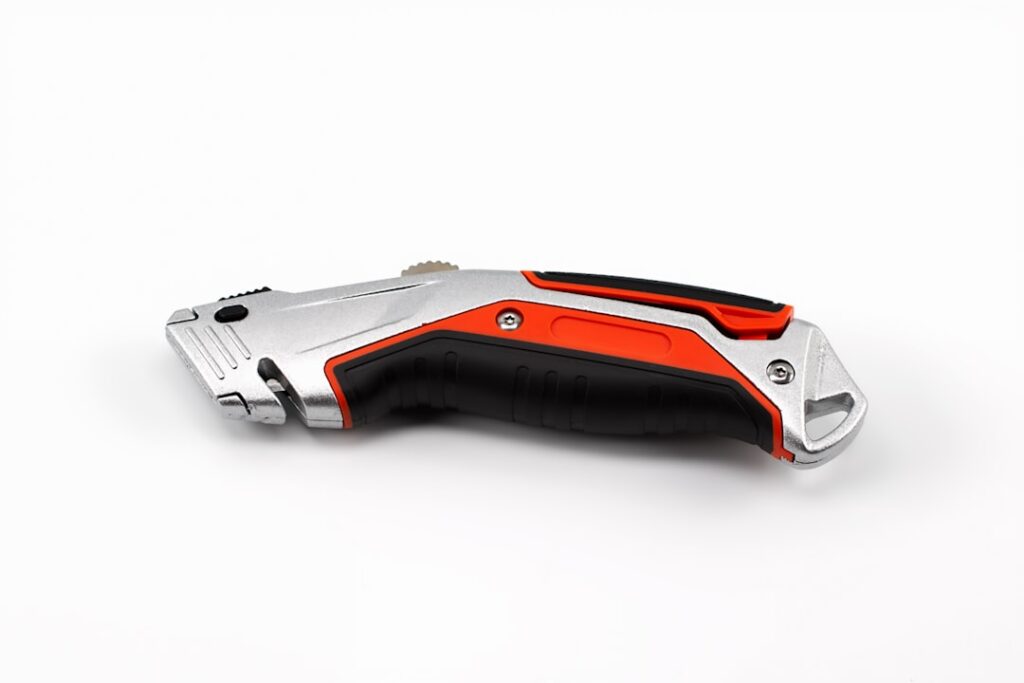
Drywall is one of the few building materials designed to be cut with a $10 knife — yet a whole family of tools exists because different cuts want different edges. Choosing the right drywall cutting tool for each situation is most of the skill: full sheets get scored and snapped, outlet boxes get routed or sawn, in-place board gets an oscillating blade, and production hangers run track systems that cut and measure in one motion. Here’s the complete toolkit, what each piece costs, the technique that makes it work, and which three tools cover 95% of any job.
Part of our Paint & Walls guide — explore the full guide →
The Utility Knife: 80% of Every Job
The score-and-snap is drywall’s defining cut, and a sharp utility knife ($8-$25) does it better than anything powered:
- Mark the cut line on the face side, or clamp a straightedge — a 48-inch drywall T-square ($20-$40) turns marking and guiding into one step for crosscuts.
- Score the face paper in one confident pass, cutting paper plus 1/16-1/8 inch into the gypsum core. You’re not sawing through; you’re creating a fracture line. Two lighter passes beat one gorilla pass on ⅝-inch board.
- Snap away from the score. Sharp bump with the knee or palm behind the line — the core breaks clean along the score.
- Cut the back paper along the folded hinge, then snap forward and free.
Technique notes that separate clean from ragged: change blades constantly — gypsum kills edges in a few sheets, and a dull blade tears paper instead of slicing it (buy 50-100 blade packs; heavy-duty blades for ⅝ Type X); score the face side so any tear-out lands on the back; and for rips, hook a tape measure with a blade held at the tape’s end (“railroading”) or use a drywall rasp ($8-$15) to shave a snapped edge to final size. A rasp or surform plane belongs in the pouch — every snapped edge that lands a little proud gets dressed in two strokes.
Jab Saw: Openings and Curves
The jab saw (keyhole/drywall saw, $8-$20) is a stiff pointed handsaw that plunges through board with a palm strike — no pilot hole. It’s the traditional tool for:
- Electrical boxes: mark from the box, stab in the middle of the waste, saw to the corners, done in a minute.
- Round holes: recessed lights and pipe penetrations — drill or stab a start, then saw the circle. (Adjustable hole cutters and carbide hole saws do neater circles for can lights.)
- Cutouts in hung board: anywhere a power tool’s dust cloud isn’t welcome.
Buy one with an aggressive tooth pattern that cuts on both push and pull, and treat the tip kindly — a bent tip wanders. The classic mistake is sawing outlet holes oversized; a hole more than ⅛ inch proud of the box means cover plates don’t hide it and you’re back with setting compound. Measure twice, cut tight, rasp to fit.
Spiral Router: The Production Outlet Tool
The drywall router (cut-out tool, RotoZip being the genericized brand; $60-$150 corded, cordless versions from every major platform) spins a ⅛- or 5/32-inch spiral bit at 25,000-30,000 RPM and cuts drywall like a pencil draws. Its killer app is outlet and fixture cutouts in already-hung board:
- Mark the box’s approximate center on the floor or note its measurements before covering it; hang the full sheet right over the box with fasteners kept 12+ inches away from it.
- Plunge at the marked center, drift to an edge until the bit meets the box interior, hop the bit to the outside of the box wall.
- Ride counterclockwise around the outside of the box — the guide-point bit traces the box perimeter and drops a perfect cutout in seconds.
Push wires deep into the box first — a spiral bit will happily strip Romex — and expect fine dust everywhere; run a dust shroud or a helper with a vacuum. For a whole-house hang, the router pays for itself the first day; for one room, the jab saw is honestly fast enough. Drywall-specific bits are guide-point (smooth pilot tip); use plunge-style bits for window and door openings where there’s no box to trace — for those, you rout, then finish edges against the framing.
Oscillating Multi-Tool: Surgical Cuts in Place
For cutting drywall that’s already on the wall — repair squares, access holes, removing damaged sections — the oscillating multi-tool ($40-$150 plus $10-$20 blades) is the control king. A half-moon or plunge blade cuts exactly as deep as you set it, which is the whole point: you can open a wall over plumbing and wiring with far less risk than any saw that plunges blind. It also cuts dead-straight lines against a level, makes clean rectangular repair openings centered on studs, and trims board in corners no other tool reaches. Slower and dustier than a knife on new sheets — this is the renovation and repair specialist, not the hanging tool. Pair it with drywall shims and a patch when you’re truing up botched openings.
Track Systems and Production Gear
- Drywall T-square (48″): $20-$40 — not optional; it’s the guide for every crosscut and the layout tool for everything else.
- Track/rail cutters: measuring-tape-mounted dual-wheel cutters and rail systems score both faces at once and gang repeated rips to identical width — strip cuts for soffits and furring in seconds. $30-$150 depending on system.
- Banjo-style edge guides and rip gauges: clamp-on knife guides ($15-$30) for consistent narrow rips without railroading freehand.
- Foot lifter and rasp: $10 each — the lifter snugs the sheet up while both hands screw; the rasp finishes every cut this article mentions.
Which Tool for Which Cut
| Cut | First choice | Backup |
|---|---|---|
| Full-sheet crosscut/rip | Utility knife + T-square | Track cutter for repeated rips |
| Outlet/switch box (production) | Spiral router | Jab saw |
| Outlet box (few holes) | Jab saw | Oscillating tool |
| Round can-light hole | Adjustable hole cutter / hole saw | Jab saw |
| Window/door opening after hang | Router with plunge bit, then rasp | Jab saw + knife score at frame |
| Repair opening in finished wall | Oscillating multi-tool | Jab saw (only where cavity is known clear) |
| Shaving a fat edge | Rasp/surform | Knife back-bevel |
| Curves and arches | Jab saw or router freehand | Oscillating tool |
What NOT to Cut Drywall With
- Circular saws and jigsaws: they work — while filling the room with the maximum possible gypsum dust and abusing the blade. Wrong tool outside of rare double-layer or cement-board situations (cement board is its own scoring-knife story anyway).
- Table saws: no. Dust in the mechanism, paper-tearing cuts, and a sheet that snaps for free doesn’t need a fence.
- Dull anything: torn face paper at cut edges telegraphs through finishing and demands extra coats of drywall compound. Sharp blades are the cheapest finishing shortcut there is.
Dust deserves one serious note: gypsum dust is an irritant and the silica content in some boards’ additives makes fine dust a real respiratory concern. Wear an N95 for router and power-tool cutting, and score-snap whenever possible precisely because it makes almost none.
The Minimalist Kit vs the Pro Kit
- One-room DIY ($50-$80): utility knife + 50 blades, 48-inch T-square, jab saw, rasp. This kit hangs a whole house — just slower at outlets.
- Serious remodeler (+$150-$250): add the spiral router with guide-point bits and an oscillating multi-tool. Every cutout gets faster and every repair gets cleaner.
- Production hanger (+$100-$200): track/rip cutters, hole cutters for cans, cordless router on your battery platform, dust extraction. Broader kit context — screws, lifts, banjos and all — lives in our drywall tools guide.
FAQ
What’s the best drywall cutting tool for a beginner?
A sharp utility knife and a T-square, full stop. Score-and-snap is a five-minute skill that produces cleaner edges than any power tool, and moving sheets around the cut is usually the harder part — a drywall cart or carry handle helps more than another saw.
How do pros cut outlets so fast?
Spiral router, boxes uncovered by the sheet, traced from inside the box perimeter after hanging. Seconds per box, near-zero measuring errors.
Can I cut drywall with scissors or snips?
Thin flexible board for arches can be knife-scored in strips, but no — gypsum board isn’t a shear material. Snips are for the corner bead, not the board.
How do I cut drywall already installed without hitting wires?
Oscillating tool with depth set to board thickness (½ or ⅝ inch), cut shallow, and open the wall in stages. Check with a stud/AC finder first and assume every stud bay near outlets carries cable.
Bottom Line
Master the score-and-snap first — it’s the soul of working with drywall — then add a jab saw for holes, and let job volume justify the router and oscillating tool. Keep blades fresh, cut tight to your marks, and dress edges with the rasp: clean cuts are invisible after finishing, and that invisibility is the entire goal.