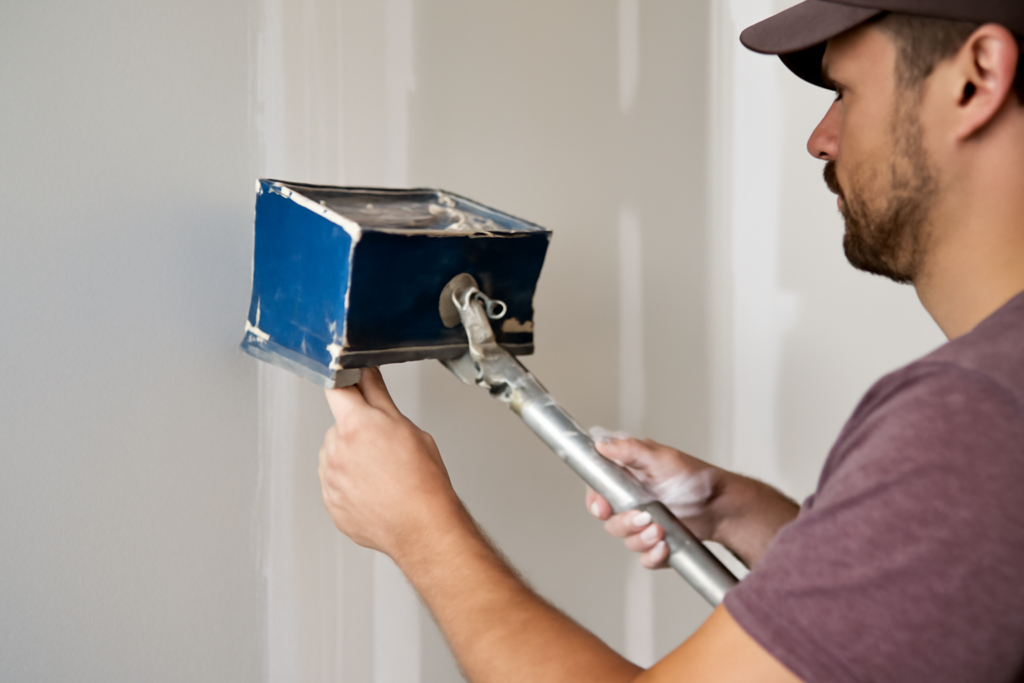
Watch a production taping crew coat an entire house’s joints in a single day and the tool doing the heavy lifting is not a knife — it is a metal box on a handle that lays down a perfectly crowned band of compound in one walking pass. A drywall flat box is the finishing tool that turns joint coating from a wrist skill into a repeatable mechanical process, applying compound and feathering both edges simultaneously at three to five times hand-taping speed. Long an exclusively professional tool, boxes have dropped enough in price that serious DIYers and remodelers now buy or rent them for whole-house projects.
Part of our Paint & Walls guide — explore the full guide →
What a Flat Box Is and What It Does
A flat box is a compound reservoir — an aluminum or composite housing holding roughly a quart to a half-gallon of joint compound — with a spring-loaded pressure plate on the back and a precision blade assembly across the front opening. Mounted on a handle and pulled along a taped joint, the box extrudes compound through the opening while the blade strikes it off at a controlled thickness and profile. Wheels on the leading edge ride the wall surface so the coat stays consistent regardless of hand pressure variations.
The blade is the clever part. It is slightly flexible and adjustable for crown, so the box leaves compound thickest over the joint centerline and feathered to nothing at both edges — the exact profile a finisher builds by hand in three knife passes, delivered in one. Boxes handle the second and third coats over taped joints (the “fill” and “finish” coats); they do not embed tape, which is the job of a banjo or automatic taper, and they do not coat fasteners or corners, which have their own dedicated tools.
Box Sizes and What Each Is For
Flat boxes come in widths matched to the coating sequence:
- 7-inch box: the first coat over tapered joints after taping. Lays a tight fill coat centered on the tape.
- 10-inch box: the standard second coat, widening the fill and burying the 7-inch shoulders.
- 12-inch box: the finish coat on tapered joints and the workhorse for widening butt joints, where total finished width needs to reach 20-24 inches via two offset passes.
- Extra-high-capacity versions: most brands sell standard and “fat boy” capacities; the larger reservoir means fewer refills on big ceilings at the cost of arm fatigue.
Boxes mount on handles from short fixed lengths around 34 inches to extendable models reaching 6-8 feet for ceilings and stairwells without stilts. A pumping station — a compound pump with a box-filling attachment — loads the box in seconds and is effectively mandatory once you own one; spooning mud into a box by hand defeats the speed advantage.
How to Run a Flat Box: Technique Basics
Running a box takes about an hour to get functional and a few rooms to get good. Thin the compound first — boxes want all-purpose or lightweight mud mixed to a thick batter, looser than knife consistency; most finishers add water until a drill-mixed batch ribbons smoothly off the paddle. Fill the box with the pump, set the blade crown, and you are ready.
Start the pass a few inches from the end of the joint, press the wheels to the wall, and pull steadily along the seam with the box angled about 30-45 degrees to the surface. Pressure on the handle drives the pressure plate, extruding mud as you move; consistent walking speed and pressure produce a consistent coat. At the end of the run, roll the box flat against the wall to feather off, then go back and pick up the short skipped section at the start with a pass from the opposite direction. Wipe the blade between joints. Ceilings run the same way on an extendable handle, which is where the box most embarrasses hand finishing — overhead knife work is slow and drippy, while a box coats a ceiling seam in one clean walk.
The crown adjuster — typically a dial or cam with numbered settings — controls how much compound stays over the joint center. Run more crown on early coats (compound shrinks as it dries) and dial it toward flat on the finish coat. A quick straightedge check on your first few dried joints tells you whether your setting and walking speed are leaving joints proud or starved.
Brands, Prices, and Rental Options
Four names dominate: TapeTech, Columbia, Drywall Master, and Level5, with Goldblatt serving the budget tier. A single professional-grade box runs $250-$450 new depending on size and brand, and a usable finishing setup — 10-inch box, 12-inch box, handle, and compound pump with filler — lands around $900-$1,600 new. Level5’s kits have pushed entry pricing down aggressively, with box-and-handle combos commonly under $400, which is a large part of why boxes crossed into the DIY market. Goldblatt boxes at $150-$250 are heavier and less refined but coat joints fine for a one-house project.
Renting makes sense for single jobs: tool rental houses in most metros carry flat box kits at $40-$75 per day or $150-$250 per week including the pump. Used professional boxes hold value and circulate constantly on contractor marketplaces at 40-60 percent of new price — a fair route if you clean and inspect the blade, which is the wear part. Replacement blades cost $20-$40 and take minutes to swap.
Flat Box vs. Hand Finishing: Honest Trade-Offs
Speed is the headline: a competent operator boxes 800-1,200 linear feet of joints per hour of coating, against perhaps 200-300 feet with a knife, and the coat comes out more consistent than all but the best hand work. Consistency is arguably the bigger win for non-professionals — the box does not get tired in hour three, and every joint gets the same crown and feather.
The limits are real, though. Boxes only do flat joints; you still hand-coat or use angle tools for inside corners, nail spotters or a knife for fasteners, and a knife for patches and irregular areas. Cleanup is non-negotiable and takes 10-15 minutes of thorough washing after every session, because dried compound in the pressure plate mechanism ruins the tool. There is also a mud-consistency learning curve — too thick and the box chatters and starves, too thin and it runs. For a single small room, setup and cleanup eat the time savings; the break-even point where a box clearly wins is roughly a full house floor, a basement buildout, or any job with long ceiling runs.
Maintenance and Common Problems
A flat box lives or dies by cleaning. Rinse immediately after use, working the pressure plate through its travel under running water, and brush the blade slot until water runs clear; a $6 wash-out brush and a mud-mixing bucket of rinse water at the job make this painless. Store the box with the pressure plate released so the springs stay lively.
Most operating problems trace to three causes. Streaks or lines in the coat mean a nicked blade or dried mud stuck in the slot — clean first, then replace the blade if the line persists. Starved, thin coats mean mud too thick, worn springs, or walking too fast. Edge ridges that need heavy sanding mean the blade corners are worn round or the crown is set too high. Blades are consumables; production finishers replace them every few houses, and a fresh $30 blade instantly fixes a box that has started leaving lines a knife has to chase.
Should You Buy One?
For anyone finishing a whole house, a flip, or recurring remodel work, a 10- or 12-inch box plus pump pays for itself on the first big job in labor hours or finisher invoices avoided — and the finish quality upgrade over amateur knife work is immediately visible under primer. For a one-bedroom patch-and-paint, rent one for a week or stick with knives. Either way, the flat box explains something every homeowner has wondered watching a pro crew: how tapers make dead-flat joints look effortless. The answer is that the flatness is built into the tool.