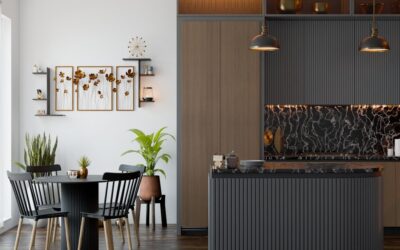
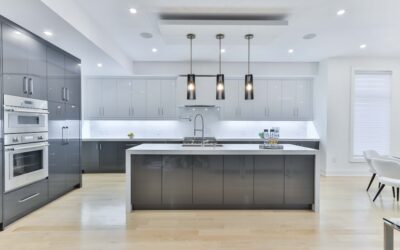
Flat-front cabinet doors have steadily replaced shaker as the dominant style in new kitchens since around 2020, especially in modern, contemporary, and Scandinavian-inspired designs. Done right, flat cabinet doors deliver a clean architectural look that ages well and reads as more expensive than the cost would suggest. Done wrong, they warp, telegraph every screw, and look like apartment-grade builder cabinets within 3 years. The difference comes down to substrate, finish, and edge banding — three details most homeowners never ask about when shopping.
Part of our Kitchen Remodeling guide — explore the full guide →
What Defines a Flat Cabinet Door
Flat (also called slab or full-overlay) cabinet doors are made from a single panel without a raised center, frame, or recessed insert. The face is one continuous surface, with all hardware mounted on the outer face or hidden inside European-style frameless construction. The visual effect is minimalist — the doors themselves disappear, and what remains is the material, the color, and the geometry of the room.
Two construction types dominate the market: solid wood slabs (typically white oak, walnut, or rift-cut maple) and engineered MDF or particleboard with a foil, laminate, or thermofoil surface. Each has tradeoffs that determine longevity, cost, and how the doors actually live in a working kitchen.
Substrate Choices and What They Mean
The substrate (the core material under the visible surface) determines how flat the door stays over time:
- Furniture-grade plywood (1/2 to 3/4 inch) — the most stable option for solid wood veneer slabs. Resists warping, holds screws well, and lasts 30+ years
- MDF (medium-density fiberboard) — perfectly flat surface, takes paint and laminates beautifully, but absorbs water and crumbles if exposed to moisture
- Particleboard — cheapest substrate, used in budget cabinets, swells visibly within 5 to 8 years near sinks and dishwashers
- Solid hardwood (walnut, white oak) — premium substrate for true wood slab doors, can develop seasonal expansion gaps if not properly engineered
For most kitchens, MDF cores with high-quality surface treatments (laminate or thermofoil) deliver the best balance of flatness, durability, and price.
Surface Finish Options
The face material on a flat door matters more than any other component:
- High-pressure laminate (HPL, Formica, Wilsonart) — extremely durable, resists scratches and stains, $200 to $500 per linear foot of cabinetry
- Thermofoil (vinyl heated and vacuum-formed onto MDF) — affordable, smooth finish, but peels at high heat (avoid near ovens)
- Painted MDF — premium custom finish, $400 to $900 per linear foot, requires careful color matching for repairs
- Wood veneer (rift-cut white oak, walnut, anigre) — natural beauty, $500 to $1,200 per linear foot, requires sealed finish to prevent fading
- Acrylic gloss (Cleaf, Nikfoil) — high-gloss European look, premium price at $700 to $1,400 per linear foot
Wood veneer flat doors deliver the most timeless look. Laminate and acrylic deliver the most durable. Thermofoil is a budget compromise that works in low-stress kitchens.
Brands That Build Flat Doors Well
The cabinet brands consistently delivering quality flat-door construction in 2026:
- IKEA Sektion with Bodbyn or Voxtorp doors — best entry-level flat doors, $4,000 to $9,000 for a typical kitchen
- Semihandmade fronts on IKEA boxes — upgraded paint, wood, and textures, $6,000 to $14,000 total
- Cliq Studios slab doors — semi-custom with quality painted finishes, $9,000 to $18,000
- Reform Copenhagen — premium European design on IKEA platform, $12,000 to $25,000
- Henrybuilt — true custom premium cabinets, $40,000 and up
- Plain English (UK) — bespoke painted slab doors, $80,000+ for a full kitchen
For most American homeowners, the IKEA Sektion + Semihandmade combination delivers the best aesthetic-per-dollar in slab cabinetry.
Edge Banding: The Critical Detail
The edge of every flat cabinet door reveals construction quality. Quality matters here:
- PVC edge banding 1mm to 2mm — durable, tight glue line, available in matching colors. Standard on most quality flat doors
- Solid wood edging on veneer doors — most natural look but can chip on impact
- Laser-applied PVC (KDT-style) — invisible glue line, premium European appearance
- Solid surface edge bands — durable but visible seam
Cheap thermofoil edges peel at corners within 2 to 5 years. If you can see a glue line on the edge during showroom inspection, the door will fail prematurely. Demand laser-edged PVC or solid wood edging on any cabinet purchase over $15,000.
Hardware Choices for Flat Doors
Flat doors offer two hardware approaches: visible pulls (the more common choice) or completely handle-free with push-to-open or finger-pull edges. Both have valid applications.
For visible hardware:
- Long pulls (8 to 18 inches) read as architectural and pair well with slab doors
- Edge pulls (mounted on the door edge) preserve the slab look while still functional
- Tab pulls minimize visual clutter without going fully handle-free
For handle-free designs, Blum Servo-Drive opens cabinets with a touch and runs about $400 per drawer. Hafele J-pull handles integrate into the door edge for a clean look at $40 to $80 per door.
Color and Finish Trends
Beyond the persistent white kitchen trend, several flat-door finishes have become design defaults:
- Rift-cut white oak — the dominant premium choice, warm and grain-aligned
- Deep saturated greens (Benjamin Moore Hunter Green 2041-10, Farrow & Ball Green Smoke No. 47) — current designer favorite
- Charcoal and warm black (Sherwin-Williams Tricorn Black SW 6258, Iron Ore SW 7069) — modern but sophisticated
- Two-tone with wood lowers and white uppers — adds warmth without committing to wood throughout
Avoid the high-gloss white European look popular in 2010-2015 — it dates kitchens immediately and shows every fingerprint.
Maintenance and Long-Term Care
Flat doors are easier to keep clean than shaker or raised-panel doors because there are no recessed areas to collect dust and grease. Wipe with a damp microfiber cloth weekly. Avoid all-purpose sprays directly on wood veneer — use Murphy Oil Soap or Method Squirt + Mop diluted in warm water instead.
Painted MDF doors will eventually show wear at high-touch points (around handles, near the dishwasher). Touch-up paint matched at the time of purchase prevents visible chips. Store a small jar of the original paint with the homeowner manual for the cabinet — without the exact match, repairs look obvious within 2 years.
Common Mistakes to Avoid
Frequent flat-door failures and how to prevent them:
- Choosing thermofoil near ovens or heat-producing appliances — peels at the seams within 18 months
- Skipping under-cabinet lighting on dark slab doors — kitchen reads as a cave
- Using cheap particleboard substrate near sinks and dishwashers — water damage in 5 years
- Mixing handle styles between cabinets and drawers — creates visual chaos
- Choosing high-gloss surfaces in poorly lit kitchens — reads as plastic rather than premium
Pick the right substrate, finish, and edge treatment, and a flat-door kitchen will look as good in 2040 as it does the day it is installed. Skip those decisions and even an expensive kitchen will need replacement within a decade.