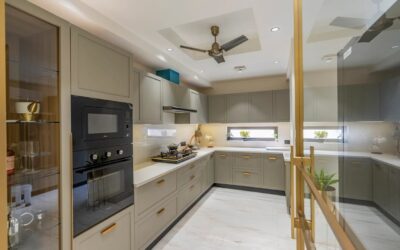
Slab kitchen cabinets are the flat, unadorned door style you see in nearly every modern and contemporary kitchen today. There’s no raised panel, no shaker frame, no grooves or profiles, just a single clean surface. That simplicity is exactly the point, and it’s why slab doors have become so popular. But flat doesn’t mean simple to get right, and the material you choose changes everything about cost, durability, and how the kitchen ages.
Part of our Kitchen Remodeling guide — explore the full guide →
Here is what to know before committing to a full slab-front kitchen.
What Makes a Cabinet “Slab”
A slab door is a full-overlay, flat-fronted door with a smooth face and no framing. Most slab kitchens are also frameless, or “full access,” European-style construction, where the door mounts directly to the cabinet box with no face frame behind it. That combination gives you the seamless, gap-free look people associate with high-end modern design and maximizes interior storage since there’s no frame eating into the opening.
You can put slab doors on a traditional face-frame box, but the crisp, floating look really depends on frameless construction with tight, consistent reveals between doors, usually about 1/8 inch. Because there’s no ornamentation to hide behind, the quality of those reveals is what your eye reads as “expensive” or “cheap.” Frameless slab cabinets need more time dialing in door alignment with the six-way adjustable European hinges than almost any other cabinet style. A door that hangs 1/16 inch off across a run of five uppers will jump out at anyone standing in the kitchen.
The Materials That Matter
This is where slab cabinets live or die. A flat surface hides nothing, so the material and how it’s finished are on full display. The main options:
- Thermofoil: a vinyl film heat-sealed over MDF. Affordable, seamless, easy to clean, and available in matte or gloss. The weakness is heat: keep it away from ovens and toaster ovens, since high heat can delaminate the film.
- MDF (painted): medium-density fiberboard is the go-to substrate for painted slab doors. It’s dead flat, has no grain, and takes a factory paint or conversion-varnish finish beautifully with no seams.
- Wood veneer: a thin layer of real wood over a stable core. This is how you get genuine walnut, oak, or rift-cut wood grain on a flat door without the cupping risk of solid wood.
- Acrylic and high-gloss laminate: the premium modern look. High-gloss acrylic delivers a deep, mirror-like reflection; matte laminate and textured melamine give a fingerprint-resistant, durable surface.
For a durable everyday kitchen, painted MDF or textured matte laminate is usually the better choice. Both look clean, resist wear, and forgive daily life better than high-gloss.
What Slab Cabinets Cost
Pricing is typically quoted per linear foot, which includes the box, door, and basic hardware but not countertops or installation. Slab styles span a wide range depending on material:
- Stock thermofoil or laminate slab: $100 to $200 per linear foot.
- Semi-custom painted MDF: $200 to $400 per linear foot.
- Custom veneer or high-gloss acrylic: $400 to $900+ per linear foot.
For a typical 25-linear-foot kitchen, that’s roughly $2,500 on the budget end to well over $20,000 for custom European-made slab cabinetry. Installation usually adds $100 to $300 per linear foot on top. RTA (ready-to-assemble) frameless slab lines have made the modern look far more affordable than it was a decade ago.
The Real Pros and Cons
Slab doors earn their popularity, but they aren’t the right call for every home. Straight talk from the field:
Advantages:
- Clean, timeless modern look that photographs and shows beautifully.
- Easiest door style to clean; no grooves, corners, or panels to trap grease and dust.
- Maximizes a small or busy kitchen by keeping visual clutter down.
- Frameless construction gives more usable interior space.
Drawbacks:
- Flat surfaces show every flaw, so material and finish quality must be high.
- High-gloss versions are magnets for fingerprints and fine scratches.
- The minimal look can feel cold if you don’t balance it with warm wood, stone, or texture.
- Cheap thermofoil can peel near heat sources over time.
Hardware-Free vs. Pulls
A big part of the slab appeal is the option to go completely handleless. There are two common ways to do it. The first is a push-to-open (touch-latch) mechanism, where a gentle press pops the door open. The second is an integrated channel or J-pull, a routed finger groove along the top or edge of the door that you hook your fingers into. Both keep the front perfectly uninterrupted.
Push-to-open looks the cleanest but can be finicky in a heavy-use kitchen, and greasy hands leave marks where you press. The practical recommendation for most families is to add slim, minimalist bar pulls, 5 to 8 inches, in matte black, stainless, or champagne gold. You keep the modern lines while gaining daily practicality, and you avoid smudging the doors every time you cook.
Cleaning and Everyday Care
Low-maintenance is one of slab’s biggest selling points, but each material has its quirks. General care:
- Wipe with a soft microfiber cloth and warm water with a drop of dish soap.
- Dry immediately to prevent water spots, especially on gloss and laminate.
- Skip abrasive pads, scouring powders, and harsh solvents that dull the finish.
- For high-gloss acrylic, use a dedicated gloss cleaner and buff to remove smudges.
- Keep toasters, kettles, and ovens away from thermofoil edges to avoid heat damage.
Best Slab Colors and Finishes Right Now
Color carries a slab kitchen because there is no profile to add interest. Warm, muted tones have taken over from the cool grays that dominated a few years back. The most popular looks now are a soft greige or mushroom paint, deep matte greens like sage or forest, warm off-whites, and natural woodgrain in white oak or walnut veneer. High-gloss white and true black still sell, but they are polarizing and show every mark.
Texture is the sleeper upgrade. Super-matte, fingerprint-resistant laminates from lines like Fenix and various textured melamines feel soft to the touch, kill glare, and self-heal minor scratches with a little heat from your palm. A two-tone scheme, wood or a bold color on the island paired with a quieter perimeter, adds depth without breaking the clean slab language. When you sample, always view the door both flat and vertical under your own kitchen lighting, because sheen and undertone shift dramatically with the light source.
Common Slab Cabinet Mistakes to Avoid
Because the style is unforgiving, the errors are predictable. Steer around these:
- Buying cheap thermofoil next to a range or wall oven, where heat eventually lifts the film at the edges.
- Choosing high-gloss in a household with young kids, then living with constant fingerprints and swirl marks.
- Ignoring reveal consistency; uneven 1/8-inch gaps between doors are the number-one tell of a low-budget install.
- Skipping the sample and ordering a full kitchen off a two-inch chip, only to find the color reads greener or grayer at scale.
- Pairing a stark slab kitchen with nothing warm, which leaves the room feeling like a showroom instead of a home.
Fix that last one with a wood floor, a stone counter with real movement, or a textured backsplash. A little warmth keeps minimalism from tipping into cold.
Getting the Modern Look on a Budget
You do not need a five-figure European order to get clean slab fronts. Ready-to-assemble (RTA) frameless lines have transformed the low end: for a 25-foot kitchen you can land quality matte-laminate or thermofoil slab boxes for $3,000 to $6,000 and assemble them over a weekend with a rubber mallet and a drill. Look for full-extension soft-close drawers, 3/4-inch boxes rather than 1/2-inch, and metal cam-lock or dowel construction instead of staples.
If your existing boxes are solid, refacing is the cheaper route still. Order flat slab doors and drawer fronts sized to your openings, wrap the visible frames in a matching laminate skin, and add new concealed hinges. That keeps the kitchen in place, skips the demolition, and delivers the modern look for a fraction of full replacement, often under $4,000 in materials for an average kitchen.
Is a Slab Kitchen Right for You?
If you want a clean, contemporary kitchen that’s easy to wipe down and stays out of the way visually, slab cabinets are hard to beat. Choose painted MDF or matte laminate for durability, veneer or acrylic if you want a statement, and add slim pulls unless you’re committed to the handleless look. Spend your budget on finish quality rather than ornamentation, because on a flat door, the finish is the entire show. Done right, slab kitchen cabinets deliver a look that stays current for well over a decade.