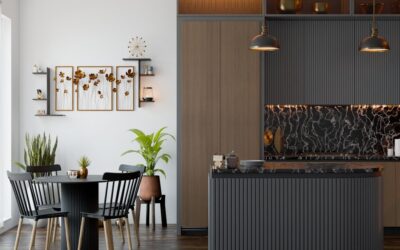
Flat front kitchen cabinets, also called slab or European-style cabinets, are the defining look of modern American kitchens right now, and for good reason. A flat door is a single uninterrupted plane with no frame, no recessed panel, and no molding. It is the simplest door to draw and the hardest to build well, because with nothing to hide behind, every flaw in the material and finish is on full display. I have built and installed slab kitchens for years, and the ones that go wrong almost always go wrong at the material spec.
Part of our Kitchen Remodeling guide — explore the full guide →
What Makes a Slab Door Different
A traditional Shaker door has five pieces: two stiles, two rails, and a center panel. A flat front door is one piece, or one engineered panel skinned on both faces. That single-plane construction is the whole design language of minimalism, but it puts enormous demands on flatness and edge treatment.
Because there is no frame to add rigidity, a flat door needs a stable core that will not warp, telegraph, or cup over a hot dishwasher or a sunny window. This is why the best slab doors are almost never solid wood. Solid lumber moves too much across a wide unbroken face.
Materials: Where the Money and the Longevity Live
The core and the surface are two separate decisions, and both matter. Here is how the common options stack up.
- Thermofoil over MDF: a vinyl film heat-pressed onto a routed MDF core. Seamless, affordable, easy to clean. Weakness is heat, so it can delaminate next to ovens over time. Runs roughly $150 to $300 per door.
- Melamine / laminate over particleboard or MDF: extremely durable surface, huge color range, good value. High-pressure laminate (HPL) resists scratches far better than low-pressure. Around $200 to $350 per door.
- Wood veneer over MDF or ply: real wood grain on a stable core, often rift-cut white oak or walnut for that horizontal grain look. Premium feel, $350 to $700+ per door.
- Painted MDF: a sprayed conversion-varnish or 2K finish on flat MDF. Beautiful and seamless, but shows chips as bare tan MDF, so touch-ups are hard.
- Acrylic / high-gloss: a mirror-like acrylic sheet, dramatic but shows every fingerprint and swirl mark. Best in matte for real kitchens.
My general steer for a working family kitchen is matte laminate or a good painted MDF. High gloss photographs beautifully and lives poorly.
The Hardware-Free Look and How It Works
Half the appeal of flat front kitchen cabinets is the option to go completely handleless, which keeps that unbroken plane pure. There are three main ways to pull a door open without a knob.
- Integrated finger pull (J-pull): the top edge of the door is routed into a lip you hook your fingers under. No hardware cost, clean look, but the lip collects a little dust.
- Recessed channel / gola profile: a continuous aluminum channel runs behind the door top, giving a fully flush face. Sleek and premium, adds roughly $40 to $90 per linear foot.
- Push-to-open (touch latch): press the door and it pops open on a sprung hinge. Zero visible pull, but touch latches can wear out and greasy hands leave marks where you push.
If you do want hardware, edge pulls and long tubular bar pulls in matte black or brushed brass suit slab doors best. A little 1-inch knob looks lost on a big flat plane.
Pros of Going Flat Front
- Easiest cabinet face in the world to wipe down. No panel grooves, no molding to trap grease.
- Contemporary, timeless-modern look that reads clean in small and large kitchens alike.
- Handleless options give you a truly seamless wall of storage.
- Wide, uninterrupted faces make small kitchens feel larger and calmer.
- Often cheaper than a detailed inset or beaded door because there is less machining.
Cons You Should Know Before Buying
- Nowhere to hide flaws. A slight warp, a proud seam, or a finish blemish shows instantly.
- Thermofoil can delaminate from heat; keep it away from unshielded oven and dishwasher vents.
- Matte and satin fingerprints on darker colors show more than you expect.
- Handleless J-pulls and channels can gather dust and crumbs along the lip.
- Repairs are tough. A chipped painted MDF edge is far harder to fix than a solid wood Shaker.
What a Flat Front Kitchen Costs
Because the door itself is simpler to machine, entry-level flat front can actually undercut Shaker. A ready-to-assemble melamine slab kitchen from an online outfit can land around $5,000 to $9,000 for a small galley. Move up to a semi-custom European line with soft-close everywhere and you are looking at $15,000 to $28,000 for a mid-size kitchen. Add a gola channel system, real wood veneer, and integrated appliance panels and a full-custom slab kitchen easily crosses $40,000.
The hidden cost is precision install. A handleless run with a continuous channel has to be dead level across the whole wall, because the eye follows that unbroken line and catches any dip. Budget for a finish carpenter who has done channel systems before, not a framer moonlighting on trim.
Who Should Choose Slab Doors
Flat front is the right call if you want a modern, low-maintenance, contemporary kitchen and you are honest with yourself about which finish you will actually keep clean. Pick matte over gloss, laminate or painted MDF for durability, and either a bar pull or a gola channel depending on how minimal you want to go. Skip flat front if your home is traditional and you want cabinets that read warm and furniture-like, because a slab door in a Colonial can feel like an office break room. Matched to the right house, though, a well-built flat front kitchen is the cleanest, easiest-living style you can put on a wall.
Edge Banding: The Detail That Ages a Kitchen
On a slab door, the edge is fully exposed, so how the edge is finished separates a cabinet that looks new in year ten from one that peels in year two. Melamine and laminate doors get a banded edge, and there are grades to it. Cheap PVC edge banding is glued with hot-melt EVA adhesive, which can let go and reveal a dark seam. The upgrade is laser or hot-air edge banding, where the band is fused to the panel with no visible glue line at all. It costs more but it is the single best durability upgrade on a laminate slab kitchen.
Thermofoil is different because the film wraps the routed edge in one continuous piece, so there is no seam to fail except at the back where it terminates. Wood veneer doors usually get a matching solid-wood edge or a veneer edge band; ask which, because a raw veneer edge chips. When you shop slab doors, run your fingernail along the edge of the showroom sample. If you feel a lip or a ridge, that edge will collect grime and eventually lift. This one test tells you more about build quality than any brochure will.
One thing that separates a designer slab kitchen from a builder-grade one is grain matching. On real wood veneer, a good shop will sequence-match the doors so the grain flows continuously across a run of cabinets, or deliberately run it horizontally for that long, low modern look. This is called a continuous or book-matched layout, and it is worth specifying up front because it is nearly impossible to add later.
On solid colors, watch the sheen and the batch. Painted MDF and laminate can vary slightly between production runs, so order all doors for a kitchen in one lot. Popular slab colors right now run to warm greiges, deep forest and navy, matte black, and natural rift oak. My advice for resale is to keep the boxes neutral and get your color hit from the backsplash or an island, since a $30,000 wall of high-gloss teal is a hard thing to unwind in five years. Order a full-size door sample in your final color and live with it in the room for a week, looking at it under both daylight and your evening lights, before you sign off. Slab color reads completely differently on a big uninterrupted plane than it does on a two-inch chip.